


Syllabus: GS3/ Economy
Context
- Recent policy reforms centred on trust-based governance have significantly improved India’s business environment, reflected in a 27% rise in active registered companies, from 1.55 lakh in 2020–21 to 1.98 lakh in 2025–26.
Key Transformational Policy Reforms
- Startup Ecosystem Development: The Startup India initiative enables eligible firms to obtain recognition from the Department for Promotion of Industry and Internal Trade (DPIIT).
- Recognised startups receive tax benefits, simplified compliance procedures, and fast-track intellectual property rights (IPR) processing.
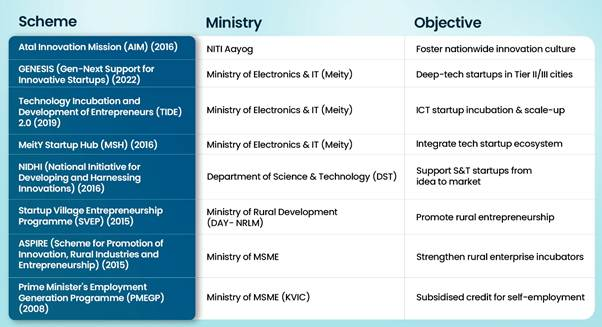
- Credit Guarantee Scheme:
- Credit Guarantee Scheme for Micro & Small Enterprises (CGTMSE): Facilitates credit guarantees for credit support of up to ₹10 crore to Micro and Small Enterprises (MSEs).
- Credit Guarantee Scheme for Startups (CGSS): Supports startups by providing credit guarantees; the revised framework has enhanced guarantee coverage, increasing the maximum limit from ₹10 crore to ₹20 crore per eligible borrower.
- Credit Guarantee Scheme for Exporters (CGSE): Additional collateral-free credit support of up to ₹20,000 crore to direct and indirect exporter MSMEs.
- Credit Assessment Model (CAM): Public Sector Banks introduced the Credit Assessment Model (CAM) in 2025 for MSME lending.
- The model utilises digitally verified financial data to automate loan appraisal and risk assessment.
- The Sabka Bima, Sabki Raksha (Amendment of Insurance Laws) Act, 2025 introduced significant reforms. Key provisions include:
- Increasing FDI limit to 100% to attract greater foreign investment.
- Introducing one-time registration for insurance intermediaries to simplify operations.
- Raising the share transfer approval threshold from 1% to 5% to reduce regulatory burden.
- Reducing the Net Owned Fund requirement for foreign reinsurers from ₹5,000 crore to ₹1,000 crore.
- The Insolvency and Bankruptcy Code (IBC), 2016 has significantly transformed India’s insolvency framework by enabling timely resolution of financially distressed companies and improving recoveries for creditors.
- GST 2.0 Reforms: GST reforms introduced in 2025 aim to simplify tax structures and reduce compliance costs. The GST taxpayer base increased from 60 lakh in 2017 to over 1.6 crore by January 2026, indicating greater formalisation.
- Rationalisation of Penalties and Prosecution:
- Integrated assessment & penalty orders with no interest on penalties during appeal; pre-deposit reduced from 20% to 10% (on core tax demand).
- Updated returns allowed even after reassessment, with an additional 10% tax.
- Immunity from penalty & prosecution extended from underreporting to misreporting, on payment of full tax and interest.
- Decriminalisation of non-production of books and TDS on payments in kind; minor offences to attract fines only.
Challenges in India’s Business Environment
- Skill Gaps in the Workforce: Shortage of industry-relevant skills affects productivity and the ability of firms to adopt advanced technologies.
- Global Economic Uncertainty: External shocks such as geopolitical tensions, supply chain disruptions, and global financial volatility impact investment and business growth.
- Limited Access to Finance for MSMEs: Many micro and small enterprises still face difficulties in obtaining timely and affordable credit despite credit guarantee schemes.
- Infrastructure Bottlenecks: Inadequate logistics, transport, and digital infrastructure in certain regions increase operational costs and reduce competitiveness.
Way Ahead
- Strengthening regulatory coordination across different levels of government and expanding digital governance platforms can ensure smoother implementation of business reforms and reduce administrative delays.
- At the same time, aligning skill development with industry needs will help build a workforce capable of supporting innovation and sustainable economic growth.
Source: PIB
Previous article
Lok Sabha to Debate Resolution on the Removal of Speaker
Next article
Quantum Computing
