


Syllabus: GS3/ Science and Technology
Context
- The Indian Institute of Science (IISc) launched a moonshot project to develop brain co-processors that combine neuromorphic hardware and AI algorithms to enhance or restore brain function.
What are Brain Co-Processors?
- Brain co-processors are advanced devices designed to interact directly with the human brain.
- They decode neural signals, process them using AI algorithms, and re-encode them back into the brain through neural stimulation or neurofeedback.
- These systems function as AI-powered closed-loop devices that assist the brain in restoring or enhancing cognitive and motor functions.
Key Objectives of the Project
- Develop implantable and non-invasive brain co-processors capable of decoding and processing brain activity.
- Use AI algorithms and neuromorphic hardware to interpret neural signals and stimulate the brain accordingly.
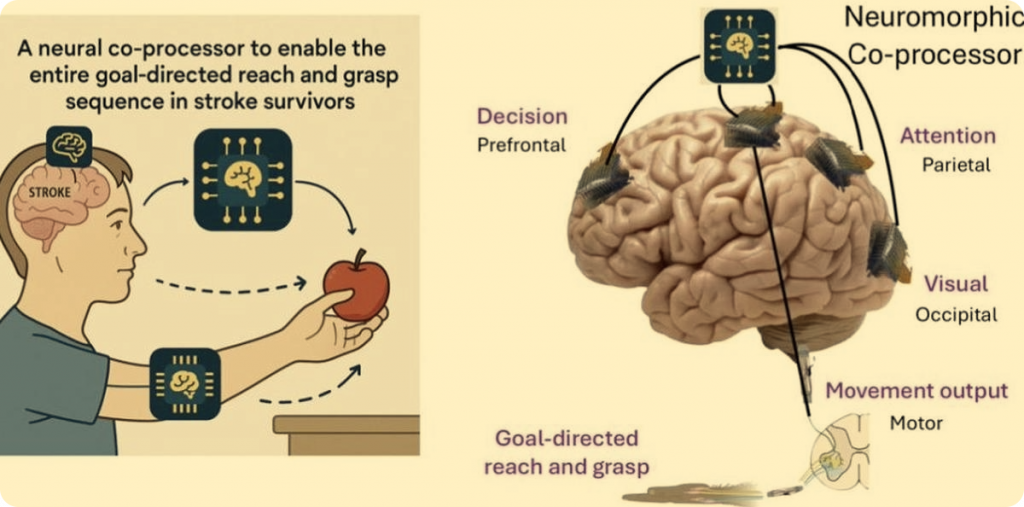
- Enable cognitive and motor rehabilitation, particularly for stroke survivors who lose sensorimotor abilities such as reaching and grasping objects.
Core Technologies Enabling Brain Co-Processors
- Brain–Machine Interface (BMI): Brain co-processors rely on brain–machine interfaces, which create a communication pathway between the brain and external devices.
- These interfaces translate neural signals into digital commands that machines can interpret.
- Neuromorphic Computing: The project integrates neuromorphic hardware, which mimics the structure and functioning of biological neurons.
- It enables energy-efficient processing of neural signals and allows real-time interaction between AI systems and the human brain.
- Neural Recording Technologies: The system will utilise advanced neural recording techniques such as:
- Stereo EEG (sEEG): It records deep brain electrical activity.
- Electrocorticography (ECoG): It records signals directly from the brain’s cortical surface.
- Closed-Loop Feedback: AI algorithms analyse neural signals and identify patterns associated with motor or cognitive functions.
- Once decoded, the system re-encodes signals and sends them back to the brain through electrical stimulation or feedback mechanisms.
Significance of the Initiative
- Strengthens India’s capabilities in neuroscience and neurotechnology research.
- Promotes indigenisation of medical technology, including implants, hardware, and AI stacks.
- Builds India-specific neural datasets and open-source digital public goods for research.
- Supports development of affordable neurological treatments suited for low-resource healthcare settings.
Challenges and Ethical Concerns
- Ethical and Privacy Issues: Neural data is extremely sensitive and can raise privacy concerns.
- Regulatory and Clinical Validation: Medical implants require rigorous testing and regulatory approvals.
- Technical Complexity: The human brain contains about 86 billion neurons, making accurate decoding extremely challenging.
- Cost and Accessibility: Advanced neurotechnology initially remains expensive and limited to specialised healthcare centres.
Concluding remarks
- The success of the Project will depend on long-term research funding, clinical trials, interdisciplinary collaboration, and strong ethical governance frameworks.
- If successfully implemented, the initiative could transform neurological rehabilitation, improve the quality of life for millions of patients, and position India at the forefront of AI-driven brain–machine interface technology.
Source: TH
Previous article
Karnataka & Andhra to Ban Social Media Use by Children
