

Syllabus: GS3/ Economy
In News
- For the first time, the Economic Survey 2025–26, tabled in Parliament, has cited the Power Gap Index to underline a Strategic Paradox in India’s rise.
- While India has officially entered the Major Power category in Asia, the Survey notes that it continues to underperform relative to its capabilities, reflected in a negative Power Gap score of –4.0.
What is the Power Gap Index?
- The Power Gap Index is not a standalone index like HDI.
- It is a derived analytical measure from the Asia Power Index compiled annually by the Lowy Institute.
- It measures the gap between a country’s potential power (resources) and its actual regional influence.
- Every country has a certain “Expected Power” based on its raw resources (population, GDP, military hardware).
- The “Comprehensive Power” is what the country actually achieves through diplomacy, trade, and alliances.
- Power Gap = Comprehensive Power Score – Expected Power Score
- Positive score: Country punches above its weight (efficient use of resources via diplomacy, alliances, economic statecraft).
- Negative score: Country punches below its weight (capabilities exist, but influence is under-leveraged).
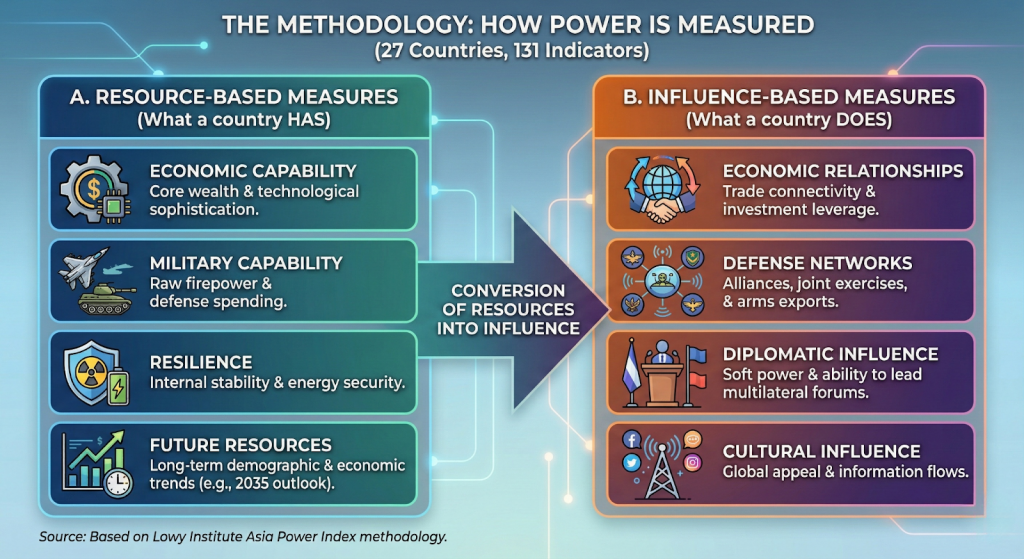
India’s Comparative Performance
- Japan (+1.0) & Singapore (+5.2): High diplomatic and economic efficiency.
- Australia (+8.0): The region’s premier “overachiever” relative to its population size.
- India (-4.0) 3rd out of 27: Lowest in Asia, excluding pariah/isolated states like Russia and North Korea.
Why is the Economic Survey Concerned?
- Economic Connectivity: While India has a large GDP, its integration into global supply chains (Economic Relationships) lags behind its resource potential.
- Defense Integration: India’s military is large (Resource), but its regional defense partnerships (Influence) are still maturing compared to China or the US.
- Stability Paradigm: The Survey notes that India has been a recipient of stability (absorbing shocks). To close the gap, India must become a provider of stability and opportunity for the Indo-Pacific.
Source: BS
Previous article
Economic Survey 2025-26 Key Highlights
Next article
Rising Digital Addiction & Mental Health Issues
