


Syllabus: GS3/Economy
Context
- As per the Economic Survey 2025-26, Swadeshi is “inevitable and necessary” as the global trading environment is marked by export controls, technology denial regimes and carbon border mechanisms.
About
- The Survey noted that, unlike corporates in post-war America, Germany, Japan, and East Asia, Indian firms show a relative lack of appetite for long-term risk absorption and nation-building investments.
- It said Indian firms show limited willingness for long-term risk absorption and global competitiveness, relying more on regulatory arbitrage and protected margins than on productivity, scale, or learning.
- Swadeshi means to ensure continuity of production in the face of external shocks, and a pathway to build enduring national capabilities that reinforce economic sovereignty.
- Lack of Capex: The Capital expenditure (capex) as a share of GDP rose to 4% from 2.6% between FY20-25, however economists are of the view that private investment remains subdued.
Manufacturing Sector of India
- India’s manufacturing sector is currently contributing 17% to India’s GDP.
- India has a goal to achieve the target of 25% GDP share for the manufacturing sector.
- India is focussing on 14 identified sunrise sectors like semiconductors, renewable energy components, medical devices, batteries and labour intensive industries, including leather and textile, to enhance the share of manufacturing in GDP.
- The industrial sector is projected to grow by 6.2%, up from 5.9% in FY25.
- The sector recorded growth of 7.0% in the first half of FY26, exceeding the growth of 6.1% in H1 of FY25 and the pre-COVID trend of 5.2%.
- Innovation: India’s innovation ecosystem has also strengthened, with the country’s Global Innovation Index rank improving to 38th in 2025, up from 66th in 2019.
- Within manufacturing, strong performance was observed with notable growth in:
- Computer, electronic and optical products (34.9%).
- Motor vehicles, trailers and semi-trailers (33.5%).
- Other transport equipment (25.1%).
- Employment Generation: As per the survey, seven states together account for around 60% of total employment in the manufacturing sector.
- TN tops the list with a 15% share of manufacturing jobs, followed by Gujarat and Maharashtra at 13% each.
Challenges Faced by India’s Manufacturing Sector
- Infrastructure Bottlenecks: High logistics cost, poor port connectivity, and power shortages leads to low output.
- Low R&D and Innovation: India invests less than 1% of GDP in R&D, limiting high-tech manufacturing.
- Import Dependence: Heavy reliance on imports for semiconductors, electronics components, and defence equipment.
- Skill Gaps: There is a major mismatch between workforce skills and industry requirements.
- Low Productivity: Due to the outdated machinery, small-scale fragmented units, and limited automation productivity remains low.
- Global Competition: Countries like Vietnam, Bangladesh, and China offer cheaper production and better ecosystems making Indian products less competitive.
- Environmental Concerns: Rising pressure for sustainable and green manufacturing with high compliance costs.
Major Initiatives Taken to Enable Make in India
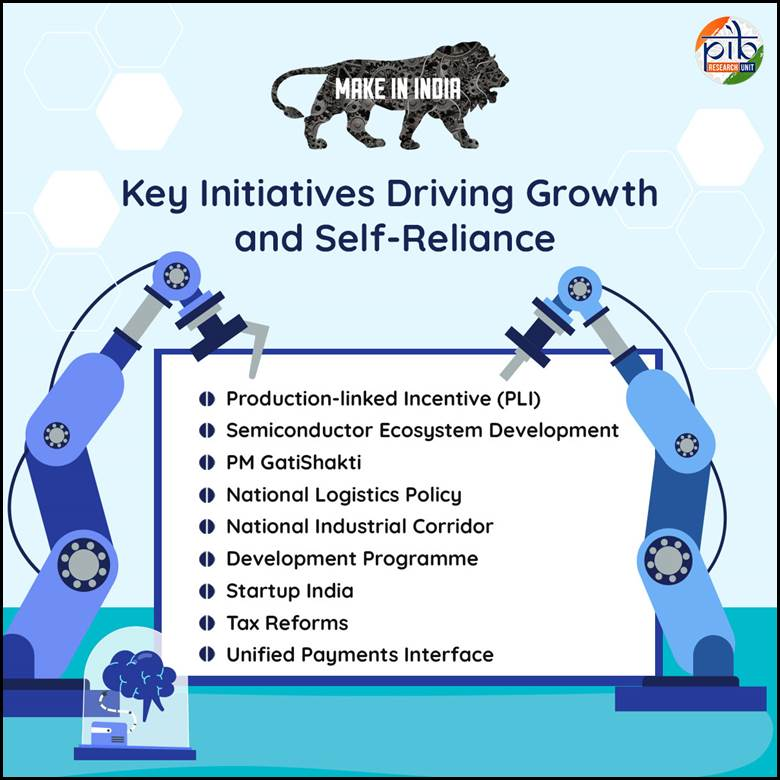
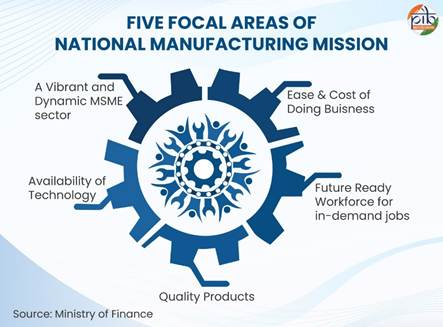
- The National Manufacturing Mission (NMM): It was announced in the Union Budget 2025–26, as a long-term strategic roadmap that integrates policy, execution, and governance into a single, unified vision.
Recent Achievements of Manufacturing Sector of India
- Ease of Doing Business: In the World Bank’s Doing Business Report (DBR) 2020 India was ranked 63rd up from 142nd rank in 2014.
- Production of Vaccine: India achieved COVID-19 vaccination coverage in record time but also became a major exporter to many developing and underdeveloped countries across the world.
- India supplies nearly 60% of the world’s vaccines, meaning every second vaccine globally is proudly made in India.
- India’s pharmaceutical industry is ranked 3rd in the world by volume and 14th in terms of value of production.
- The industry is projected to grow to USD 130 billion by 2030 and the US$ 450 billion market by 2047.
- Vande Bharat Trains: It is India’s first indigenous semi-high-speed trains, and are an example of the success of the ‘Make in India’ initiative.
- As of now, 102 Vande Bharat train services (51 trains) are operational across Indian Railways.
- INS Vikrant: It is the first domestically made aircraft carrier.
- In 2023-24, defence production soared to ₹1.27 lakh crore, with exports reaching over 90 countries, showcasing India’s growing strength and capability in this critical area.
- Electronics: India’s electronics manufacturing sector has seen a sixfold rise in production and an eightfold surge in exports over the past 11 years. Electronics value addition has jumped from 30% to 70%, with targets to reach 90% by FY27.
- India is the second-largest mobile manufacturer in the world and now manufactures 99% domestically.
- Indian bicycles have gained international acclaim, with exports to the UK, Germany, and the Netherlands soaring.
- Made in Bihar’ boots are now part of the Russian Army’s equipment, marking a significant milestone for Indian products in the global defence market.
- Amul has expanded its presence by launching its dairy products in the US promoting Indian dairy on the world stage.
Conclusion
- As India advances toward its $35 trillion vision by 2047, manufacturing will be the engine of growth.
- Supported by reforms, sectoral incentives, and resilient supply chains, the sector has gained strong momentum, reflected in GDP growth projections.
- If this momentum is sustained, India can transform from being the “factory of the world” to becoming the “innovation and leadership hub of the world.”
Source: IE
Previous article
India-Arab League: Bridging Cultures, Creating Opportunities
Next article
News In Short 30-01-2026
