

Ellora Caves
Syllabus: GS1/ History and Culture
Context
- Scottish historian William Dalrymple has urged the Maharashtra government to bring greater visibility to the lesser-known heritage sites around the Ellora Caves.
About
- Located in Chhatrapati Sambhajinagar, Maharashtra, the Ellora Caves are among India’s first UNESCO World Heritage sites.
- The cave complex was carved between 600 CE and 1000 CE, spanning the rule of the Chalukyas, Rashtrakutas, and Yadavas.
- Religious Pluralism: The complex comprises 34 major caves, 12 Buddhist, 17 Hindu, and 5 Jain, demonstrating a unique period of interreligious harmony and artistic exchange.
Key Architectural Features
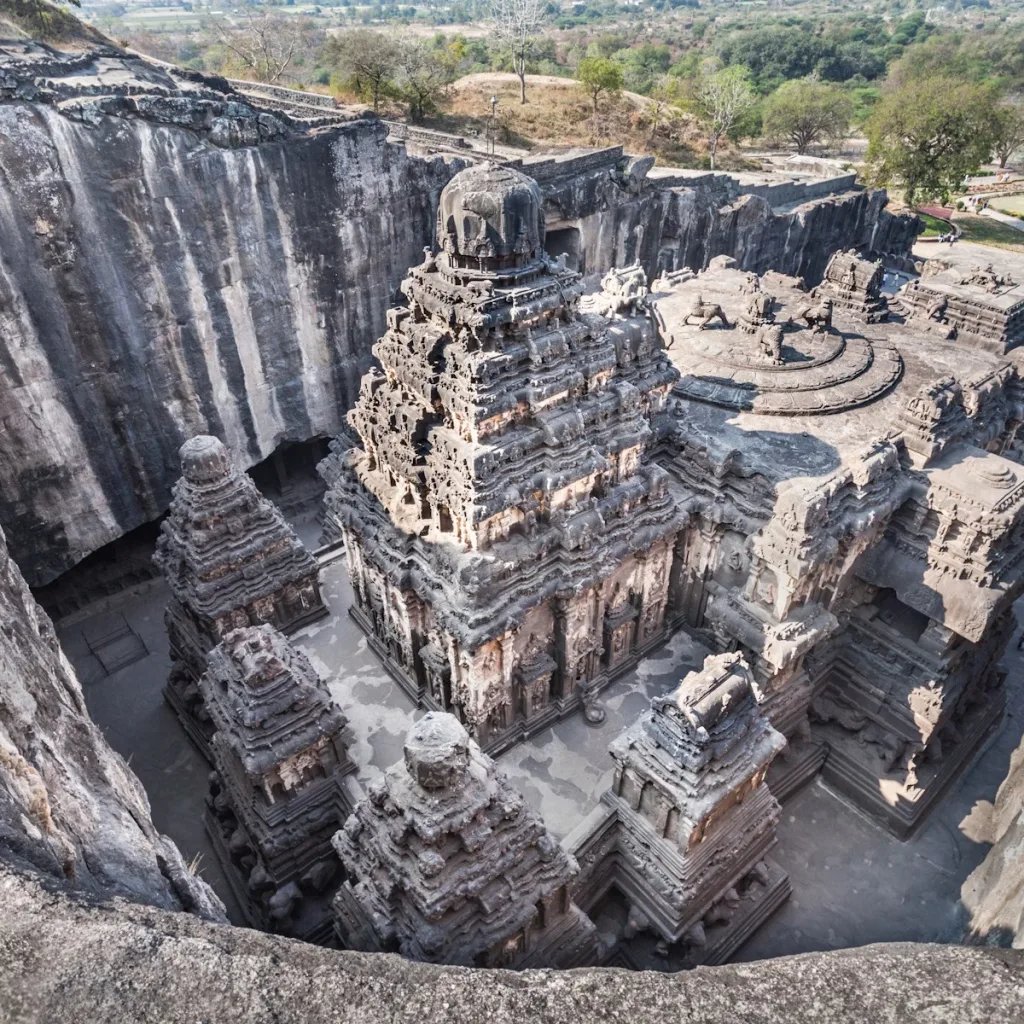
- Kailasa Temple (Cave 16): It is carved from a single monolithic basalt rock, dedicated to the Hindu god Lord Shiva.
- Its design replicates Mount Kailash, the abode of Lord Shiva, and integrates complex Dravida-style architecture, multi-level mandapas, sculptural panels, and detailed narrative friezes.
- Buddhist Caves: These include monasteries (viharas) and prayer halls (chaityas).
- Cave 10, the Vishvakarma Cave, features a vaulted ceiling and an intricately carved seated Buddha.
- Jain Caves: Built during the later phase of Ellora’s development.
- Known for delicate carvings, Tirthankara figures, and themes of austerity and cosmic order.
- Cave 32 (Indra Sabha) is notable for its richly sculpted pillars and ceiling panels.
Source: TH
Hornbill Festival
Syllabus: GS1/Culture
In News
- The 26th edition of Nagaland’s famed Hornbill Festival, known as the “Festival of Festivals,” began at the Naga Heritage Village in Kisama, Kohima, coinciding with the state’s Statehood Day (December 1st).
The Hornbill Festival
- It is held annually in the first week of December at Kisama near Kohima, and is a vibrant cultural showcase of all Naga tribes.
- It was conceived in 2000 to promote unity and preserve ethnic heritage.
- It highlights both traditional and contemporary Naga culture through music, crafts, cuisine, and folklore.
- Its venue, the Naga Heritage Village, was created to safeguard cultural traditions and boost tourism, and features seventeen indigenous Morungs (youth dormitories), each representing a distinct tribe.
Importance
- The festival has transformed Nagaland’s tourism landscape, offering visitors a unique opportunity to experience the diversity and distinctiveness of Naga life in one place.
Source :Air
Baikonur Cosmodrome
Syllabus: GS1/Places
In News
- A Soyuz-2.1a rocket damaged Baikonur’s Site 31/6 by collapsing a service platform into the flame trench, leading to the suspension of crewed launches during the Soyuz MS-28 mission.
- Baikonur has witnessed accidents, notably the 1960 Nedelin catastrophe.
Baikonur cosmodrome
- It is a spaceport in Kazakhstan that Russia leases and operates as the site of its space launches.
- It was built in the 1950s first as a missile test range before becoming the centre of the Soviet space programme.
- It contains launch complexes, assembly buildings, tracking stations, and housing.
- Its facilities can accommodate the Proton and Soyuz rockets and cargo ships intended for the International Space Station.
Source :TH
SIM Binding Mandatory for Online Messaging Platforms
Syllabus: GS2/Governance
Context
- The Department of Telecommunications (DoT) has directed online messaging platforms to bar users from accessing their services without the SIM card used to register for the application.
About
- The new norms mean that apps like WhatsApp, Telegram, Signal, Arattai, Snapchat, ShareChat and JioChat must continuously verify if the smartphones running them have the same SIM card active on them or not.
- If the registered SIM is not found on the phones, the apps must stop functioning.
- For web versions of these apps, the service must automatically log out users periodically, no later than every six hours.
- This regulation aims to prevent cyber fraud and enhance security.
- It also warned that failure to comply with the new norms will lead to action being taken under the Telecommunications Act, 2023, the Telecom Cyber Security Rules and other applicable laws.
Source: IE
India Re-Elected to UNESCO Executive Board for 2025–29 Term
Syllabus:GS2/IR
In News
- India has been re-elected to the UNESCO Executive Board for the 2025-29 term.
The UNESCO Executive Board
- It is one of the three constitutional organs of the U.N. agency (the others being the General Conference and the Secretariat) and it is elected by the General Conference.
- It acts under the authority of the General Conference.
- It examines the programme of work for the organisation and corresponding budget estimates submitted to it by the Director-General.
- It consists of 58 Member States each with a four-year term of office.
Functions
- It prepares the Conference agenda, reviews the programme of work and budget proposals, and submits recommendations.
- It advises on admitting new States outside the UN, the appointment of the Director-General, and oversees the execution of programmes by examining reports on organizational activities.
- It can convene extraordinary sessions of the General Conference and summon international or non-governmental conferences in education, sciences, humanities, and knowledge dissemination.
Importance for India
- India’s re-election reflects the international community’s confidence in longstanding commitment to multilateralism and to UNESCO’s mandate across education, culture, science, communication and information.
- India’s continued presence on the Executive Board underscores growing global support for its vision of inclusive, human-centric development and for strengthening cooperation among nations.
Source :Air
Central Industrial Security Force (CISF)
Syllabus: GS3/Internal Security
Context
- The Central Industrial Security Force (CISF) has introduced a revised posting policy for personnel assigned to Parliament security duties.
About
- It has revised the tenure of its personnel deployed at Parliament to a minimum of four years from the previous three years.
- In 2024 CISF assumed charge of all core security layers at Parliament.
- The new policy includes tighter eligibility norms and multi-stage screening.
- Personnel with a clean service record and only those who clear psychological assessment tests will be deployed.
- The updated system is expected to ensure better familiarity with Parliament protocols and improve the overall efficiency of security operations.
Central Industrial Security Force (CISF)
- It is a paramilitary force established in 1969, under the Central Industrial Security Force Act, 1968.
- Every year, CISF Raising Day is observed on March 10.
- The force is led by a Director General (DG) and operates under the Ministry of Home Affairs of India.
- Roles:
- Providing security to the strategic establishment, including the Department of Space, the Department of Atomic Energy, the Airports, the Delhi Metro, the ports.
- Also, the historical monuments and the basic areas of the Indian economy such as petroleum and natural gas, electricity, coal, steel and mining.
- It also provides counter-terrorism security to various sensitive facilities, as well as private sector operations.
- CISF also provides consultancy services to private industries as well as other organisations within the Indian government.
- It is also providing security to the protected persons classified as Z Plus, Z, X, Y.
Source: TH
Hansa-3 NG Trainer Aircraft
Syllabus: GS3/ Defence
Context
- The CSIR-National Aerospace Laboratories (NAL), Bengaluru, launched a “production version” of the indigenous Hansa-3(NG) trainer aircraft.
About Hansa-3
- Hansa-3 is India’s indigenous two-seat trainer aircraft developed by CSIR-NAL.
- Designed for basic flight training, it featured analogue instruments, mechanically operated flaps, and a standard cockpit, catering mainly to flying clubs and pilot training schools.
- Being entirely constructed from fiberglass and carbon composite materials, it offers inherent advantages in corrosion resistance, damage tolerance, and ease of repair.
- Hansa-3 NG (New Generation) is an enhanced version of Hansa-3 with following key features;
- Digital Glass Cockpit: Replaces analogue instruments for better situational awareness.
- Increased Fuel Capacity: Enables longer training sorties and higher endurance.
- Stable Flight Handling: Low stall speed and predictable behaviour make it ideal for ab-initio training.
Source: TH
International Treaty on Plant Genetic Resources for Food and Agriculture
Syllabus: GS3/ Agriculture
Context
- The 11th Governing Body Meeting of the International Treaty on Plant Genetic Resources for Food and Agriculture (ITPGRFA) concluded in Lima, Peru without consensus on expanding the list of crops covered under the Standard Material Transfer Agreement (SMTA).
About
- India and several other countries opposed the proposal to extend the Multilateral System (MLS) to all crops and revise benefit-sharing rules, arguing it could dilute national sovereignty over seed diversity.
- Under the SMTA, genetic material of 64 crops is accessible only to treaty members and exclusively for research, breeding and training.
- Recipients cannot claim IPR over the material in its received form and must share benefits through the treaty’s four benefit-sharing mechanisms.
What is ITPGRFA?
- The ITPGRFA is a legally binding FAO treaty, adopted in 2001 and enforced since 2004, aimed at conservation, sustainable use and fair benefit-sharing of Plant Genetic Resources for Food and Agriculture (PGRFA).
- It complements the CBD and Nagoya Protocol.
Source: BS
Previous article
Private Sector Entry in India’s Nuclear Sector
Next article
National Strategy For Financial Inclusion 2025–30
