


Syllabus: GS3/ Energy
Context
- Prime Minister Narendra Modi has said that the government is moving towards opening up the nuclear sector for private players.
About
- Traditionally, nuclear power plants in India have been owned and operated only by state-owned Nuclear Power Corporation of India Ltd (NPCIL) and its fully-owned subsidiary Bharatiya Nabhikiya Vidyut Nigam (BHAVINI).
- To allow private sector participation government has proposed amendments to key legislations;
- Atomic Energy Act, 1962, a framework for nuclear energy development and regulation.
- Civil Liability for Nuclear Damage Act, 2010, ensuring compensation mechanisms for nuclear incidents.
| What is Nuclear Energy? – Nuclear energy is the energy released during nuclear reactions, either through fission (splitting of atomic nuclei) or fusion (merging of atomic nuclei). – In nuclear fission, heavy atomic nuclei, such as those of uranium or plutonium, are split into lighter nuclei, releasing a large amount of energy. 1. This process is utilized in nuclear power plants to generate electricity. Status of Nuclear power capacity in India – The current installed nuclear power capacity in the country is 8,180 MW, spread across 24 nuclear power reactors. – The government has set an ambitious target to increase the country’s nuclear power capacity to 100 GW by 2047 – Capacity Expansion: 10 new reactors (totaling 8 GW) under construction across Gujarat, Rajasthan, Tamil Nadu, Haryana, Karnataka, and Madhya Pradesh. 1. Approval for a 6×1208 MW nuclear plant in Andhra Pradesh in collaboration with the USA. 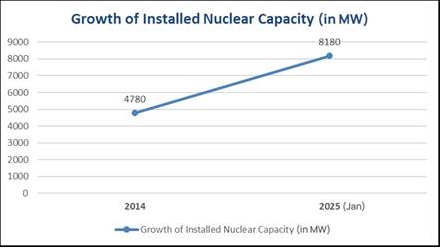 |
Benefits of Private Sector Involvement
- Faster Capacity Expansion: Private investment will help bridge the financial gap needed for rapid nuclear power growth.
- Technological Advancement: Collaboration with private companies drive innovation and bring in global expertise.
- Cost Efficiency: Competitive bidding and private participation will help reduce project costs and delays.
- Energy Security: Increased nuclear power generation helps India reduce dependence on fossil fuels and meet clean energy goals.
Concerns to Private Sector Entry
- Regulatory Hurdles: Amendments to existing laws are required to enable private sector participation.
- High Capital Requirement: Nuclear power projects involve long gestation periods and large upfront investments, which deters private players.
- Liability Concerns: The Civil Liability for Nuclear Damage Act imposes high liability on operators, making private investment risky.
- Safety and Security: Nuclear energy requires strict safety protocols, and allowing private firms to operate reactors necessitates robust regulatory oversight.
- Public Perception: Concerns over nuclear safety, waste management, and radiation risks will face public resistance.
Government steps
- India had announced a Rs 20,000 crore R&D mission for development of small modular reactors (SMRs).
- India is also targeting the deployment of at least five of these indigenously developed reactors by 2033.
- NPCIL and National Thermal Power Corporation (NTPC) have signed a supplementary Joint Venture (JV) agreement to develop nuclear power facilities in the country.
- The JV named ASHVINI will build, own, and operate nuclear power plants, including the upcoming 4×700 MWe PHWR Mahi-Banswara Rajasthan Atomic Power Project.
Way Ahead
- Clear Regulatory Framework: Establish a robust regulatory environment to ensure safety, compliance, and transparency, addressing concerns about accountability and national security.
- Public-Private Partnerships (PPPs): Promote partnerships where the government maintains oversight, while private players handle operations, innovation, and investment, ensuring a balance of interests.
- Gradual Implementation: Start with pilot projects and small-scale initiatives to test private sector involvement, ensuring risk management before large-scale implementation.
Source: AIR
Previous article
Rupee’s Depreciation: Global Volatility & Structural Concerns
Next article
News In Short 1-12-2025
