


Syllabus: GS2/Polity and Governance
Context
- Tamil Nadu has found itself in the middle of a controversy over the appointment of a regular Director-General of Police/Head of Police Force (DGP/HoPF).
About
- For the first time in recent years, the State was unable to appoint a regular police chief in time to succeed the outgoing DGP.
- The Union Public Service Commission (UPSC) had finalised a panel of three senior DGP-rank officers from the list forwarded by the State, the Tamil Nadu government rejected the panel.
- A petitioner filed a case against the State, alleging wilful contempt for appointing an in-charge DGP and withholding the appointment of a candidate from the panel.
- The Supreme Court has sought the State’s response within three weeks.
Superintendence over the State Police
- Police is a State subject in the seventh schedule to the Constitution, it is primarily the State Governments who exercises control and superintendence over the state police forces.
- At the district level, the District Magistrate (DM) may also give directions to the SP and supervise police administration.
- This is called the dual system of control (as authority is vested in both the DM and SP) at the district level.
- In urban areas, however, the dual system has been replaced by the Commissionerate system to allow for quicker decision-making in response to complex law and order situations.
Hierarchy of State Police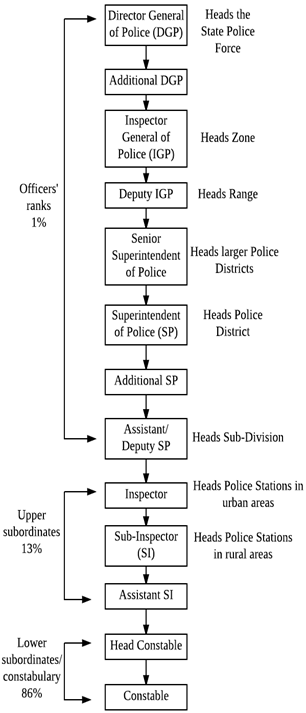 |
Recruitment
- The state governments are responsible for recruiting police personnel directly to the ranks of Constables, Sub-Inspectors and Deputy SPs.
- The central government recruits Indian Police Service (IPS) officers for the rank of Assistant SP. IPS is an All India Service created under the Constitution.
- Vacancies at other positions (as well as at the ranks of Sub-Inspector and Assistant/ Deputy SPs) may be filled up through promotions.
- Single-window System for Appointing State DGPs: The Union Government has notified a Single Window System for appointing State Director-General of Police/Head of Police Force.
- The new policy effective April 22, 2025, comes against the backdrop of several States not following the Supreme Court orders in the Prakash Singh case (2006) and the Ministry of Home Affairs guidelines as regards appointment of DGP/HoPF.
- Features:
- A detailed checklist and standardised formats for State proposals.
- Aimed at quick and smooth empanelment by UPSC.
- Responsibility fixed: A Secretary-rank officer must now certify eligibility and minimum tenure of DGP-rank officers sent for empanelment to the UPSC.
- The UPSC empanelment committee is headed by its chairperson and comprises the Union Home Secretary, the Chief Secretary, the DGP of the State concerned, and an officer from among the Heads of Central Police Organisations/Central paramilitary forces.
- Eligibility Conditions (As per SC and MHA):
- Officers must have at least 6 months residual service from the date of vacancy.
- Proposals must be sent to UPSC at least 3 months before the DGP/HoPF post becomes vacant.
Prakash Singh Judgment on Police Reforms
- In a landmark judgment, the Supreme Court in 2006 had directed all states and Union Territories to bring in police reforms.
- The ruling issued a series of measures that were to be undertaken by the governments to ensure the police could do their work without worrying about any political interference.
Directions to the Centre and States as per the SC Judgement:
- Constitute a State Security Commission in every state that will lay down policy for police functioning, evaluate police performance, and ensure that state governments do not exercise unwarranted influence on the police.
- Constitute a Police Establishment Board in every state that will decide postings, transfers and promotions for officers below the rank of Deputy Superintendent of Police, and make recommendations to the state government for officers of higher ranks.
- Constitute Police Complaints Authorities at the state and district levels to inquire into allegations of serious misconduct and abuse of power by police personnel.
- Provide a minimum tenure of at least two years for the DGP and other key police officers within the state forces, and the Chiefs of the central forces to protect them against arbitrary transfers and postings.
- Ensure that the DGP of state police is appointed from amongst three senior-most officers who have been empanelled for the promotion by the Union Public Service Commission on the basis of length of service, good record and experience.
- Separate the investigating police from the law and order police to ensure speedier investigation, better expertise and improved rapport with the people.
- Constitute a National Security Commission to shortlist the candidates for appointment as Chiefs of the central armed police forces.
Conclusion
- The 2nd ARC emphasized that police reforms are central to good governance and rule of law.
- While some states have adopted measures, implementation remains uneven.
- The Supreme Court’s 2006 directives in the Prakash Singh case also drew upon several of these recommendations, but compliance continues to be patchy.
Source: TH
Previous article
Assam Prohibition of Polygamy Bill 2025
