


Syllabus: GS2/IR/GS3/Internal Security
Context
- The ministry of external affairs (MEA) said that Arunachal Pradesh is an integral and inalienable part of India.
About
- Recently, Chinese immigration officials at the Shanghai airport detained an Indian Citizen for 18 hours on the ground that her passport was “invalid” as her birthplace was Arunachal Pradesh.
- The immigration officers declared her passport “invalid,” saying Arunachal is not part of India.
- MEA strongly criticised China over the “arbitrary detention” calling it a violation of International civil aviation norms, including the Chicago and Montreal Conventions.
China’s Claim Over Arunachal Pradesh
- Arunachal Pradesh, known as the North Eastern Frontier Agency (NEFA) until 1972, is the largest state in the northeast and shares international borders with China (Tibet) in the north and northeast, Bhutan towards the west and Myanmar to the east.
- China’s Claims: China claims Arunachal Pradesh as a part of southern Tibet. Its main interest lies in the district of Tawang, which is in the north-western region of Arunachal and borders Bhutan and Tibet.
Why does China Claim Arunachal Pradesh?
- Tawang monastery: Tawang is the second largest monastery of Tibetan Buddhism in the world.
- The monastery was founded by Merag Lodroe Gyamtso in the year 1680-81 to honour the wishes of the fifth Dalai Lama.
- China claims that the monastery is evidence that the district once belonged to Tibet.
- Cultural connections and China’s Concerns: There are some tribes in the upper Arunachal region which have cultural connections to the people of Tibet.
- China fears that the presence of these ethnic groups in Arunachal could at some stage give rise to a pro-democracy Tibetan movement against China.
- Dispute over the McMahon Line: The McMahon Line, drawn during the 1914 Simla Convention between British India and Tibet, designates Arunachal Pradesh as part of India.
- China rejects the Simla Convention, arguing that Tibet had no independent authority to sign the agreement.
| Shimla Convention 1914 – The 1914 Simla convention, which included a Chinese representative on an equal footing with a Tibetan representative, gave birth to the McMahon Line separating Tibet from India in the eastern sector. 1. It clearly defined the frontiers of the boundary between India and Tibet. 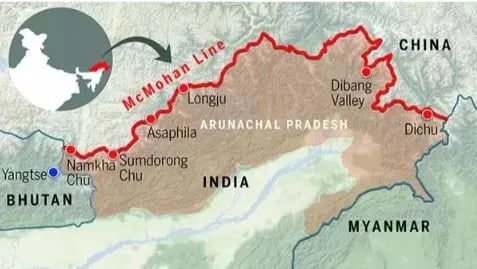 |
- Escape of Dalai Lama: When the Dalai Lama escaped Tibet in 1959 amid China crackdown, he entered India through Tawang and stayed in the Tawang monastery for some time which has been a bone of contention between India and China.
- Strategic Importance: The region overlooks the Tibetan plateau and provides India with advantageous terrain.
- It is close to key Chinese military assets in Tibet.
- Control over this territory would allow China to strengthen its buffer zone and military posture in the eastern sector.
- The Bhutan factor: If China gains control of Arunachal, it would mean that the kingdom of Bhutan would have China as its neighbour on both the western and eastern borders.
- Political Leverage in Border Negotiations: China often uses its claim over Arunachal Pradesh as a bargaining tool to extract concessions in other sectors, especially Aksai Chin (western sector), which it controls.
India’s Stand
- Arunachal Pradesh is an Integral Part of India: India asserts full sovereignty over Arunachal Pradesh based on historical, legal, and administrative continuity.
- People of Arunachal Pradesh have democratically elected governments within the Indian Constitution.
- McMahon Line is the Legal Boundary: India recognises the 1914 McMahon Line as the official and legitimate boundary.
- China’s Claims Are Unfounded: Government statements consistently underline that assigning invented names or issuing stapled visas does not change the ground reality.
- Evidence of Effective Control: India has administered the region continuously since Independence—governance, elections, judiciary, development schemes, and armed forces presence.
- People of Arunachal identify culturally, politically, and socially with India.
- Development and Infrastructure in Arunachal Will Continue: India rejects China’s objections to infrastructure projects.
- Stands that development of Indian territory is India’s internal matter.
Way Ahead
- India has initiated its biggest hydroelectric project of 11,000 megawatt (MW) in Upper Subansiri in Arunachal Pradesh.
- The hydro electric project is seen as a strategic move to counter the potential impact of Chinese flow diversion through the dams it is constructing.
- India’s sovereignty over Arunachal Pradesh is internationally recognised and accepted.
- India has repeatedly rejected China’s territorial claims over Arunachal Pradesh, asserting that the state is an integral part of the country.
Source: IE
Previous article
Row over Selecting Head of Police Force in T.N.
Next article
India’s Research Fraud Epidemic
