

Syllabus: GS3/ Science and Technology
Context
- The Indian Space Research Organisation (ISRO) successfully launched the Indian Navy’s advanced communication satellite GSAT-7R (CMS-03) from the Satish Dhawan S Satish Dhawanpace Centre in Sriharikota.
About the GSAT-7R Satellite
- Gsat-7R an indigenously developed satellite, weighing approximately 4,400 kg, is India’s heaviest communication satellite to be launched from the country to date.
- It is designed to replace Gsat-7 (Rukmini), which was launched in 2013 and is primarily dedicated to the Indian Navy.
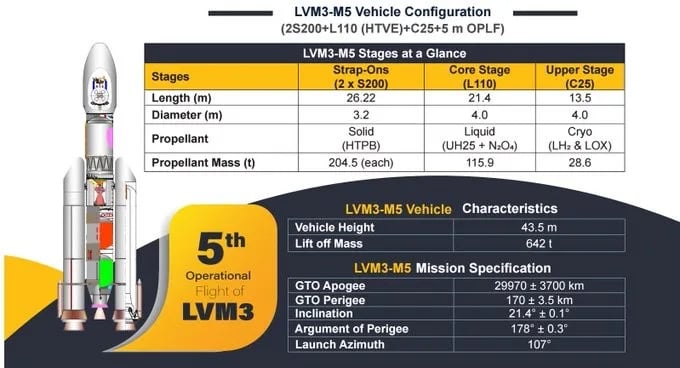
- ISRO launched the rocket aboard its most powerful launch vehicle, the LVM3, on its M5 mission.
- The satellite had been successfully inserted into a geosynchronous transfer orbit (GTO).
| Geosynchronous Transfer Orbit – The GTO allows satellites to be positioned into geostationary orbits, where they can maintain a fixed position relative to the Earth’s surface. – This is crucial for communication and weather satellites that need to monitor specific areas continuously. |
- The satellite carries advanced payloads in multiple frequency bands, UHF, S-band, C-band and Ku-band, and includes several indigenous technologies such as a 1,200-litre propulsion tank and collapsible antenna systems.
- Its payload includes transponders capable of supporting voice, data, and video links over multiple communication bands.
- Significance: With state-of-the-art indigenous components, the GSAT-7R will provide robust and secure telecommunication coverage across the Indian Ocean Region.
Reasons for Heavy Mass of Communication Satellites
- Wide Coverage and Multi-band Capability: To serve the entire Indian mainland, communication satellites require broad-area coverage and support for multiple frequency bands.
- This multi-band design demands large deployable antennas, high-power amplifiers, waveguides, and digital processors, all of which contribute to greater mass.
- High Power Demand and Large Solar Arrays: Modern communication satellites are high-power platforms, consuming several kilowatts of electricity.
- To sustain this for 12–15 years, satellites carry large solar panels and batteries to provide continuous energy during Earth’s shadow (eclipse) periods.
- Redundancy for Long Service Life: To ensure reliability, satellites include redundant systems, duplicate computers, radios, power units, and control systems.
- This redundancy allows continued operation even if primary systems fail.
- While critical for mission longevity, redundancy significantly increases the overall launch mass.
Source: TH
Previous article
Research Development and Innovation (RDI) Scheme Fund
Next article
News in Short – 3 November, 2025
