


Museum of Royal Kingdoms of India
Syllabus: GS1/Post-Independence History
Context
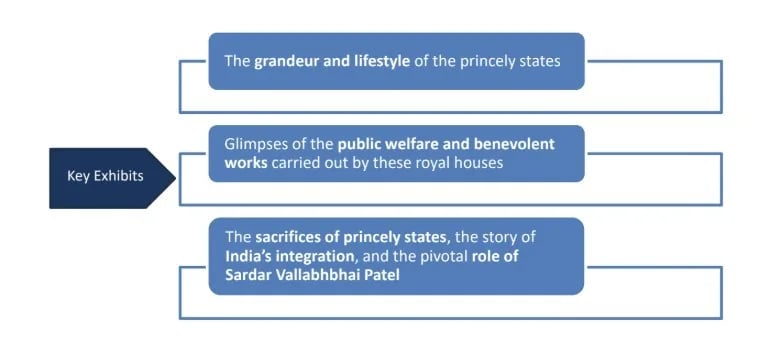
- The Prime Minister laid the foundation stone for the Museum of Royal Kingdoms of India near the Statue of Unity in Gujarat.
About
- Aim: To preserve the memory of the past while inspiring future generations with the timeless spirit of unity and sacrifice.
- This museum, costing ₹367 crore, will have four thematic galleries.
- This museum will be built on five acres of land near the Statue of Unity in Ekta Nagar.
Historical Background
- At the time of India’s Independence on 15 August 1947, the subcontinent comprised British-administered territories and over 550 princely states and kingdoms.
- Under the leadership of Sardar Vallabhbhai Patel, then Deputy Prime Minister and Home Minister, the rulers of the princely states were persuaded to accede to India through the Instrument of Accession.
- By 1949, nearly all princely states had joined the Indian Union, laying the foundation for a unified and sovereign Republic.
- This peaceful unification stands as a testament to India’s spirit of diplomacy, inclusivity, and nation-building.
Source: PIB
Georgia New Hub for Indian Medical Students
Syllabus: GS1/Places
In News
- Amid the ongoing war in Ukraine, Georgia has rapidly emerged as a preferred destination for Indian medical aspirants, with education-related remittances rising to $50.25 million in 2024–25—a fivefold increase since 2018–19.
- Its popularity stems from affordable medical courses, simple residency laws, and proximity to Europe.
Georgia
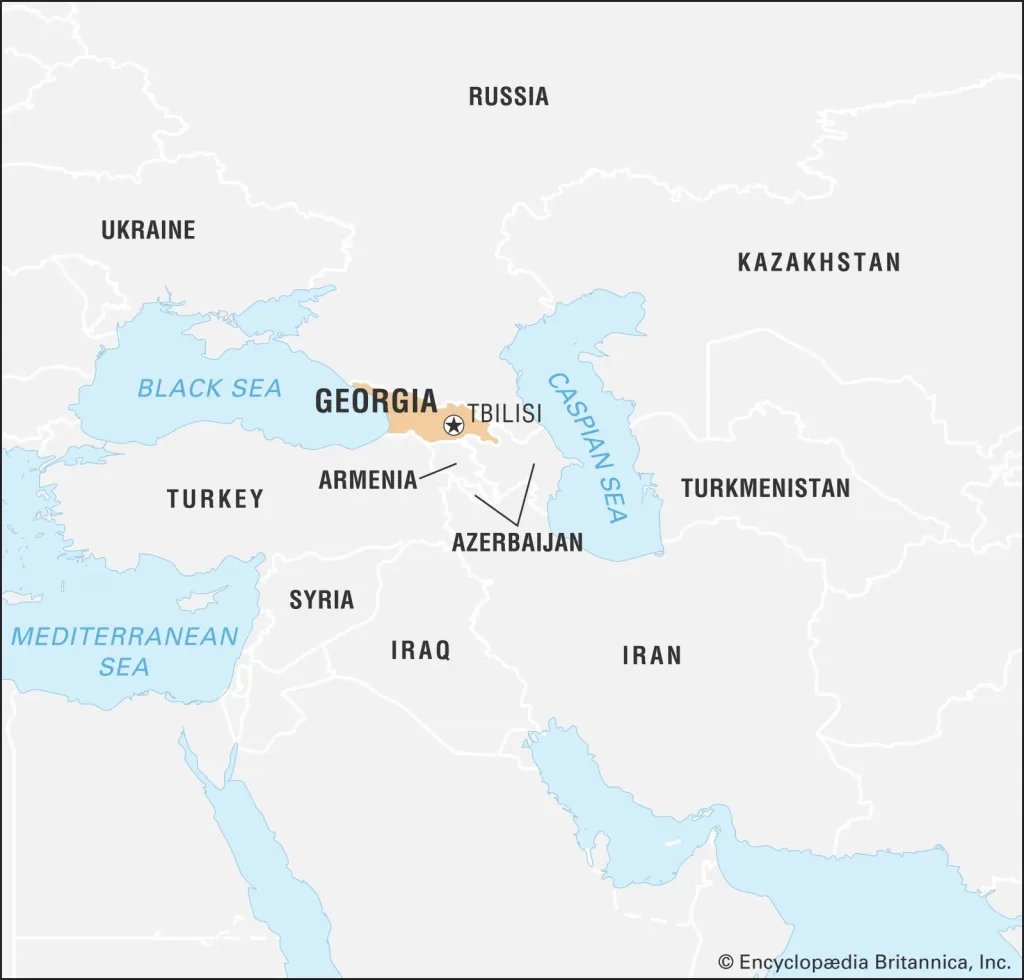
- It is located at the eastern edge of the Black Sea and bordered by Russia, Azerbaijan, Armenia, and Turkey.
- It includes three ethnic enclaves—Abkhazia, Ajaria, and South Ossetia—and its capital is Tbilisi.
- It has a rich cultural heritage and was a powerful kingdom in the medieval period.
- It declared sovereignty in 1989 and full independence in 1991.
| Do you know? – The RBI’s Liberalised Remittance Scheme allows Indians to send up to $250,000 abroad annually for education and other purposes. |
Source :IE
Union Health Ministry sets 3 Guinness World Records
Syllabus: GS2/Health
Context
- The Union Health Ministry has achieved three Guinness World Record titles under the nationwide “Swasth Nari, Sashakt Parivar Abhiyaan” (SNSPA) campaign.
About
- The Records Achieved are:
- Most people register for a health care platform in one month.
- Most people sign up for a breast cancer screening online in one week.
- Most people sign up for vital signs screening online in one week (at state level).
Swasth Nari, Sashakt Parivar Abhiyaan
- The PM launched the nationwide campaign “Swasth Nari, Sashakt Parivar Abhiyaan” from 17th September to 2nd October 2025, in conjunction with Poshan Maah.
- The campaign focuses on improving the health and nutrition of women, adolescent girls, and children.
- This recognition from Guinness World Records stands as a testament to India’s collective effort—combining government systems, digital health innovation, and community participation.
Source: TH
‘Aabhar’ Online Store
Syllabus: GS3/Economy
In News
- Indian Railways is supporting the new ‘Aabhar’ online store showcasing gift items made by indigenous tribes, handloom weavers, and One District One Product (ODOP) and Geographical Indication (GI) product makers to promote local talent and craftsmanship.
‘Aabhar’ online store
- The online store hosted by the Government e-Marketplace (GeM) sources gift items exclusively from the Central Cottage Industries Emporium (CCIE), Khadi and Village Industries Commission (KVIC), and various Central and State Handicraft and Handloom Emporiums.
- It is promoted with the ‘Vocal for Local’ campaign and the store would offer a variety of articles and hampers that could be used in official events, ceremonies, and functions.
- It is aimed at fostering social inclusion and supporting rural artisans, women-led enterprises, and traditional industries.
| Do you know? – The ‘One Station One Product’ (OSOP) scheme was launched by the railways to promote local and indigenous products and provide additional income opportunities for marginalized communities. |
Source :TH
Census Self-enumeration Trial to Begin
Syllabus:GS2/Governance
In News
- The government began testing the self-enumeration module for the first phase of Population Census 2027, marking India’s first digital and caste-based census.
Background
- Census 2021 that was postponed indefinitely initially due to COVID-19 pandemic is now being known as Population Census 2027.
- The exercise excludes updates to the National Population Register (NPR), which was last revised in 2015–16.
- The NPR, created in 2010, is considered the first step toward a National Register of Citizens (NRC). Unlike previous Census exercises, the methodology for caste enumeration is still under review, and only the HLO phase is being tested.
- The pre-test for the planned 2021 Census took place in 2019, covering more than 26 lakh people in 76 districts of 36 States and Union Territories. Around 6,000 enumerators and 1,100 supervisors from State governments were engaged in 2019.
Self-enumeration trial
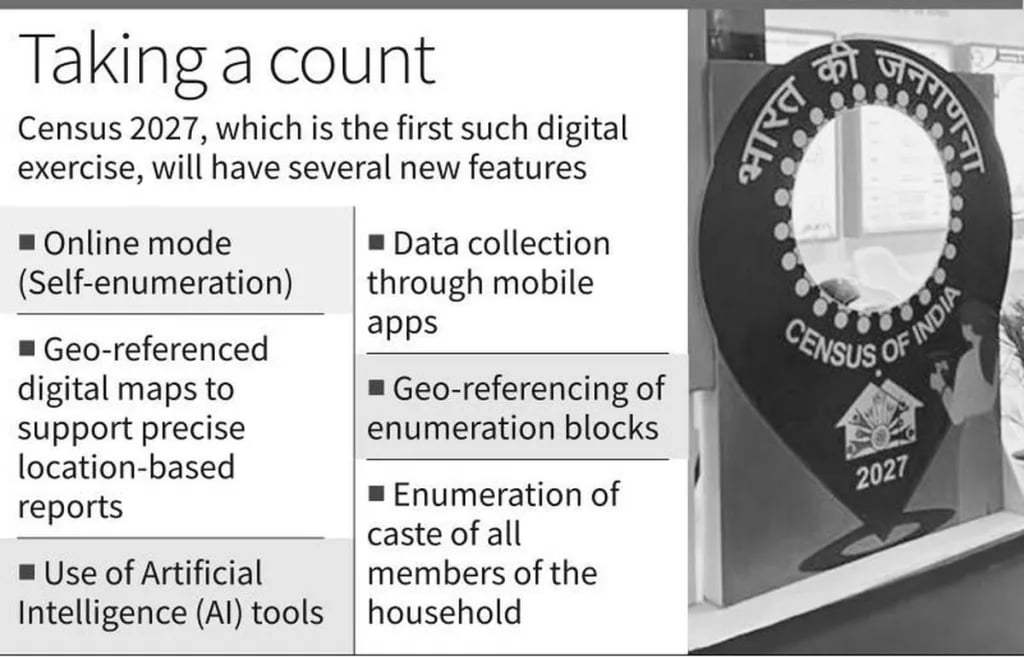
- India’s first digital and caste-enumerating Population Census begins its pre-test phase with enumerators assisting select citizens in self-enumeration via a dedicated portal.
- This phase, known as the Houselisting and Housing Census (HLO), will be tested in two stages—self-enumeration and field verification across sample areas in all States and UTs.
- It will include 30 household-related questions on housing, amenities, and assets.
- Enumerators will use a digital layout map and mobile app linked to the Census Management and Monitoring System to collect and verify data efficiently.
Source :TH
Digital Marine Fisheries Census 2025
Syllabus: GS2/ Governance, GS3/ Economy
Context
- The Union Ministry of Fisheries, Animal Husbandry and Dairying launched the Marine Fisheries Census (MFC) 2025 Household Enumeration and the VYAS – BHARAT and VYAS- SUTRA app.
About
- Fully Digital and Geo-Referenced Census: The MFC 2025 departs from traditional paper-based methods used in earlier editions.
- The fifth edition covers around 1.2 million fisher households across 5,000 marine fishing villages in 13 coastal States and Union Territories, including the Andaman & Nicobar Islands and Lakshadweep.
- Digital Architecture: The digital process is powered by three multilingual Android applications developed by the ICAR–Central Marine Fisheries Research Institute (CMFRI):
- VyAS–NAV: For validation of fishing villages and harbours.
- VyAS–BHARAT: For household and infrastructure enumeration.
- VyAS–SUTRA: For real-time supervision and monitoring of data collection.
- Expanded Socio-economic Data: For the first time, the enumeration includes detailed information on crucial indicators like total family income, homeownership, outstanding liabilities, and sources of credit.
Source: PIB
Kendriya Grihmantri Dakshata Padak
Syllabus: Miscellaneous
Context
- The Kendriya Grihmantri Dakshata Padak has been awarded to 1,466 personnel for the year 2025.
About
- The Kendriya Grihmantri Dakshata Padak was instituted by the Ministry of Home Affairs (MHA).
- It recognises excellence in operations, exceptional investigative service, intelligence work marked by courage and determination, and meritorious contributions in forensic science by serving government scientists.
- It is conferred annually on October 31, marking the birth anniversary of Sardar Vallabhbhai Patel, India’s first Home Minister and the architect of national integration.
- Key Areas of Recognition: Special Operations, Investigation, Intelligence, and Forensic Science.
- The medal is conferred on members of the Police Forces, Security Organisations, Intelligence Wings/Branches, Central Armed Police Forces (CAPFs), Central Police Organisations (CPOs), and Forensic Science units at the Central, State, and Union Territory levels.
Source: AIR
Previous article
Carbon Capture for Net-Zero India
Next article
Degradation of Social Platforms
