


Syllabus: GS3 / Science and Technology
Context
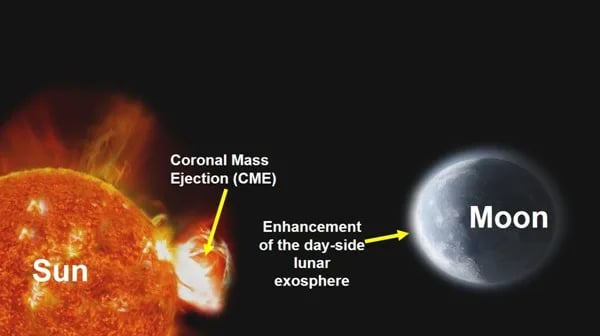
- The Chandrayaan-2 mission has made the first-ever observation of the effects of the Sun’s Coronal Mass Ejection (CME) on the Moon using its onboard scientific instruments.
About the observation
- The finding was made by Chandra’s Atmospheric Composition Explorer-2 (CHACE-2), a payload onboard Chandrayaan-2’s orbiter.
- CHACE-2 recorded a sharp rise in total pressure and molecular density in the Moon’s sunlit exosphere.
- CMEs are the events when the Sun ejects significant quantities of its building material, comprising mostly Helium and Hydrogen ions.
Composition of Lunar Exosphere
- The Moon’s atmosphere is extremely thin, classified as an exosphere, implying that the gas atoms and molecules in the lunar environment rarely interact despite their coexistence.
- The boundary of the exosphere is the surface of the Moon and hence the Moon’s exosphere falls under the category of ‘surface boundary exosphere’.
- The lunar exosphere is formed by processes such as:
- Solar radiation,
- Solar wind (ions of hydrogen, helium, and trace heavier elements), and
- Meteorite impacts that release surface atoms into space.
- Unlike Earth, the Moon lacks a magnetic field, making it directly exposed to CMEs.
| Chandrayaan-2 – Chandrayaan-2 was India’s second lunar mission, launched by the Indian Space Research Organisation (ISRO) in 2019, using the GSLV-MkIII-M1 rocket. – It comprises an orbiter, lander (Vikram), and rover (Pragyan). – CHACE-2 Payload Objective: To study the composition, distribution, and variability of the lunar neutral exosphere. |
Significance of the observation
- It provides valuable insight into lunar exospheric dynamics and space weather effects on airless celestial bodies.
- Enhances understanding of Sun–Moon interactions, contributing to better space weather prediction models.
- Provides critical knowledge for future lunar missions and habitats, especially for human presence on the Moon by 2040.
- Reinforces India’s growing capability in planetary science and space environment monitoring.
Source: AIR
Previous article
Evolving Dimensions of Poverty in India
