

Syllabus: GS3/Economy
Context
- The Union Minister of Commerce and Industry launched the report on Assessment of Logistics Cost in India.
About
- Prepared by: The Industry and Commerce Departments.
- Comprehensive Framework: It provides a comprehensive framework by capturing logistics costs across different transport modes, product categories, and firm sizes.
- Aim: It follows the mandate of the National Logistics Policy (2022) to establish a uniform framework for measuring logistics costs and benchmarking them against global practices.
- Logistics Cost: As per the current assessment logistics costs in India are estimated at about 7.97% of total GDP.
- Previous Estimates: Until now, logistics costs in India were often misrepresented, with commonly cited figures of 13–14% of GDP derived from external studies or partial datasets.
- This led to inconsistent estimates, causing confusion among policymakers and global stakeholders.
- Improvement: Estimates for the previous five years show that the growth rate of logistics costs is gradually slowing compared with the pace of growth in non-services output.
Key Achievements of India’s Logistics Sector
- Ranking in 2023 Logistics Performance Index (LPI): India was ranked 38th place out of 139 nations, a notable improvement of six places since the last ranking in 2018.
- The Inland Waterways Authority of India (IWAI) recorded cargo movement of 145.5 million tonnes in the year 2024–25.
- The number of operational national waterways has also increased from 24 to 29 during the same period.
| Key Objectives of National Logistics Policy (NLP): – To reduce logistics costs to global benchmarks and to bring it below 10% of GDP. – To improve India’s ranking in the Logistics Performance Index (LPI) to the top 25 by 2030. – To establish a robust, data-driven decision support system to ensure an efficient and integrated logistics ecosystem. |
Challenges
- High Logistics Cost: India’s logistics cost is very high at around 13–14% of GDP (as estimated previously), making Indian exports less competitive compared to global peers.
- Infrastructure Gaps: The sector suffers from infrastructure gaps in warehousing, cold storage, and last-mile connectivity.
- Overdependence on Road: There is an overdependence on road transport, which causes congestion, delays, and higher transportation costs.
- Multimodal Transport Issues: The low share of railways and inland waterways in freight transport hampers the development of an efficient multimodal system.
- Environmental Concerns: Heavy dependence on diesel-based trucking increases carbon emissions and contributes to environmental pollution.
Key Government Initiatives in Logistics
- PM GatiShakti Master Plan: It was launched in 2021 to integrate different modes of transport into a coordinated network.
- It has brought together 57 Central Ministries/Departments and all 36 states and union territories.
- Maritime Amrit Kaal Vision 2047: It is aligned with blue economy principles, lays out a long-term roadmap to transform India’s maritime sector.
- The vision also aims to boost coastal tourism, strengthen maritime skill development, and position India as a global hub for shipbuilding and repair.
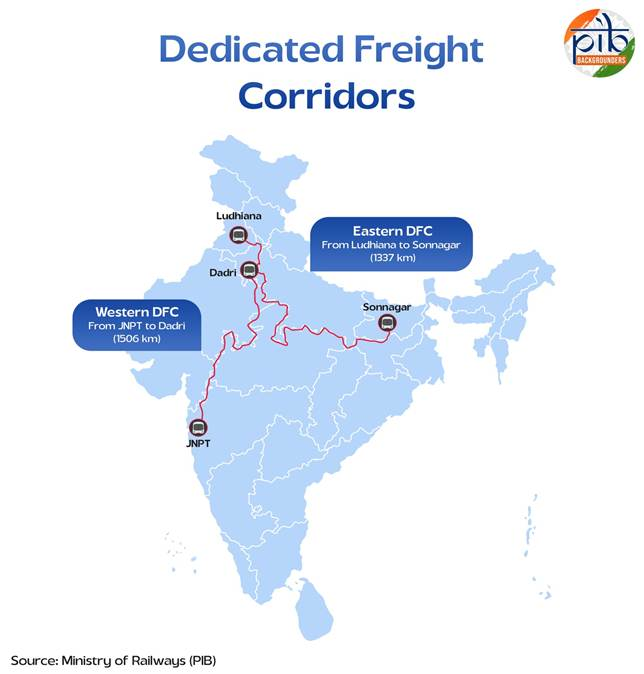
- Dedicated Freight Corridors: The Ministry of Railways is currently developing two Dedicated Freight Corridors (DFCs).
- The objectives of these specialized railway lines are to ease congestion on existing passenger routes, lower transportation costs, and improve energy efficiency.
- Multi-Modal Logistics Park: 35 key locations such as Chennai, Bengaluru, Nagpur, Indore, and others have been approved through both private and public sector efforts for the development of MMLPs. Out of these, 5 are expected to be operational by 2027.
- Unified Logistics Interface Platform (ULIP): It is a digital platform that brings together data from various logistics-related ministries and departments on a single interface; it has recorded 100 crore API transactions in 2025.
- Gati Shakti Vishwavidyalaya (GSV): The GSV is India’s first university dedicated to transport and logistics education.
- GSV plays a key role in preparing skilled professionals to support this national goal.
- Gati Shakti Vishwavidyalaya has signed Memoranda of Understanding (MoUs) with about 40 different industrial and academic institutions.
- Sustainability:The Freight Greenhouse Gas (GHG) Calculator has been developed for calculating and comparing the total cost of transportation and GHG emissions to build awareness and support sustainable development.
- The Indian Railways has launched Rail Green Points for freight customers, allowing them to see potential carbon emission savings.
Source: PIB
Previous article
News In Short – 20 September, 2025
Next article
Large Ships Granted Infrastructure Status
