



National Archives of India (NAI)
Syllabus: GS1/ Art & Culture
In News
- 50th Golden Jubilee Meeting of the National Committee of Archivists (NCA) organized by the National Archives of India (NAI).
About National Archives of India (NAI)
- It is the premier repository of the Government of India for preserving and maintaining the nation’s documentary heritage.
- It was originally established in 1891 in Calcutta (Kolkata) as the Imperial Record Department, and later shifted to New Delhi in 1911, where it is housed in a building designed by Sir Edwin Lutyens, located near the India Gate on Janpath.
- The NAI functions as an attached office of the Ministry of Culture and is the custodian of non-current records of the Government of India.
- It holds over 40 million documents, dating from the 16th century to the present, in multiple languages, including Persian, Arabic, Sanskrit, Urdu, and English.
- It is headed by the Director General of Archives, who is responsible for implementation of the Public Records Act, 1993 and Rules, 1997.
Source: PIB
Secularism
Syllabus: GS2/Polity and Governance
Context
- The Supreme Court reminded a petitioner opposing “Muslim” Booker Prize winner Banu Mushtaq inaugurating Mysuru Dasara festival that the Preamble upholds secularism, liberty, equality, and fraternity as core ideals of national unity.
| Mysore Dasara – Mysore Dasara, also called Nadahabba (state festival of Karnataka), is the royal version of Dussehra, celebrated in Karnataka. – It marks the victory of good over evil – Goddess Chamundeshwari (a form of Durga) killing the demon Mahishasura, after whom Mysuru (Mysore) is named. – It is celebrated for 10 days, ending on Vijayadashami. |

Secularism in India
- Indian secularism is based on “equal respect for all religions”, not strict separation of religion and State.
- The State can regulate or reform religious practices but cannot promote or favour any religion.
- Constitutional Provisions:
- Preamble: Secularism is a core ideal ensuring liberty of belief, faith, and worship.
- Article 14: Equality before law and equal protection of laws.
- Article 15 & 16: Prohibition of discrimination on religious grounds.
- Article 25: Freedom of conscience and free profession, practice, and propagation of religion.
- Article 26: Freedom to manage religious affairs.
- Article 27: No compulsion to pay taxes for promotion of any religion.
- Article 28: No religious instruction in State-funded institutions.
- Articles 29–30: Rights of religious and cultural minorities.
Judicial Interpretations
- Kesavananda Bharati (1973): The SC held that Secularism is part of the Basic Structure of the Constitution.
- 1994 case of S.R. Bommai v. Union of India: The Supreme Court held that secularism is a basic feature of the Indian Constitution and that politics and religion must remain separate.
Indian vs Western Secularism
- Western model: In the western model of secularism there is a strict separation of Church and State.
- Indian model: In India the state has provided equal rights and protection to all religions and can engage with religions for reform, equality, and harmony.
Significance of Indian Secularism
- India is a diverse country with many religions, it ensures unity in diversity.
- Protects minority rights.
- Upholds democracy, equality, and fraternity as envisioned in the Constitution.
Source: TH
India Re-Elected to Universal Postal Union’s Governing Councils
Syllabus: Miscellaneous
Context
- India has been re-elected to the Council of Administration (CA) and the Postal Operations Council (POC) of the Universal Postal Union (UPU) during the 28th UPU Congress held in Dubai, United Arab Emirates.
About
- The Universal Postal Union is a United Nations specialized agency and the postal sector’s primary forum for international cooperation.
- Origin: On 9 October 1874, 22 countries signed the Treaty of Bern, creating the General Postal Union.
- Later it became known as the Universal Postal Union.
- Member countries: The UPU has 192 member countries.
- Any member country of the United Nations may become a member of the UPU.
- India has been a member of the UPU since 1876.
- Headquarters: The Swiss capital Berne
- It consists of 4 bodies;
- The Congress: It is the supreme authority; meets every four years.
- The Council of Administration: It supervises its activities and studies regulatory, administrative, legislative and legal issues.
- The Postal Operations Council: It is the technical and operational mind of the UPU and consists of 48 member countries, elected during Congress.
- The International Bureau: It provides logistical and technical support.
India’s Role in UPU
- Digital Transformation: Pioneered initiatives such as DigiPIN (digital addressing system), UPI-enabled cross-border remittances, and Dak Ghar Niryat Kendras for e-commerce facilitation.
- Capacity Building & Cooperation: Through the Indian Technical and Economic Cooperation (ITEC) programme, India has trained postal officials from Asia, Africa, and other regions.
Source: AIR
EPFO’s ‘Passbook Lite’ To Provide Easy Access to PF Details
Syllabus:GS2/Governance
In News
- The Employees’ Provident Fund Organisation (EPFO) launched ‘Passbook Lite’.
EPFO Passbook Lite facility
- It will allow members to access their passbook and a related summarised view of the contributions, withdrawals and balance in a simplified format through the member portal itself without visiting the passbook portal.
- It aims to enhance the user experience of EPFO members by offering all key services through a single login, including access to the passbook.
- However, members can still use the existing Passbook Portal to get complete information on passbook details, including graphical displays.
About Employees’ Provident Fund Organisation (EPFO)
- It is India’s largest social security organisation under the Ministry of Labour and Employment, Government of India.
- It was established in 1951 with the enactment of the Employees’ Provident Funds and Miscellaneous Provisions Act, 1952.
- EPFO manages the provident fund, pension, and insurance schemes for the organised workforce in India, covering establishments with 20 or more employees.
- EPFO is administered by a tripartite body called the Central Board of Trustees (CBT), consisting of representatives from the government (both Centre and States), employers, and employees.
- It has also introduced initiatives like Universal Account Number (UAN) to facilitate portability of PF accounts, and digital claim settlement systems to improve efficiency.
Source :TH
H-1B Visas
Syllabus: GS2/IR
Context
- The U.S. President has signed a proclamation to raise the fee for H-1B visas to a staggering $1,00,000 annually, representing a dramatic increase from the current $1,500 administrative costs.
H-1 Visa
- An H-1B visa is a non-immigrant visa in the United States that allows US companies to temporarily employ foreign workers in specialty occupations.
- These are jobs that typically require technical expertise, a bachelor’s degree or higher, or its equivalent in fields like IT, engineering, science, medicine, and finance.
- It is designed to fill specialised skill gaps in the US labor market where qualified Americans are unavailable.
- Initially valid for 3 years, extendable up to 6 years. The visa is tied to the employer, meaning the worker cannot switch jobs without a new H-1B petition.
- There is an annual cap of 85,000 visas, including 20,000 reserved for US master’s degree holders.
- Indians have been the biggest beneficiaries of the H-1B program, accounting for more than 70% of successful H-1B petitions followed by China, who account for 12-13%.
Source: TH
Clearing Corporation of India (CCIL)
Syllabus: GS3/ Economy
In News
- The RBI Governor has encouraged the Clearing Corporation of India (CCIL) to adopt innovative settlement frameworks beyond the traditional dollar-rupee system to promote the international use of the rupee.
About CCIL
- It was established in 2001 by leading banks, financial institutions, and the Reserve Bank of India (RBI) to provide an efficient clearing and settlement system for India’s financial markets.
- It acts as a central counterparty (CCP) for transactions in government securities, foreign exchange, money market instruments, and rupee derivatives, thereby reducing counterparty risk by becoming the buyer to every seller and the seller to every buyer.
- Regulated by the RBI under the Payment and Settlement Systems Act, 2007, CCIL plays a vital role in ensuring financial stability, market efficiency, and systemic risk reduction in India’s financial ecosystem.
- CCIL is officially recognised by the RBI as a Qualified Central Counterparty (QCCP), a global standard reflecting its robust risk management and operational reliability.
Source: TOI
India’s Sovereign Rating Upgraded to BBB+
Syllabus: GS3/Economy
Context
- India’s Sovereign Rating has been upgraded to BBB plus rating by a Japanese credit rating agency namely ‘Rating and Investment Information (R&I)’.
About
- India’s long-term sovereign credit rating has been upgraded from the BBB to BBB plus.
- BBB plus rating indicates stability.
- Following the decision, the government has retained the Stable Outlook for the Indian economy.
- A sovereign credit rating is an independent evaluation of a country’s creditworthiness, which helps investors assess the risk associated with investing in that country’s debt.
- Rating scale:
- Investment grade AAA, AA, A, BBB: It reflects lower risk, cheaper borrowing costs.
- Speculative grade (junk) BB, B, CCC: It reflects higher risk, higher borrowing costs.
Source: AIR
Indonesia Suspends Indian Groundnut Imports over Aflatoxins
Syllabus: GS3/ Agriculture
Context
- Indonesia suspended imports of Indian groundnuts citing aflatoxin contamination.
What are Aflatoxins?
- Aflatoxins are toxic molds caused by Aspergillus flavus and Aspergillus parasiticus fungi.
- They contaminate grains and oilseeds, particularly in warm, humid conditions.
- They are considered carcinogenic and genotoxic.
About Groundnut
- Groundnut is a tropical and subtropical crop. It is an annual herbaceous plant growing 30 to 50 cm tall.
- It requires a warm, frost-free climate.
- Groundnut is raised in a sandy loam as well as well drained sandy clay loam soil.
- The peanut was probably first domesticated and cultivated in the valleys of Paraguay.
- India is the second-largest producer of groundnuts in the world.
- Major growing states are Gujarat, Andhra Pradesh, Tamil Nadu, Karnataka, Maharashtra, Rajasthan, Madhya Pradesh, Orissa, and Uttar Pradesh.
- India is among the largest exporters of groundnuts, with major markets in Southeast Asia, Europe, and the Middle East.
Source: TH
Kadamb Tree
Syllabus: GS3/ Environment
Context
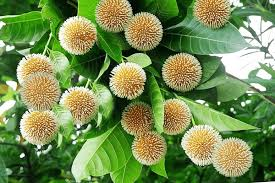
- King Charles III of the United Kingdom sent a Burflower tree, commonly referred to as kadamb tree, to the Indian Prime Minister as a gift on his 75th birthday.
About kadamb tree (Neolamarckia cadamba)
- The kadamb tree is an evergreen, tropical tree native to South and Southeast Asia. It can grow up to 45 m tall.
- Distinct Features: Known for its fragrant orange flowers that bloom in dense, globe-shaped clusters.
- Historical Connections:
- Kadamba Dynasty: The tree lent its name to the Kadamba dynasty which ruled from Banavasi in present-day Karnataka from 345 CE to 525 CE, as per Talagunda inscription. The tree was considered a holy tree by the Kadamba dynasty.
- Athmallik State Emblem: The kadamba flower served as the emblem of Athmallik, a princely state during the British Raj.
Source: DD News
Hangul Deer
Syllabus :GS3/Environment
In News
- A youngster from Srinagar, is continuing his family’s multi-generational legacy of conserving the hangul deer.
Hangul

- It is also known as Kashmir stag and is a subspecies of Central Asian red deer that is endemic to Kashmir and surrounding areas
- Habitat and Distribution : It inhabits deciduous woodlands, alpine meadows, and mountainous areas, preferring oak, mulberry, and riverine habitats in winter, and oak-conifer forests in summer for better food availability.
- It was once found across the Himalaya, Chenab Valley, and parts of Himachal Pradesh, but now survives within Dachigam National Park(Kashmir).
- Threats: Hangul decline is mainly due to poaching, habitat pressure from insurgents, herders, and livestock competition, leading to low genetic diversity and recruitment. Predation, disease, and lack of strong protection worsen the threat.
- Conservation status: IUCN Red List of Threatened species classified hangul as Critically Endangered species.
Source :DTE
Adamya Commissioned at Paradip Port
Syllabus: GS3/Defence
In News
- Indian Coast Guard Ship (ICGS) Adamya, the first of eight Adamya-class Fast Patrol Vessels (FPVs), was commissioned at Paradip Port, Odisha.
- It is built by Goa Shipyard Limited with over 60% indigenous content which reflects the vision of ‘Aatmanirbhar Bharat’.
Paradip Port
- Paradip Port, founded by Late Biju Patnaik and its foundation stone laid by Prime Minister Jawaharlal Nehru in 1962, near the confluence of the Mahanadi River and the Bay of Bengal.
- It is the only Major Port in the State of Odisha situated 210 nautical miles south of Kolkata and 260 nautical miles north of Visakhapatnam on the east coast on the shore of Bay of Bengal.
- In 1966, it was declared the eighth Major Port of India and the first major port on the East Coast commissioned after independence.
Source :TH
Previous article
Gujarat’s Dhordo Becomes Fully Solar-Powered
Next article
Assessment of Logistics Cost in India
