


Syllabus: GS3/Economy
In Context
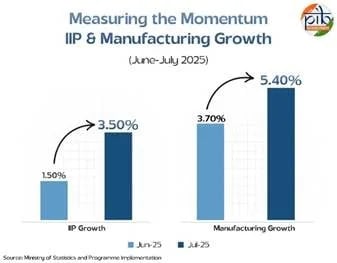
- The Index of Industrial Production (IIP) showed a significant rise in July 2025, with overall growth at 3.5% and manufacturing growth at 5.4% year-on-year, mainly driven by manufacturing, reflecting rising demand and better capacity use.
Present Status of India’s Manufacturing sector
- India’s manufacturing exports are growing steadily, with total exports rising 6.18% YoY to US$ 349.35 billion in April-August 2025.
- Merchandise exports grew 2.52% to US$ 184.13 billion.
- The sector is on track to reach US$ 1 trillion by FY26 and could add US$ 500 billion annually to the global economy by 2030.
Engines of Growth: Sectors on the Move
- Electronics: India’s electronics manufacturing sector has seen a sixfold rise in production and an eightfold surge in exports over the past 11 years. Electronics value addition has jumped from 30% to 70%, with targets to reach 90% by FY27.
- Mobile manufacturing expanded from 2 to 300 units, and exports surged 127 times. Import dependence dropped from 75% to 0.02%, making India the world’s second-largest mobile manufacturer.
- Pharma: India’s pharmaceutical industry is a global powerhouse ranking 3rd in the world by volume and 14th in terms of value of production supplying over 50% of global vaccine demand and nearly 40% of generics to the US.
- The industry is projected to grow to USD 130 billion by 2030 and the US$ 450 billion market by 2047.
- It is backed by policy support for Pharmaceuticals like the PLI scheme (₹15,000 crore) and Strengthening of Pharmaceuticals Industry (SPI) scheme (₹500 crore).
- Automobiles: India’s automotive industry is a key driver of the economy, contributing 7.1% to GDP and 49% to manufacturing GDP. In FY25, over 3.10 crore vehicles were produced, making India the world’s fourth-largest automobile producer with strong potential to lead the global automotive value chain.
- Textiles: India’s textile and apparel industry, one of the largest globally, contributes 2.3% to GDP, 13% to industrial production, and 12% to exports.
- It is projected to grow to US$ 350 billion by 2030, creating 3.5 crore jobs.
- The sector employs over 45 million people, mainly in MSME clusters.
- The government has approved seven PM MITRA Parks with ₹4,445 crore funding to attract ₹70,000 crore investment and generate 20 lakh jobs.
- The first park in Dhar, Madhya Pradesh, opened recently.
Importance of India’s manufacturing sector
- India has become a top destination for global investors due to consistent reforms, simpler regulations, and a stable policy environment.
- Maharashtra led with 39% of inflows, followed by Karnataka and Delhi.
- Singapore, Mauritius, and the US were the top FDI sources.
- Maharashtra led with 39% of inflows, followed by Karnataka and Delhi.
- The manufacturing sector is becoming a key driver of economic growth, boosting both domestic demand and its role in global supply chains.
- Manufacturing in India is a major job creator, especially for semi-skilled and skilled workers.
- Recent data shows rising workforce participation, particularly among women, with the Worker Population Ratio at 52.2% and female participation improving steadily.
- Unemployment rates have eased, reflecting broad-based and inclusive employment growth.
Steps and Policies
- India is driving its next manufacturing surge through complementary policies across manufacturing, logistics, urban development, and entrepreneurship, supported by flagship initiatives that boost investment, innovation, and job creation.
- GST 2.0 reforms have simplified tax slabs and reduced rates on key goods, lowering costs for manufacturers and consumers, supporting MSMEs, enhancing supply chain efficiency, and boosting sectors like auto and textiles.
- The National Manufacturing Mission (NMM), launched in Budget 2025-26, offers a unified, cross-ministerial strategy focused on sustainable, clean-tech industrial growth aligned with India’s net-zero goals, aiming to elevate India’s global manufacturing leadership.
- The Production Linked Incentive (PLI) Scheme, with ₹1.97 lakh crore outlay, incentivizes 14 key sectors like electronics, pharma, and solar, driving export surpluses, record-breaking smartphone exports, strong investments, and job creation.
- The National Logistics Policy (NLP) seeks to reduce logistics costs and improve efficiency by 2030, integrating digital systems, multi-modal connectivity, and infrastructure like logistics parks, aligned with the PM GatiShakti master plan.
- Startup India has fostered India’s third-largest startup ecosystem with 1.91 lakh recognized startups creating over 17.69 lakh jobs, fueling innovation and economic growth.
- The National Industrial Corridor Development Programme is building smart industrial cities with multi-modal connectivity, promoting manufacturing and urbanization, backed by ₹28,602 crore investment in new projects, enhancing India’s global manufacturing appeal.
- The Union Budget 2025–26 boosts India’s manufacturing with an ₹8,800 crore (US$ 1.1 billion) extension of the restructured Skill India Programme until 2026.
- It integrates key schemes into a unified, industry-aligned framework to develop a demand-driven, tech-enabled workforce that meets modern industry needs.
Future Outlook
- India aims to become a $35 trillion economy by 2047, with manufacturing as its key growth driver. Supported by reforms, incentives, and strong supply chains, the sector shows robust momentum and resilience.
- Government initiatives like the PLI scheme, National Manufacturing Mission, and skill development offer a clear path for industrial growth.
- As global supply chains realign, India has a unique opportunity to evolve from the “factory of the world” to a global hub of innovation and leadership.
Source :PIB
Previous article
India and Canada Reset Ties
Next article
Gujarat’s Dhordo Becomes Fully Solar-Powered
