

Syllabus: GS3/Economy
Context
- Recently, the Prime Minister of India, at the SEMICON India 2025 (4th Edition), unveiled an ambitious roadmap to position India as a global leader in semiconductor manufacturing.
Why Semiconductors Matter?
- Semiconductors are the backbone of modern electronics — powering everything from smartphones and electric vehicles to defense systems and space technologies.
- These have become central to economic security and strategic independence, as the world moves toward greater digitalization and automation.
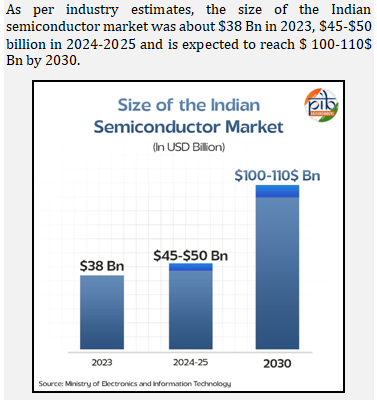
India’s Semiconductor Sector
- The 33(MeitY) is the nodal agency responsible for implementing India’s semiconductor and display ecosystem strategy. Its goals include:
- Building a vibrant semiconductor design and manufacturing ecosystem;
- Attracting global investments and partnerships;
- Supporting startups and innovators through fiscal incentives.
- India Semiconductor Mission (ISM): It is an Independent Business Division within Digital India Corporation. It has been working as nodal agency for the Schemes approved under SEMICON India Programme. Key schemes under ISM are:
- Semiconductor Fabs: Up to 50% of project cost;
- Display Fabs: Up to 50% of project cost;
- Compound Semiconductors & ATMP: 50% of capital expenditure;
- Design Linked Incentive (DLI): Support for 23 chip design startups and projects.
Recent Milestones
- SEMICON India Programme (2025): It was launched with an investment of ₹76,000 crore, implemented through the India Semiconductor Mission (ISM).
- Theme (2025): ‘Building the Next Semiconductor Powerhouse’.
- Over 350 global companies participated in it, showcasing India’s growing influence in the sector;
- The Union IT Minister presented the first ‘Made in India’ chip — developed by ISRO’s Vikram Sarabhai Space Centre (VSSC) and the Semiconductor Laboratory in Chandigarh.
- India launched its first Outsourced Semiconductor Assembly and Test (OSAT) pilot line in Sanand, Gujarat.
- Approval of four major semiconductor projects: SiCSem, CDIL, 3D Glass Solutions Inc., and ASIP.
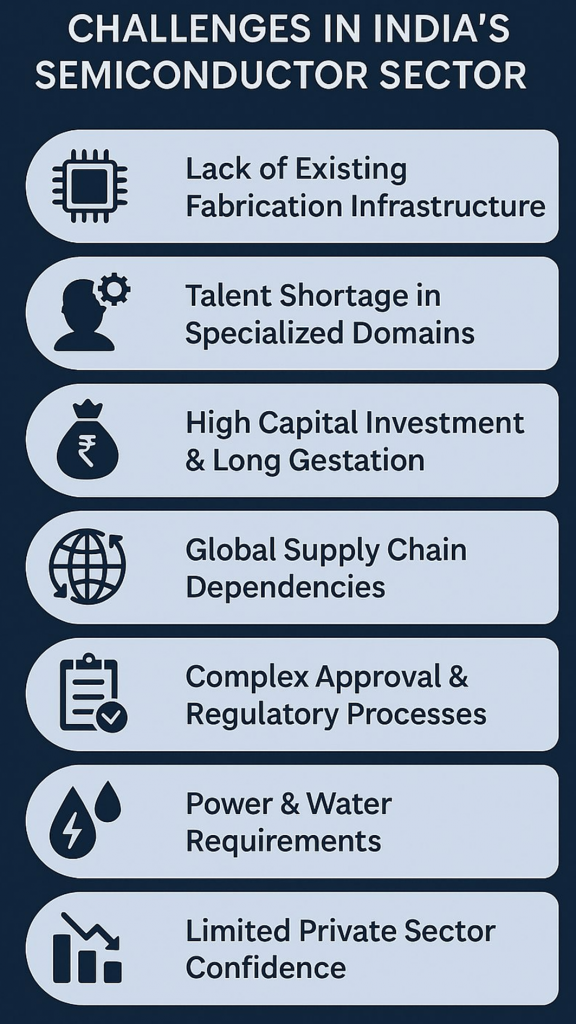
Fast-Tracking the India Semiconductor Mission (ISM)
- India approved five new semiconductor projects, bringing the total to ten, with a combined investment of $18 billion (₹1.5 lakh crore), in 2025 alone.
- India is working on the next phase of the India Semiconductor Mission to accelerate progress, which includes:
- Faster approvals through the National Single Window System, integrating both central and state-level clearances;
- A commitment to reduce the time from ‘file to factory’;
- Support for long-term investments rather than short-term incentives.
India as a player in the Semiconductor Market
- The global semiconductor market is expected to reach USD 1 Trillion by 2030.
- India has the capacity to emerge as a key contributor to the 3 primary pillars of the semiconductor manufacturing supply chain:
- Equipment: Leveraging strong base of MSMEs to produce components for semiconductor equipment;
- Materials: India is a rich source of chemicals, minerals and gases which can be utilized by semiconductor supply chain companies; and
- Services: R&D, Logistics and supply chain, major talent in AI, big data, cloud computing and IoT.
Previous article
News In Short – 2 September, 2025
Next article
WHO Released New Reports on Mental Health
