India- Fiji Islands Relation

india fiji islands relations

Syllabus: GS2/IR

Context

  • India and Fiji unveiled initiatives to bolster defence and maritime security cooperation, including the creation of a Defence Attache post at the High Commission of India in Suva, which will also cover the Pacific Islands.
    • There is a growing momentum in bilateral ties aimed at promoting peace, stability, and prosperity in the Indo-Pacific region.

India-Fiji Ties

  • Historical Relations: The India-Fiji relations began in 1879. Over the next four decades, approximately 60,553 Indians were brought to work on sugarcane plantations, laying the foundation for a vibrant Indian diaspora known as Girmitiyas.
  • FIPIC: In 2014, the Indian Prime Minister visited Fiji; this visit, coinciding with the inaugural Forum for India-Pacific Islands Cooperation (FIPIC) Summit, cemented India’s commitment to the Pacific region.
    • The Forum saw participation of 14 Pacific Island Countries.
  • Trade Relations: The bilateral trade stood at approximately US$68 million in 2024-2025, which includes US$65.05 million in exports to Fiji from India.
  • Developmental Partnership: The solarisation project at the State House, the cogeneration plant, and initiatives in healthcare and education reflect India’s commitment to Fiji’s sustainable development.
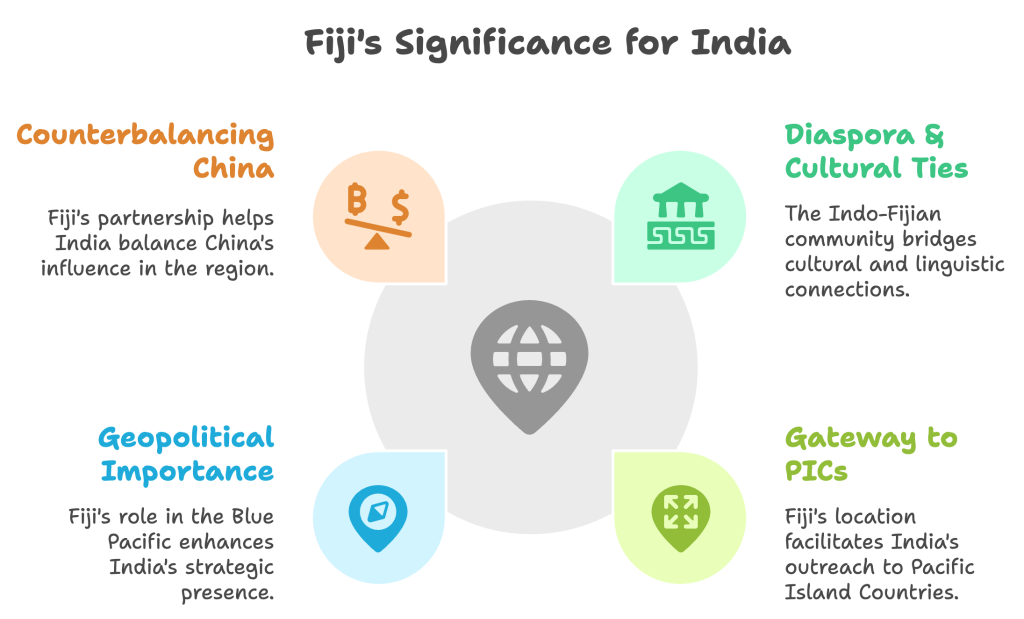
fiji significance for india
  • Diaspora: The Girmit Day commemorations in Fiji mark the arrival of the first Indian labourers.
    • The number of Indians living in Fiji is about 2300, mostly engaged in services like IT, management, finance, banking, education, medical, the hotel industry, etc.  
    • Hindi is one of the official languages of Fiji.
  • Multilateral Forums: Fiji has joined both the International Solar Alliance (ISA) and the Global Biofuel Alliance (GBA).
    • It collaborates with India at the UN, Commonwealth, and other multilateral fora on issues like climate change, sustainable development, and ocean governance.

About Fiji

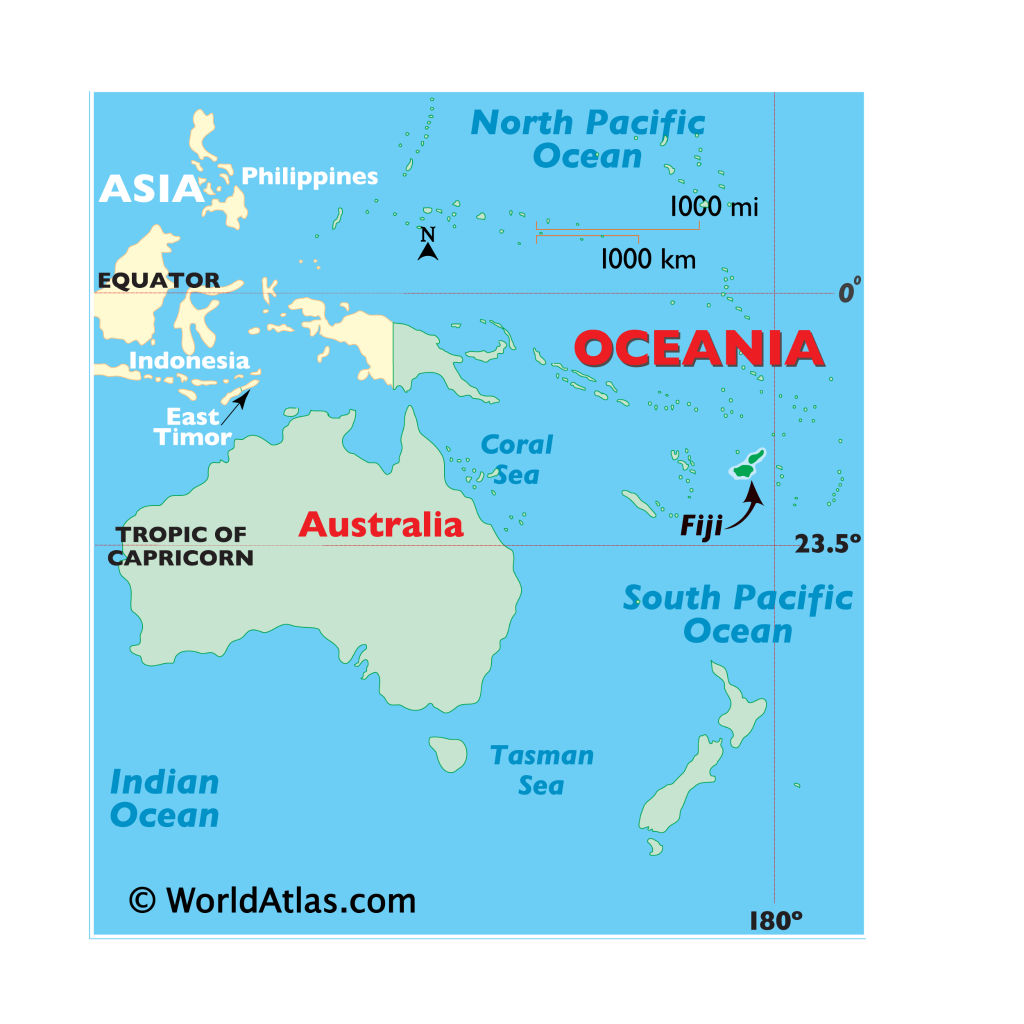
  • Location: Republic of Fiji is situated in the South Pacific Ocean, east of Australia and north of New Zealand.
  • Composition: About 330 islands and over 500 islets & reefs. Around 110 islands are inhabited.
  • Capital: Suva (on Viti Levu island).
  • Political Structure: Parliamentary democracy, member of the Commonwealth.
  • Major Islands: 
    • Viti Levu: Largest island, home to capital Suva and ~70% of population.
    • Vanua Levu: Second largest island.
about fiji

Source: PIB


Other News of the Day

Syllabus: GS2/ Polity In News The Supreme Court of India recently clarified that commercial and prohibited speeches do not enjoy protection under the Fundamental Right to Freedom of Speech and Expression (Article 19(1)(a)). The ruling reinforces the idea that Fundamental Rights are not absolute and are subject to reasonable restrictions. Constitutional Background– Article 19(1)(a): Guarantees...
Read More

Syllabus :GS1/Women Empowerment In News The Ministry of Labour and Employment has emphasized that Women’s employment rate in India has nearly doubled between 2017-18  to 2023-24. Recent Trend in Women’s Labour Participation As per the Periodic Labour Force Survey (PLFS) 2023-24 the women’s employment rate (WPR) has increased from 22% in 2017-18 to 40.3% in...
Read More

Syllabus: GS2/ Polity and Governance Context An analysis of MPs and MLAs across India shows that 31% of Members of Parliament (MPs) and 29% of Members of Legislative Assemblies (MLAs) have declared serious criminal charges against them. Criminalisation of politics Criminalisation of politics refers to the growing participation of individuals with criminal backgrounds in electoral...
Read More

Syllabus: GS1/Population Context The concept of being a ‘foreigner or videshi’ typically reserved for international migrants, is increasingly used by internal migrants in India to describe their experience of cultural displacement. Defining Diaspora The term ‘diaspora’ has become central in policy and academic discussions after the High-Level Committee on the Indian Diaspora published its report...
Read More

Syllabus: GS3/Economy Context There is a growing consensus that India must transition from being primarily a service-driven economy to a product nation amid US punitive tariff action. What is Product Nation? A “product nation” is a term often used to describe a country that moves beyond being primarily a service provider or outsourcing hub and...
Read More

Syllabus: GS3/ Environment and Climate Change Context A recent study highlights a global shift towards younger forests, disrupting the carbon balance as older, carbon-rich forests decline. Between 2010–2020, the area of forests aged 21–40 years increased by 17% (0.03 billion hectares), but this came at the cost of older forests. Importance of Forest Age Young...
Read More

Tawi River Syllabus: GS1/ Geography In News India recently warned Pakistan of a potential flood in the Tawi River as a humanitarian gesture. The communication was made through diplomatic channels, not via the Indus Waters Commission as required under the Indus Waters Treaty (IWT), 1960. About River Tawi Origin: Kailash Kund glacier (Kali Kund) near...
Read More
scroll to top