
Adi Karmayogi Abhiyan

Syllabus: GS2/ Government Policies & Interventions

In News

  • The Ministry of Tribal Affairs has launched the Adi Karmayogi Abhiyan, envisaged as the world’s largest tribal grassroots leadership programme.
    • It aligns with the Janjatiya Gaurav Varsh celebrations and contributes to the vision of Viksit Bharat @2047.

Core Philosophy

  • Guided by Sewa (Service), Sankalp (Resolve), Samarpan (Dedication).
  • Embodies the principle of “Sabka Saath, Sabka Vikas, Sabka Prayas, Sabka Vishwas.”

Key Components & Outcomes

  • Adi Sewa Kendra: Proposed in every tribal-dominated village, where government officials and villagers dedicate a few hours fortnightly as “Adi Sewa Samay.” These centres will address local problems, mentor youth, and support last-mile delivery of schemes.
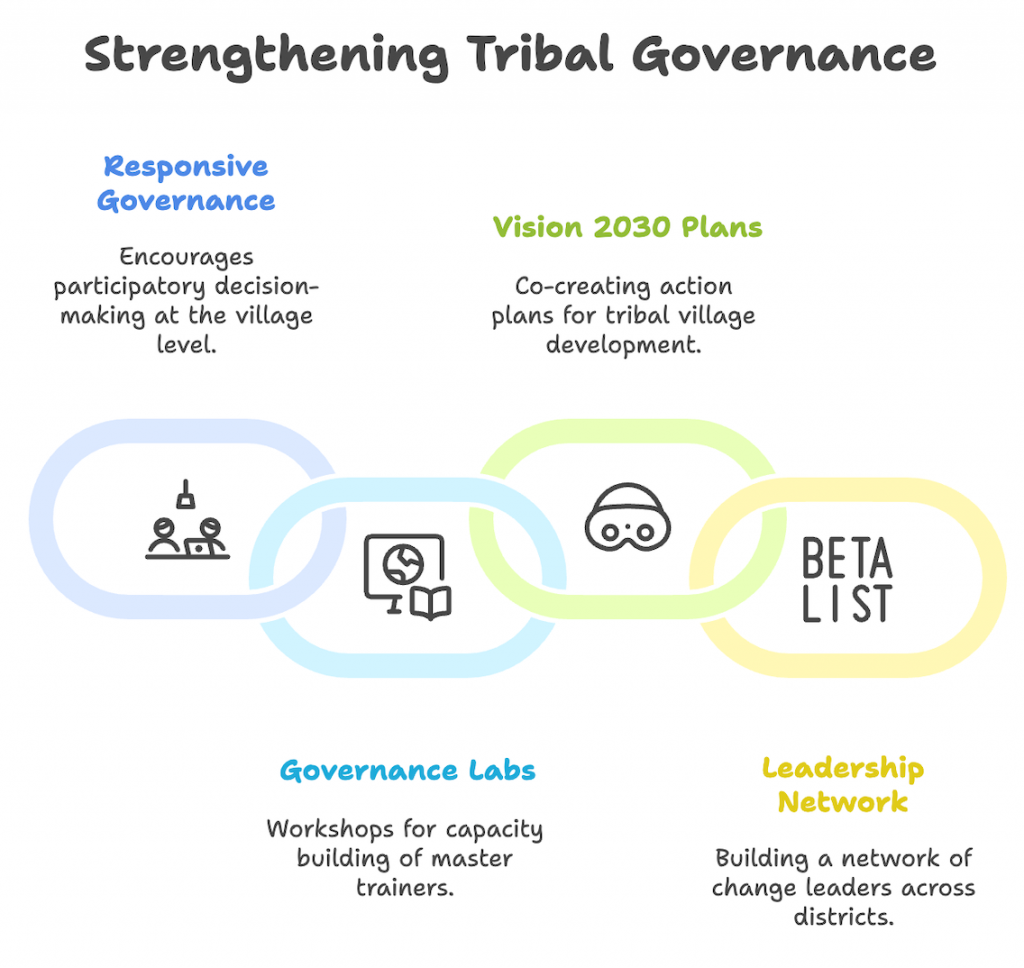
  • Governance Lab Workshops: Multi-departmental labs for collaborative problem-solving, ensuring convergence of welfare schemes.
  • Tribal Village Action Plan (Vision 2030): Co-created by officers and villagers, aligning with national goals and the Sustainable Development Goals (SDGs).
  • Role of Volunteers: Adi Sahyogi: Teachers, doctors, and professionals who mentor and mobilise communities.
    • Adi Saathi: SHGs, tribal elders, NRLM members, and local leaders aiding outreach and implementation.
strengthening-tribal-governance

Significance

  • Empowerment: Moves beyond welfare to leadership creation.
  • Trust Building: Bridges the gap between tribal communities and government institutions.
  • Conflict Mitigation: Reduces alienation and strengthens social harmony.
  • Sustainable Development: Ensures grassroots action is aligned with Agenda 2030 and India’s vision for 2047.

Source: PIB


Other News of the Day

Syllabus: GS2/ International Relations Context Recently India-China held the 24th round of India-China Special Representative talks. Key Outcomes of the Dialogue Trade and Connectivity:  Resumption of direct flights between India and China, facilitation of visas for tourists, businesses, media, and others. Re-opening of border trade through Lipulekh Pass, Shipki La Pass, and Nathu La Pass....
Read More

Syllabus :GS 3/Economy  In News In August 2025, U.S. President Donald Trump imposed a 50% tariff on imports from India, including a 25% penalty related to India’s oil purchases from Russia. India’s vulnerabilities in the global system. U.S. tariffs averaged 2–3% for two decades until April 2024 but  the new hike marks a sharp departure....
Read More

Syllabus: GS2/Government Policy & Intervention; GS3/Environment Context The Ministry of Finance released the Draft Framework of India’s Climate Finance Taxonomy which is aimed to create a unified classification system for climate-aligned investments, ensuring transparency, credibility, and alignment with national and global climate goals. What Is a Climate Taxonomy? A climate taxonomy is a classification system...
Read More

Syllabus: GS3/ Defence Context According to the Department of Defence Production, the private sector contributed ₹33,979 crore (22.56%) to India’s total defence production of ₹1,50,590 crore in FY 2024-25. This marks the highest-ever private participation since 2016-17, when the share was 19%. Defence Production in India Sectoral Contribution: In FY 2024-25, defence public sector undertakings...
Read More

Henry Derozio Effect Syllabus :GS1/History In News In her book, India’s First Radicals: Young Bengal and the British Empire, Rosinka Chaudhuri highlights Henry Derozio’s role in India’s independence movement. About In 1826, Henry Derozio, a 17-year-old Anglo-Portuguese poet, became a lecturer at Hindu College, Calcutta. He was Dismissed in April 1831 for “propagating atheism,” Derozio...
Read More
scroll to top