


Henry Derozio Effect
Syllabus :GS1/History
In News
- In her book, India’s First Radicals: Young Bengal and the British Empire, Rosinka Chaudhuri highlights Henry Derozio’s role in India’s independence movement.
About
- In 1826, Henry Derozio, a 17-year-old Anglo-Portuguese poet, became a lecturer at Hindu College, Calcutta.
- He was Dismissed in April 1831 for “propagating atheism,” Derozio died soon after, but his students continued his legacy.
Influence
- His English poetry, especially The Fakeer of Jungheera, expressed nationalist anguish and a call for freedom.
- He inspired students to form the Academic Association, promoting liberty, reason, and reformist debate.
- The Derozians evolved into Young Bengal, a radical group challenging religious and social orthodoxy.
- In 1843, they founded India’s first political party — Bengal British India Society — with egalitarian aims.
- Their vision contrasted with Macaulay’s anglicized elite; they were described by Alexander Duff as “a new race of men in the East.”
Legacy & Ideological Continuity
- Though short-lived, Young Bengal’s ideals — inclusivity, tolerance, intellectual openness — prefigured the visions of Gandhi and Nehru.
- Rosinka Chaudhuri frames their radicalism as foundational to India’s modern political and cultural identity.
Source :TH
Globally Important Agricultural Heritage Systems (GIAHS) in India
Syllabus :GS 3/Economy
In News
- As per the Food and Agriculture Organization (FAO), India is currently home to three Globally Important Agricultural Heritage Systems (GIAHS).
The Globally Important Agricultural Heritage Systems (GIAHS)
- They are dynamic, community-managed farming systems that integrate agrobiodiversity, traditional knowledge, and cultural heritage to ensure sustainable livelihoods and food security.
- They are recognised by the FAO, 99 such systems have been designated across 29 countries.
- Recently, a mountain agropastoral system in Tajikistan has become Central Asia’s first inclusion in the GIAHS.
- Additionally, a pine tree agroforestry system and a traditional bamboo-fishery system in South Korea, and an agrosilvopastoral system in Portugal have also been recognized.
India’s Globally Important Agricultural Heritage Systems (GIAHS)
- Koraput region, Odisha : It is known for highland subsistence paddy farming and rich diversity of indigenous rice varieties, along with medicinal plant resources linked to tribal knowledge systems.
- Kuttanad farming system, Kerala : It is a unique below-sea-level agriculture model combining paddy fields, coconut gardens, inland fisheries, and shell collection in a wetland ecosystem.
- Saffron Heritage of Kashmir : It features traditional saffron cultivation using intercropping and organic practices, supporting biodiversity and soil health.
Source :PIB
Parliament Passes Mines and Minerals Amendment Bill, 2025
Syllabus: GS2/ Polity and Governance
Context
- Parliament passed the Mines and Minerals (Development and Regulation) Amendment Bill, 2025, aimed at promoting sustainable mining, and advancing the objectives of the National Critical Mineral Mission.
- The bill will amend the Mines and Minerals (Development and Regulation) Act, 1957.
Key Provisions of the Bill
- The Bill provides that lease holders may apply to the state government for adding other minerals to an existing lease.
- For inclusion of critical and strategic minerals, and other specified minerals, no additional amount needs to be paid.
- These include minerals such as lithium, graphite, nickel, cobalt, gold, and silver.
- The Bill expands the scope of the National Mineral Exploration Trust, renaming it as the National Mineral Exploration and Development Trust.
- Captive mines are allowed to sell up to 50 per cent of minerals produced in a year, after meeting end-use requirements.
- The Bill removes the limit on sale of minerals and provides for establishing an authority to register and regulate mineral exchanges.
- The bill empowers the government to facilitate mineral trading through exchanges, allow the sale of mineral dumps to reduce environmental hazards, and promote extraction of deep-seated minerals.
Source: DD News
White-Collar and Blue-Collar Jobs in the Age of AI
Syllabus: GS3/ Economy, Skill Development
Context
- A recent report, The Work Ahead by job listing platform Indeed, highlights that both white-collar and blue-collar workers in India are increasingly embracing Artificial Intelligence (AI) to future-proof their careers.
White-Collar vs. Blue-Collar Jobs in the AI Era
- White-Collar Jobs: Traditionally involve cognitive and desk-based roles (finance, IT, legal, management).
- AI is reshaping these by automating repetitive tasks, enabling focus on higher-value work, and requiring reskilling in digital literacy, data analysis, and AI ethics.
- Blue-Collar Jobs: Traditionally involve manual and skilled labour (manufacturing, delivery, construction).
- With AI, tasks like predictive maintenance, safety monitoring, logistics optimization, and customer engagement are being digitized, requiring basic digital and AI familiarity.
Source: TH
AI Designs Antibiotics
Syllabus: GS3/ Science and Technology
Context
- Researchers at the Massachusetts Institute of Technology (MIT) have developed two new potential antibiotics using generative artificial intelligence (AI) to combat drug-resistant Neisseria gonorrhoeae and methicillin-resistant Staphylococcus aureus (MRSA).
- Gonorrhea is a sexually transmitted infection (STI) caused by the bacterium Neisseria gonorrhoeae.
About
- Antibiotics are antimicrobial agents that target specific bacterial processes, disrupting their growth or killing them.
- Alexander Fleming’s discovery of penicillin in 1928, from the fungus Penicillium notatum, led to the first modern antibiotic.
- Superbugs, also known as multidrug-resistant microbes, are infectious organisms, primarily bacteria, that have developed resistance to multiple types of antibiotics and other antimicrobial drugs, making them difficult to treat.
Source: BBC
Quantum Mechanics and General Relativity
Syllabus :GS3/Science and Technology
In News
- A new study proposes a groundbreaking experiment to explore the intersection of quantum mechanics and general relativity.
Quantum Mechanics
- It describes the behavior of matter and energy at atomic and subatomic scales.
- It reveals wave-particle duality, where particles like electrons exhibit both wave-like and particle-like properties.
- Key concepts include superposition, entanglement, and quantization of energy.
- Technologies like atomic clocks, quantum sensors, and quantum networks rely on these principles.
General Relativity
- It was proposed by Einstein in 1915, general relativity redefined gravity as the curvature of spacetime caused by mass.
- It is validated by phenomena like gravitational lensing, black holes, and time dilation.
- It’s a continuous theory, describing large-scale structures like planets and galaxies.
Recent Research
- A new study proposes using entangled atomic clocks at different elevations to test how quantum systems behave in curved spacetime.
- By leveraging robust W-state entanglement and precision timekeeping with ytterbium atoms, the setup aims to detect minute frequency shifts caused by gravitational time dilation, offering a direct test of quantum coherence under relativistic conditions.
Importance
- The recent experiment could validate core quantum principles like unitarity and linearity in curved spacetime, and potentially reveal new physics.
- It marks a major step toward bridging quantum mechanics and general relativity using existing technologies.
Source :TH
Palmyra Palm Trees
Syllabus: GS3/ Environment
In News
- Odisha ranks among the top states in lightning-related deaths (as per IMD & NCRB data).
- Planting of Palmyra palm trees is being promoted as a natural safeguard to lightning strikes.
About Palmyra Palm (Borassus flabellifer)
- Origin & Status: Tropical regions of South and Southeast Asia.
- Declared the State Tree of Tamil Nadu.
- Geographical Requirements:
- Highly adaptable soil, grows in sandy, red, black, alluvial, arid, and even wasteland soils.
- Well-suited to semi-arid regions with less than 750 mm of annual rainfall.
- Can live up to 100 years or more.
- Utility:
- Fruits are edible (toddy, palm sugar, jaggery, palm fruit jelly).
- Leaves used for thatching, mats, writing material in ancient times.
- Deep roots prevent soil erosion.
- Helps in groundwater recharge.
- Provides fodder and shade in arid regions.
Source: DTE
Saltwater Crocodiles in Sundarbans
Syllabus: GS3/ Environment
Context
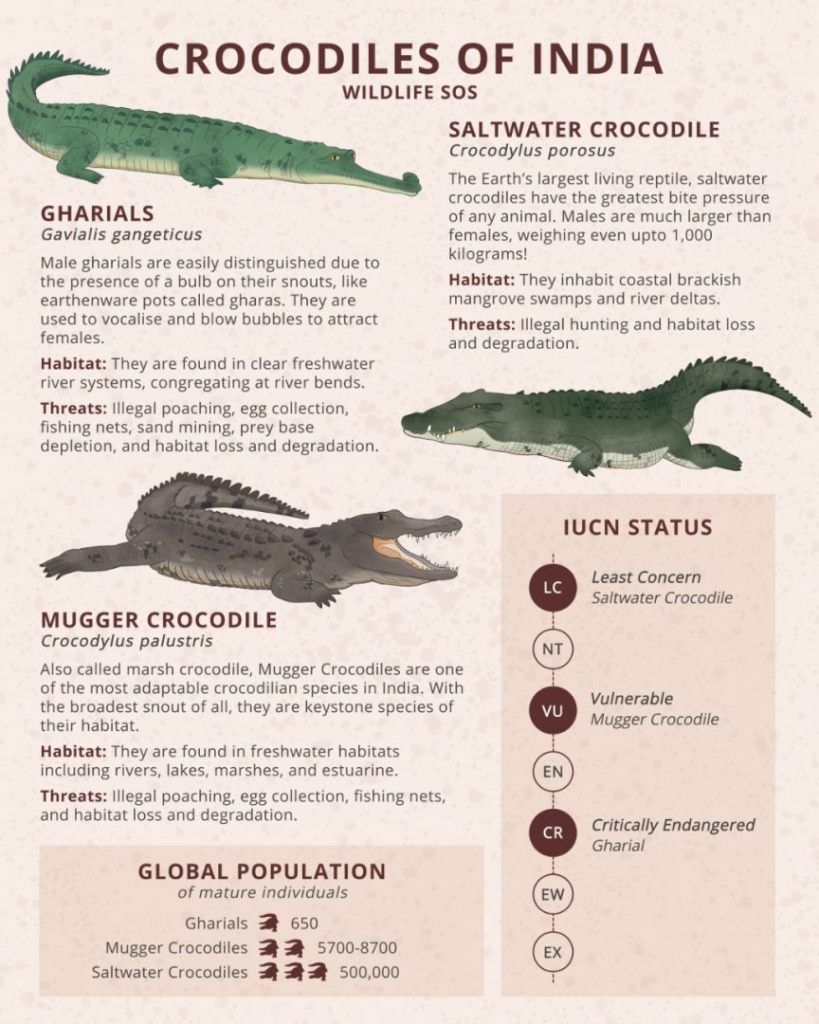
- A recent report titled “Population Assessment and Habitat Ecology Study of Saltwater Crocodiles in Sundarbans 2025” highlights an increase in the population of saltwater crocodiles in the Sundarban Biosphere Reserve (SBR).
Estuarine or Saltwater crocodile (Crocodylus Porosus)
- In India, saltwater crocodiles are distributed across the swamplands, rivers, mangroves of Odisha and West Bengal and the coastal areas of the Andaman and Nicobar Islands.
- They are the largest living reptile on earth.
- Ecological Significance: It maintains ecological balance as a hypercarnivorous species and keeps flowing water clean by feeding on carcasses and wild remains.
- Conservation status:
- IUCN Status: Least Concern
- It is listed under Schedule 1 of the Wild Life (Protection) Act, 1972.
Crocodiles Species in India
- India is home to three main kinds of crocodile species – the gharial (gavialis gangeticus), the saltwater crocodile (crocodylus porosus), and the mugger (crocodylus palustris).
- Odisha is uniquely positioned by hosting wild populations of all three crocodile species.
| Sundarban Biosphere Reserve (SBR) – Sunderban is the largest delta (Ganges–Brahmaputra–Meghna delta) and mangrove forest in the world. – Location: The Sundarbans Biosphere Reserve or Indian Sundarbans is situated in West Bengal and covers an area of 9,630 square kilometers. 1. The region is situated south of the Tropic of Cancer. – River system: It is bounded on the west by river Muriganga and on the east by rivers Harinbhahga and Raimangal. 1. Other major rivers flowing through this eco-system are Saptamukhi, Thakuran, Matla and Goasaba. – Ecological Significance: It is home to 34 mangrove species, including true mangroves like Heritiera fomes and Excoecaria agallocha. 1. Fauna: Royal Bengal Tiger, Fishing Cat, Olive Ridley Turtles, Irrawaddy Dolphins etc. 2. Ecosystem Services: Carbon sink, storm surge buffer, nursery for fisheries. Recognitions of Sundarban Biosphere Reserve (SBR) – The core area (Sunderban National Park) was designated as a World Heritage site in 1987. – It was declared a UNESCO Biosphere Reserve in 1989. – The Sundarban Wetland was designated as a Ramsar site in 2019. |
Source: TH
Revival of Corals in the Gulf of Mannar
Syllabus: GS1/Geography; GS3/Environment
Context
- Coral reefs in the Gulf of Mannar, located off the coast of Tamil Nadu, have undergone a significant revival due to over two decades of dedicated scientific restoration efforts.
About
- Corals are invertebrates that belong to a large group of animals called Cnidaria.
- Corals are formed by multiple small, soft organisms known as polyps.
- They secrete a rocky chalk-like (calcium carbonate) exoskeleton around themselves for protection.
- Coral reefs are therefore created by millions of tiny polyps forming large carbonate structures.
- Appearance: Corals range in colour from red to purple and even blue, but are most commonly shades of brown and green.
- Coral reefs in India: Gulf of Kutch, Gulf of Mannar, Andaman & Nicobar, Lakshadweep Island and Malvan.
About the Gulf of Mannar
- It is one of India’s coral-rich regions, covering about 100 sq.km, with high species diversity of reef-building corals (117 species reported).
- It is a large shallow bay in the Laccadive Sea, lying between the southeastern tip of India and western Sri Lanka.
- It is bounded by Rameswaram (island), Adam’s (Rama’s) Bridge (a chain of shoals), and Mannar Island; approximately 130–275 km wide and 160 km long.
Source: TH
Palm Civet
Syllabus: GS3/Species in News
Context
- Civet problem forces Kerala High Court to adjourn for the day.
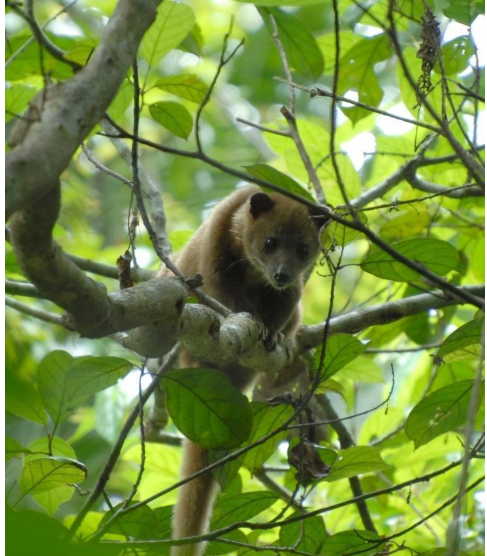
About Palm Civet (Paradoxurus hermaphroditus)
- Common names: Asian palm civet, common palm civet, and toddy cat.
- Appearance: Often mistaken for a cat; known for its pungent urine, making its presence noticeable in enclosed spaces.
- Ecological role: Important for forest ecosystems as a seed disperser, supporting biodiversity.
- Diet: It is an omnivore and feeds mostly on fruits and berries and occasionally small mammals and insects.
- Habitat and Activity: It is widely found in south and southeast Asia, and is known to be most active between night and dawn.
- Threats: Deforestation, land conversion for agriculture, and wildlife trafficking.
- Conservation status: Least Concern (IUCN).
Do you know?
- Kopi luwak (civet coffee) is made from coffee cherries partially digested and excreted by the Asian palm civet.
- The digestion process reduces acidity in the beans, giving the coffee a unique flavor.
Source: TH
Previous article
Increase of Private Sector Share in India’s Defence Production
Next article
The Constitution (130th Amendment) Bill, 2025
