


Syllabus: GS3/Science & Technology
Context
- Recently, two Indian aquanauts successfully conducted deep-sea dives in the Atlantic Ocean, part of Samudrayaan Project, under the Deep Ocean Mission.
- Over 100 kg of cobalt-rich polymetallic nodules were collected from 1,173 meters depth in the Andaman Sea.
About the Deep Ocean Mission
- It was launched by the Ministry of Earth Sciences (MoES) with an investment of ₹4,077 crore over five years on September 7, 2021.
- It aims to develop technologies for exploring and sustainably utilizing deep ocean resources, and to support India’s Blue Economy and scientific leadership.
- Blue Economy is a core growth dimension, with potential to push India’s maritime economy beyond ₹100 billion.
- It is being implemented in phases and aligns with the UN Decade of Ocean Science for Sustainable Development (2021–2030).
Key Components of the Mission
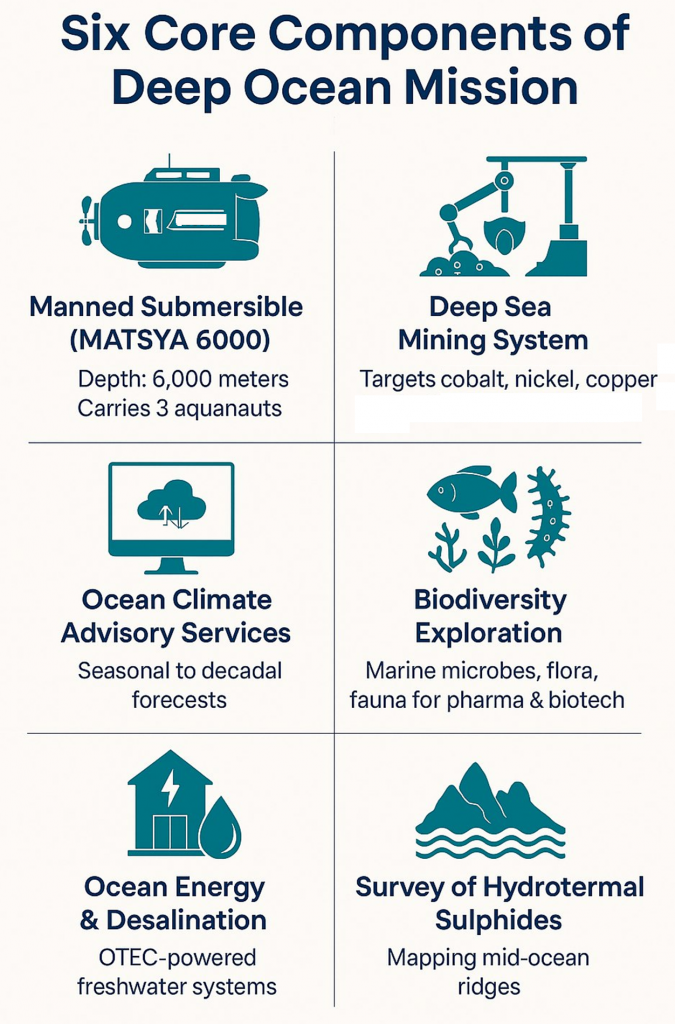
- Samudrayaan Project (Deep-Sea Mining & Manned Submersible): Development of a manned submersible to carry three people up to 6,000 metres depth.
- Creation of an Integrated Mining System for extracting polymetallic nodules in the Central Indian Ocean.
- Ocean Climate Change Advisory Services: Building observations and model suites to forecast climate variables from seasonal to decadal scales.
- Supports better planning for coastal communities and tourism.
- Biodiversity Exploration & Conservation: Bio-prospecting of deep-sea flora, fauna, and microbes.
- Promotes sustainable use of marine biological resources for fisheries and allied sectors.
- Deep Ocean Survey & Exploration: Identification of multi-metal hydrothermal sulphide sites along the mid-ocean ridges.
- Expands India’s access to deep-sea mineral reserves.
- Energy and Freshwater from the Ocean: Proof-of-concept for Ocean Thermal Energy Conversion (OTEC) powered desalination plants.
- Advances offshore renewable energy and water security.
- Advanced Marine Station for Ocean Biology: Establishment of a research hub for ocean biology and engineering.
- Facilitates innovation, incubation, and industrial applications of marine science.
Strategic Importance
- India’s unique maritime geography — with 11,098.81 km of coastline, nine coastal states, and 1,382 islands — makes it a natural leader in ocean science. The mission supports:
- Fisheries and aquaculture;
- Marine biotechnology;
- Coastal tourism;
- Energy security
- Prime Minister, in his recent Independence Day address, emphasized India’s push toward a ‘Samudra Manthan’ — a mission-mode effort to explore oil and gas reserves beneath the ocean floor.
- The Deep Ocean Mission is now being expanded into a National Deep Water Exploration Mission.
Previous article
Soaps and Detergents
Next article
News In Short 19-August-2025
