

Syllabus: GS3/Economic Development
Context
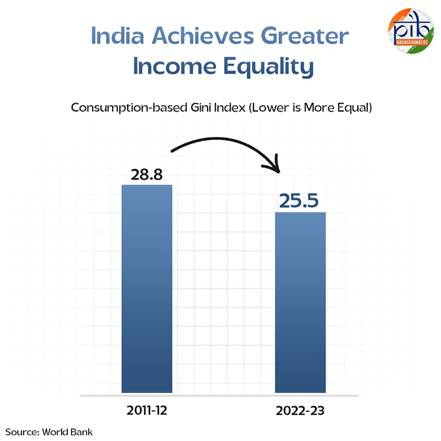
- According to the World Bank, India’s Gini Index stands at 25.5, making it the fourth most equal country in the world.
Major Highlights
- India was placed after the Slovak Republic, Slovenia and Belarus.
- India’s score is much lower than China’s 35.7 and far lower than the United States, which stands at 41.8.
- India falls into the “moderately low” inequality category, which includes Gini scores between 25 and 30.
- India has a better score than all of the other 167 countries for which the World Bank has released data.
- Poverty Reduction: Extreme poverty dropped to 2.3% in 2022-23.
- 171 million Indians moved out of extreme poverty between 2011–23.
Gini Index
- The Gini Index shows how equally income, wealth or consumption is distributed across households or individuals in a country.
- It ranges in value from 0 to 100. A score of 0 means perfect equality and a score of 100 means absolute inequality.
- The higher the Gini Index the more unequal the country.
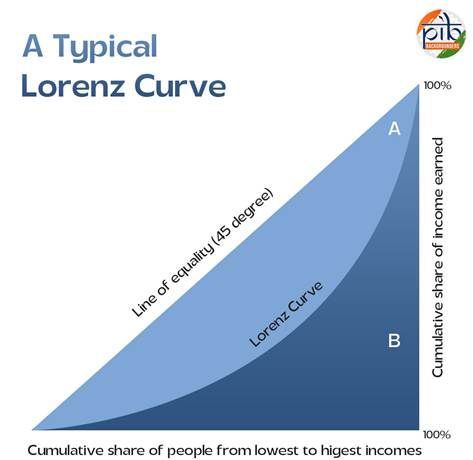
- Lorenz Curve: Graphically Gini Index can be explained by the Lorenz curve.
- A Lorenz curve plots the cumulative percentages of total income received against the cumulative number of recipients, starting with the poorest individual or household.
- A perfectly equal distribution will be shown by a diagonal line, while the actual distribution will be shown by the Lorenz curve.
- The Gini index measures the area between the Lorenz curve and a hypothetical line of absolute equality.
- The bigger the gap, the more unequal the income.
Key Government Initiatives
- PM Jan Dhan Yojana: In 2025 over 55.69 crore people will hold Jan Dhan accounts, giving them direct access to government benefits and formal banking services.
- Aadhaar and Digital Identity: This system forms the backbone of welfare delivery by ensuring that benefits reach the right person at the right time through reliable authentication.
- Direct Benefit Transfer (DBT): The DBT system has streamlined welfare payments, reducing leakages and delays.
- Ayushman Bharat: The scheme provides health coverage of up to ₹5 lakh per family per year.
- The government launched the Ayushman Vay Vandana scheme to extend this coverage to all citizens aged 70 and above, regardless of income.
- The Ayushman Bharat Digital Mission has further strengthened this effort, with over 79 crore health accounts created to link individuals to digital health services.
- Stand-Up India: To promote inclusive entrepreneurship, the Stand-Up India scheme provides loans between ₹10 lakh and ₹1 crore to SC/ST and women entrepreneurs for setting up greenfield enterprises.
- This initiative empowers individuals from disadvantaged communities to participate in economic growth on their own terms.
- Pradhan Mantri Garib Kalyan Anna Yojana (PMGKAY): Launched during the COVID-19 pandemic, PMGKAY has continued to serve the most vulnerable sections of society.
- PM Vishwakarma Yojana: Traditional artisans and craftspeople are vital to India’s economic and cultural fabric, the scheme supports them with collateral-free loans, toolkits, digital training, and marketing support.
Conclusion
- India’s path to income equality has been steady and focused. The Gini Index of 25.5 reflects real change in people’s lives.
- As the world looks for models that combine growth with fairness, India’s example stands out.
- Its experience shows that equality and development are not separate goals.
Source: AIR
Previous article
17th BRICS Summit in Brazil
Next article
Cooperatives: The Economic Backbone of India
