
10 Years of the Digital India Journey

Syllabus: GS3/Infrastructure

Context

  • The Digital India program was launched by the Government on July 1, 2015, envisions transforming India into a knowledge-based economy and digitally empowered society.

Digital Economy

  • The digital economy is growing fast, contributing 11.74% to the national income in 2022–23 and expected to reach 13.42% by 2024–25. 
  • According to the State of India’s Digital Economy Report 2024, released by ICRIER, India now ranks third in the world for digitalisation of the economy. 
  • By 2030, India’s digital economy is projected to contribute nearly one-fifth of the country’s overall economy, outpacing the growth of traditional sectors.
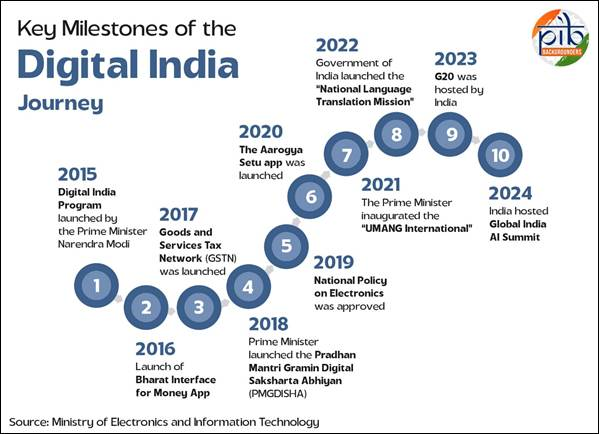
10 years of the digital india journey

Key Focus Areas and Services Under Digital India

  • Connectivity and Infrastructure: Over the years, Digital India has built strong digital infrastructure across the country. Mobile connectivity has expanded to almost every village. 
  • Telecom and Internet Penetration: Total telephone connections in India rose from 93.3 crore in 2014 to over 120 crores in 2025, with tele-density increasing from 75.23% to 84.49% by 2024.
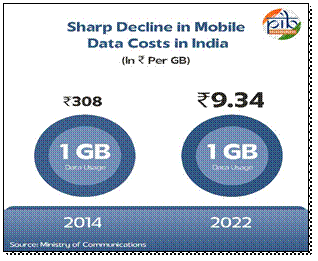
sharp decline in mobile data costs in india
  • UPI: According to the ACI Worldwide Report 2024, India handled 49% of global real-time transactions in 2023. UPI now lives in over seven countries, boosting global digital payments and financial inclusion.
  • Aadhaar: The Aadhaar-based e-KYC system has helped simplify processes in both banking and public services. It made verification faster, reduced paperwork, and brought transparency across sectors.
  • Direct Benefits Transfer (DBT): DBT uses Aadhaar to deliver welfare payments directly and remove fake beneficiaries.
  • Open Network for Digital Commerce (ONDC): Launched in 2022, ONDC helps small businesses enter digital markets. By 2025, it covers 616+ cities and has registered more than 7.64 lakh sellers and service providers.
  • IndiaAI Mission: It focuses on enabling access to computing, supporting innovation, improving datasets, funding startups, and ensuring ethical AI use.
    • By May 2025, India’s national computer power crossed 34,000 GPUs, marking a major milestone in AI infrastructure growth.
  • India Semiconductor Mission: With a ₹76,000 crore outlay, the mission supports local chip and display manufacturing. It offers up to 50% support for fabs and incentives for chip design and production.
  • E-Governance: E-Governance in India has revolutionized the way citizens interact with the government by making services more accessible, transparent, and efficient.

Source: TH


Other News of the Day

Syllabus: GS 2/Governance In News The Union Cabinet chaired by the Prime Minister Narendra Modi approved the National Sports Policy (NSP) 2025. Historical Linkages: Timeline Sports in India have ancient roots, originating from survival skills like archery and wrestling that evolved into modern sports.  After independence in 1947, sports received limited focus due to national...
Read More

Syllabus: GS3/ Economy In Context India has completed eight years since the implementation of the Goods and Services Tax (GST) on July 1, 2017, a significant reform aimed at creating a “One Nation, One Tax” regime. Key Aspects of GST Destination-Based Indirect Tax: GST is a destination-based tax, meaning the tax revenue accrues to the...
Read More

Syllabus: GS3/Economy Context The fourth International Conference on Financing for Development (FfD4) is being held in Spain which brings focus on the massive debt burden on developing countries. Public Debt or Sovereign debt is the money borrowed by a national government from either domestic or international sources, usually through the issuance of government bonds or...
Read More

Syllabus: GS3/Science and Technology Context The Union Cabinet has approved the Research Development and Innovation (RDI) Scheme with a corpus of Rs. One lakh Crore. Research Development and Innovation (RDI) Scheme Key Objectives: Promote private sector investment in RDI, especially in areas of economic security and strategic relevance; Support transformative projects at higher Technology Readiness...
Read More

Syllabus: GS3/ Environment In News The Convention on International Trade in Endangered Species of Wild Fauna and Flora (CITES) marks 50 years since it entered into force.  About Genesis: CITES (the Convention on International Trade in Endangered Species of Wild Fauna and Flora) is a pioneering global agreement originally conceived in 1963 at a meeting...
Read More

Syllabus: GS2/ Governance, GS3/ Environment Context The Union Ministry of Environment, Forest and Climate Change has issued the ‘Model Rules for Felling of Trees in Agricultural Lands’, with the objective of supporting States and Union Territories in simplifying regulatory frameworks and promoting agroforestry. What is Agroforestry? Agroforestry is a combination of practising agriculture and forestry...
Read More

Munnar as ‘Responsible Tourism Destination’ Syllabus: GS1/Places In News The Kerala government is working to transform Munnar into a Responsible Tourism Destination, aiming to make it a net-zero tourist hub that protects its fragile ecosystem.  Munnar It is a serene hill station in Kerala’s Idukki district and sits 1,600 meters above sea level at the...
Read More
scroll to top