

ASI to Host International Conclave to Decode Indus Valley script
Syllabus: GS1/Ancient History
Context
- The Archaeological Survey of India (ASI) will host a three-day international brainstorming conference in August on ways to decipher the Indus Valley script.
About
- The Indus Valley Civilisation was discovered more than a 100 years ago in 1921 at Harappa, and was formally announced to the world in 1924 by John Marshall, the then Director-General of the ASI.
Indus Script
- The first official report on excavations at Mohenjo-daro, in 1931 had a section on the ‘Indus Script’.
- This script has attracted and fascinated a number of archaeologists, epigraphists, scientists, and many others who have made sincere attempts to solve its riddles.
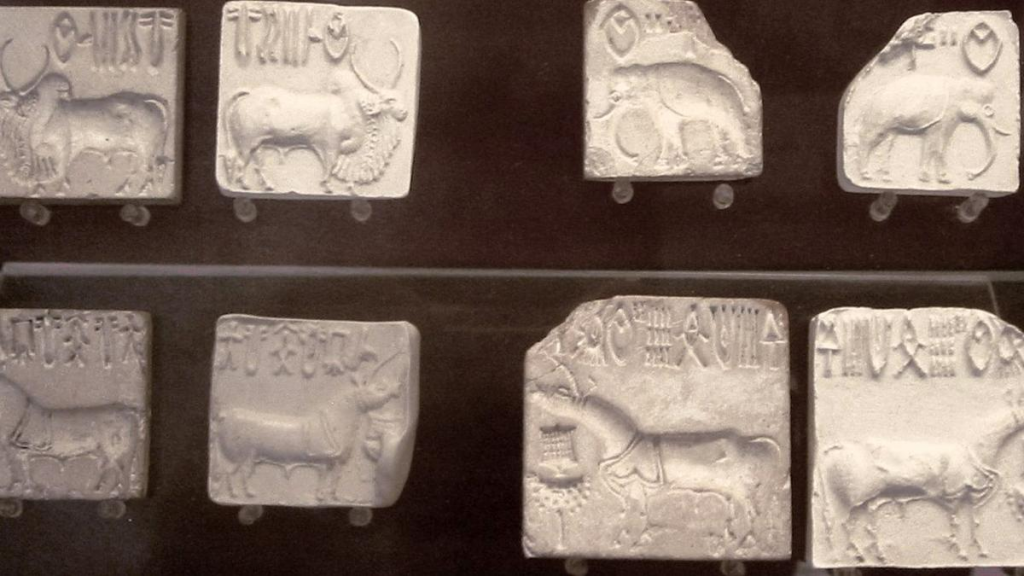
- Where is it preserved? Most examples of this script have been found on Harappan seals and their impressions.
- Other objects that preserved this script are metal and terracotta tablets, copper objects, pottery, etc.
- Nature of the Script: Consists of signs and symbols, many resembling human and animal figures, plants, or tools.
- Most inscriptions are very short—typically 4–5 signs long; the longest is about 26 characters.
Attempts at Decipherment
- Various methods using computer analysis, comparative linguistics, and frequency analysis have been attempted.
- Due to the lack of a bilingual inscription (like the Rosetta Stone), decipherment is extremely difficult.
- So far Archaeologists haven’t been able to find any bilingual records running into at least a couple of sentences.
- Hence they refrain from making any claims on deciphering the script.
| Archaeological Survey of India (ASI) – ASI is the premier organization for the archaeological research and protection of the cultural heritage of the nation under the Ministry of Culture. – Maintenance of ancient monuments and archaeological sites and remains of national importance is the prime concern of the ASI. – It regulates all archaeological activities in the country as per the provisions of the Ancient Monuments and Archaeological Sites and Remains Act, 1958. It also regulates the Antiquities and Art Treasure Act, 1972. |
Source: TH
Seine River
Syllabus: GS1/ Geography
Context
- Paris is leveraging an underground cooling system that uses water from the Seine River to cool over 800 buildings.
About
- Origin: The Seine River originates from the Langres Plateau in northeastern France.
- Length: Approximately 777 kilometers long.
- Major Tributaries: Aube, Marne, Yonne, Oise, and Eure rivers.
- Navigability: The river is navigable for about 560 kilometers, supporting both commercial and recreational transport.
- The Banks of the Seine in Paris were inscribed as a UNESCO World Heritage Site in 1991 .
Source: TH
National Internet Exchange of India (NIXI)
Syllabus: GS2/ Governance
In News
- The National Internet Exchange of India (NIXI) recently turned 20.
About
- NIXI is a not-for-profit organisation set up in 2003 under the Ministry of Electronics and Information Technology (MeitY).
- NIXI has played a key role in ensuring that India’s internet remains local in routing, robust in performance, and ready for future demands.
- It currently operates 77 Internet Exchange Points (IXPs) across the country, which help domestic traffic stay within India’s borders — reducing latency, increasing speed, and enhancing security.
- Through its IRINN division, it is guiding India’s transition to IPv6, which will be essential as the country moves deeper into the era of connected devices, AI, and quantum computing.
Role & Significance
- Acts as the silent pillar behind India’s booming digital economy — from UPI at kirana stores to digital classrooms in tribal belts.
- Strengthens India’s ambition of becoming a $5 trillion digital economy.
- Aligns with goals like Digital India, Bhashini, and localised internet ecosystems.
Source: DD News
Shanghai Cooperation Organisation
Syllabus: GS2/Regional Groupings
Context
- Defence Minister Rajnath Singh will travel to China to attend the Shanghai Cooperation Organisation Defence Ministers’ meet.
Shanghai Cooperation Organisation (SCO)
- Shanghai Five emerged in 1996 from a series of border demarcation and demilitarization talks between 4 former USSR republics and China.
- Kazakhstan, China, Kyrgyzstan, Russia and Tajikistan were members of the Shanghai Five.
- With the accession of Uzbekistan to the group in 2001, the Shanghai Five was renamed the SCO.
- Objective: To enhance regional cooperation for efforts to curb terrorism, separatism, and extremism in the Central Asian region.
- Members: China, Russia, India (2017), Pakistan, Iran, Belarus and the four Central Asian countries of Kazakhstan, Kyrgyzstan, Tajikistan, Uzbekistan.
- Observer status: Afghanistan and Mongolia.
- Language: The SCO’s official languages are Russian and Chinese.
- Structure: The supreme decision-making body of the SCO is the Council of Heads of States (CHS) which meets once a year.
- The Organization has 2 standing bodies — the Secretariat in Beijing and the Executive Committee of the Regional Anti-Terrorist Structure (RATS) in Tashkent.
Source: TH
WHA’s Landmark Resolution on Skin Diseases
Syllabus: GS2/Health
In News
- The World Health Assembly has unanimously adopted a resolution declaring skin diseases a global public health priority.
Skin diseases resolution
- Skin diseases include all conditions that irritate, clog or damage your skin, as well as skin cancer.
- They are among the most visible health conditions, often leading to stigma, discrimination, and emotional distress.
- They affect 1.9 billion people worldwide, especially in low- and middle-income countries (LMICs).
- They are now recognised for their deep social, psychological, and economic impacts.
Features of resolution
- It is jointly sponsored by Côte d’Ivoire, Nigeria, Togo, and Micronesia, and others, supported by the International League of Dermatologic Societies (ILDS), the world’s largest alliance of dermatology organizations marks a pivotal moment in recognising skin diseases as a global public health priority.
- It calls attention to low awareness, poor surveillance, and limited health worker training, despite most skin diseases being manageable at the primary care level with proper support.
- It seeks to integrate skin health into national health agendas, improve funding, strengthen frontline dermatologic care, and combat stigma.
- It urges coordinated national action to improve financing, diagnostics, medicine access, integration with other health programmes, and research.
Source: TH
Reverse Flipping
Syllabus: GS3/Economy
Context
- The Securities and Exchange Board of India (SEBI) has approved a series of reforms aimed at improving the ease of doing business and reverse Flipping Support.
What is Reverse Flipping?
- Reverse Flipping is a term used in the startup ecosystem and corporate structuring to describe the process where an Indian startup or company moves their domicile back to India—essentially “flipping” in reverse.
- How does it work?
- The parent company abroad transfers ownership, assets, or control to an Indian entity.
- The Indian subsidiary (which was earlier just an operational arm) became the main holding company.
- This may involve shifting intellectual property (IP), data, and key functions to India.
Why Do Startups Flip in the First Place?
- Initially, many Indian startups “flip” to foreign jurisdictions because:
- Easier access to global venture capital.
- Simplified regulations around stock options, fundraising, or acquisitions.
- Favorable tax regimes.
- Ease of listing on foreign stock exchanges.
Significance of Reverse Flipping?
- Reflects confidence in India’s economic and regulatory ecosystem.
- Tied to broader goals like Atmanirbhar Bharat, ease of doing business, and capital market reforms.
- Important for innovation, job creation, and domestic capital mobilisation.
Source: BS
Energy Transition Index (ETI)
Syllabus: GS3/ Environment
In News
- India ranked 71 on the World Economic Forum (WEF)’s Energy Transition Index (ETI) 2025, dropped from rank 63 in 2024.
Key Findings
- Sweden, ranked first in the Index followed by Finland, Denmark and Norway.
- China topped the “Emerging Asia” category.
About ETI
- The ETI is a tool developed by the WEF, an international non-profit for public-private cooperation set up in 1971 to quantify the yearly progress of nations in energy transition.
- The energy transition means moving from high carbon-emitting fuels such as coal to what are generally considered cleaner and renewable fuels such as solar power.
- It is based on 43 indicators from various global data sources.
Source: DTE
Extreme Helium (EHe) Stars
Syllabus: GS3/ Space
In News
- Indian astronomers have discovered singly-ionized germanium (Ge II) in a rare class of stars known as Extreme Helium (EHe) stars, specifically in the star A980.
What are Extreme Helium (EHe) Stars?
- EHe stars are rare hydrogen-deficient stars that are primarily composed of helium with trace amounts of other elements.
- Only a few dozen such stars have been discovered.
- The most accepted formation theory suggests they result from the merger of two white dwarfs:
- One helium-rich, the other carbon-oxygen-rich.
- EHe stars are cool, low-gravity objects that defy normal stellar chemical profiles.
Significance of Germanium Detection
- Germanium is a heavy element that forms via the s-process (slow neutron capture) — common in the Asymptotic Giant Branch (AGB) phase of stellar evolution.
- The presence of Ge implies prior synthesis through stellar nucleosynthesis, possibly before the white dwarf merger.
Source: PIB
Operation Sindhu
Syllabus: GS2/ IR and Miscellaneous
Context
- India has launched Operation Sindhu to evacuate its nationals from both Iran and Israel, amid the escalating conflict between the two countries.
About the Operation
- It is launched by the Ministry of External Affairs (MEA), Govt. of India.
- They were evacuated from northern Iran to Armenia, and flown from Yerevan (Armenian capital) to New Delhi on a special flight.
- India is utilising safe and open airspace corridors for evacuation flights, with logistical coordination through diplomatic channels in the region.
- In a planned expansion of the operation, Indians in Israel will be evacuated via land borders, followed by onward air travel from neighbouring countries, given the suspension of flight operations at Israeli airports.
Other India’s Civilian Evacuations Missions
| Mission Name | Context | Year |
|---|---|---|
| Vande Bharat Mission | COVID-19 global repatriation | 2020 |
| Operation Devi Shakti | Afghanistan regime fall | 2021 |
| Operation Ganga | Russia-Ukraine conflict | 2022 |
| Operation Kaveri | Sudan civil war | 2023 |
| Operation Ajay | Israel-Hamas conflict | 2023 |
| Operation Sindhu | Iran conflict escalation | 2025 |
Source: AIR
Previous article
Rethinking Alcohol Control in India
Next article
Nuclear Non-Proliferation Treaty (NPT)
