


Syllabus :GS 3/Science and Tech
In Context
- DNA has been instrumental in solving cold cases by analyzing profiles from archived crime scene materials.
Deoxyribonucleic acid (DNA)
- It is the hereditary material in humans and most organisms, with nearly every cell containing the same DNA.
- It is primarily found in the cell nucleus as nuclear DNA, though a small amount exists in mitochondria as mitochondrial DNA.
- DNA is made up of four chemical bases: adenine (A), guanine (G), cytosine (C), and thymine (T), which pair up to form base pairs (A with T, C with G).
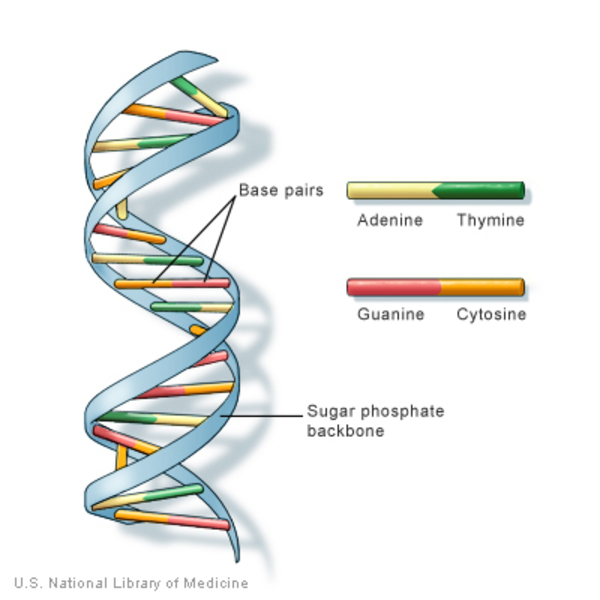
- These bases are attached to sugar and phosphate molecules, forming nucleotides that create a double helix structure.
- The sequence of these bases encodes information for building and maintaining organisms, similar to how letters form words.
- DNA can replicate, making exact copies of itself, which is crucial for cell division, ensuring that new cells contain the same DNA as the original.
DNA’s and Identification
- DNA acts like a biological fingerprint, used to uniquely identify individuals, much like an Aadhaar number does for social security.
- DNA is present in every cell of the body, and each cell contains 46 DNA molecules—23 inherited from the mother and 23 from the father.
- DNA is packed in chromosomes. For example, chromosome 3 contains 6.5% of the total DNA.
| Polymorphisms – Polymorphism in genomics refers to the existence of different forms of a DNA sequence among individuals or populations. – They are small differences in DNA between individuals, and they help in tracing ancestry by identifying variations inherited from parents. Use of Polymorphism  Short Tandem Repeats (STRs) – STRs are short DNA sequences repeated multiple times (e.g., GATCGATCGATC). – STRs are polymorphic, meaning unrelated individuals often have different numbers of repeats in specific STRs. |
Polymerase Chain Reaction (PCR)
- PCR is used to amplify (copy) specific DNA sequences, even from small amounts of DNA.
- The process involves separating DNA strands, binding primers to target sequences, and using DNA polymerase to replicate the sequence. It can create millions of copies in about 50 minutes.
Applications of DNA Fingerprints
- DNA fingerprints are used in forensic science, paternity testing, disaster victim identification, and organ donation matching.
- They can also help solve cold cases by identifying suspects or exonerating wrongly accused individuals.
Importance
- DNA is highly stable, and scientists have successfully extracted DNA from ancient human remains (e.g., 65,000 years old).
- This stability makes DNA useful in solving crimes from archived materials.
Source :TH
Previous article
Govt Notifies Revised Criteria for Classifying MSMEs
Next article
News In Short-25-03-2025
