


Syllabus: GS2/Polity and Governance
Context
- A performance audit report on implementation of the 74th Constitutional Amendment Act has been released by the Comptroller and Auditor General of India (CAG).
About
- The 74th Constitutional Amendment Act, came into effect in 1993, it provided a clear mandate for democratic decentralisation.
- It created democracy at the grass root level through self-governing local bodies in urban areas.
- It empowered Urban Local Bodies (ULBs) to perform 18 functions as listed in the 12th Schedule of the Constitution.
- Audit by CAG: The aim of this Audit was to ascertain empowerment of ULBs through devolution of adequate resources for effective discharge of functions, as enshrined in 12th Schedule.
- The performance audits were conducted between 2014 and 2021 across 393 urban local bodies in 18 states.
| 12th Schedule of the Constitution – It was added by the 74th Amendment Act of 1992. – It contains the powers, authority and responsibilities of Municipalities. This schedule has 18 items. 1. Regulation of land use and construction of land buildings. 2. Urban planning including the town planning. 3. Planning for economic and social development. 4. Urban poverty alleviation. 5. Water supply for domestic, industrial and commercial purposes. 6. Fire services. 7. Public health sanitation, conservancy and solid waste management. 8. Slum improvement and up-gradation. 9. Safeguarding the interests of the weaker sections of society. 10. Urban forestry, protection of environment and promotion of ecological aspects. 11. Construction of roads and bridges.Provision of urban amenities and facilities. 12. Promotion of cultural, educational and aesthetic aspects. 13. Burials and burials grounds, cremation and cremation grounds and electric crematoriums. 14. Cattle ponds, prevention of cruelty to animals. 15. Regulation of slaughter houses and tanneries. 16. Public amenities including street lighting, parking spaces, bus stops and public conveniences. 17. Vital statistics including registration of births and deaths. |
Findings of the CAG Report
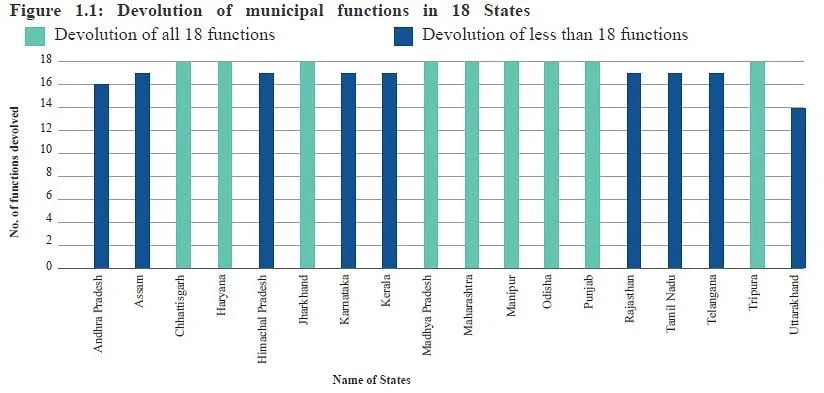
- Devolution of Functions: 17 of the 18 functions were devolved in 18 states, just 4 functions were effectively devolved with complete autonomy.
- 4 functions include burial grounds, public amenities, prevention of cruelty to animals and regulation of slaughter houses.
- Only 9 states (Chhattisgarh, Haryana, Jharkhand, Madhya Pradesh, Maharashtra, Manipur, Odisha, Punjab and Tripura) have devolved all the 18 functions.
- Concerns about the Fiscal Health of ULBs: Just 32% of the total revenue of ULBs was their own and the rest was grants from state and central government.
- There was a 42% gap between revenue resources and expenditure of ULBs in the 18 states.
- Shortage of Staff: While the population in cities is rapidly increasing, ULBs in most states don’t have sufficient manpower.
- Reservation for Women: Six out of the 14 states reserved 50% of their city council seats for women, surpassing the constitutional requirement of 33% reservation for women.
- Ward Delimitation: Only 4 of the 15 states, namely Himachal Pradesh, Kerala, Maharashtra and Tamil Nadu have empowered state election commissions with ward delimitation while in the remaining 11, it is vested with the State Government.
- Direct Elections for Mayor: Only 5 states (Chhattisgarh, Haryana, Jharkhand, Tamil Nadu and Uttarakhand) have the provision for direct election of mayors.
Recommendations
- Changes required: There is a need to conduct municipal elections every five years, constitute planning committees to control haphazard urbanisation and empower state finance commissions to focus on better fiscal management.
- Scientific Budget: Efforts need to be made to motivate the ULBs to prepare their budgets in a scientific manner taking into account realistic projection of funds.
- Release of Funds: The State Government should monitor the release of grants to Urban Local Bodies so that allocated grants are released fully and in time.
- Delegation of Power: The State Government may consider to delegate adequate powers over manpower resources to Urban Local Bodies in matters such as assessment and recruitment of required staff.
| Urban Local Bodies (ULBs) – The 73rd and 74th Constitution Amendment Acts established local self-governance in rural and urban India respectively. 1. The two amendments were added to the Constitution’s Part IX, titled “The Panchayats” and Part IXA titled “The Municipalities” respectively. – Following the two amendments, panchayats and municipalities were termed as institutions of self-government. – ULBs are small local bodies that administers or governs a city or a town of specified population. 1. ULBs are vested with a long list of functions by the state governments. 2. These functions broadly relate to public health, welfare, regulatory functions, public safety, public infrastructure works, and development activities. – The ULBs mainly receive funds from the Government of India (GOI) and the State Government in the form of Grants. – A five-year-tenure was prescribed for the body, and elections to the successor body had to finish before the previous body’s term expired. 1. In case of the body’s dissolution, an election had to be conducted within 6 months compulsorily. 2. There would also be a State Election Commission in each state for superintendence, direction, and control of the electoral rolls for these elections. |
Source: HT
Previous article
Guru Nanak Jayanti
Next article
Combating Hate speech
