
 80813-00200


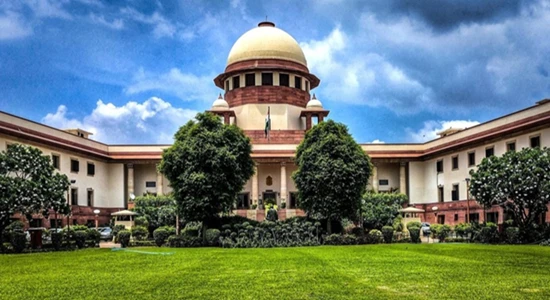
The Supreme Court of India was established under article 124 of the Indian Constitution. It was inaugurated on 28th January 1950 in the chamber of Princes at the Old Parliament House and moved to the present building in 1958. It replaced the Federal Court of India and Justice Harilal J. Kania became the 1st Chief Justice of India (CJI). The Supreme Court is famously known as the guardian and custodian of the constitution of India. Under article 32, Indian Citizens can directly approach the supreme court in case of violation of fundamental rights. The current Chief Justice of India is Surya Kant.
Jurisdiction and Powers of Supreme Court of India
| S.No. | Articles | Power and Jurisdiction |
|---|---|---|
| 1 | Article 124 |
|
| 2 | Article 131 |
|
| 3 | Article 32 |
|
| 4 | Article 139 |
|
| 5 | Articles 132 and 134A |
|
| 6 | Article 133 |
|
| 7 | Article 134 |
|
| 8 | Article 136 |
|
| 9 | Article 143 |
|
| 10 | Article 137 |
|
| 11 | Articles 137 and 142; judicial innovation |
|
| 12 | Article 139A |
|
| 13 | Article 228 |
|
| 14 | Article 129 |
|
| 15 | Article 129 |
|
| 16 | Article 142 |
|
| 17 | Article 141 |
|
| 18 | Article 144 |
|
| 19 | Article 145 |
|
| 20 | Article 138 |
|
| 21 | Article 142(1), Article 144 |
|
| 22 | Article 140 |
|
| 23 | Article 71 |
|
| 24 | Article 317(1) |
|
| 25 | Representation of the People Act, 1951 |
|
About Indian Judiciary
Inspired by the Government of India Act of 1935, the Indian Constitution has established an integrated judicial system with a three-tier structure:
- The Supreme Court
- The High Courts
- The Subordinate Courts (District Courts, and other Lower Courts)
This single system of courts enforces both Central and State Laws across the country.
Supreme Court Constitutional Provisions
Articles 124 to 147 in Part V of the Indian Constitution deal with the provisions related to the Supreme Court of India.
The constitutional provisions mentioned under these articles deal with the organization, independence, jurisdiction, powers, and procedures of the SC.
- The Parliament is also authorized to regulate these provisions.
Major Supreme Court Judgements
| S.No. | Year | Landmark Case | Key ruling |
|---|---|---|---|
| 1 | 1973 |
|
|
| 2 | 1978 |
|
|
| 3 | 1980 |
|
|
| 4 | 1992 |
|
|
| 5 | 1994 |
|
|
| 6 | 1997 |
|
|
| 7 | 2015 |
|
|
| 8 | 2017 |
|
|
| 9 | 2018 |
|
|
| 10 | 2024 |
|
|
Composition of Judges
- Originally, the strength of the Supreme Court was fixed at 8 (1 Chief Justice and 7 other judges).
- The Constitution of India empowers the Parliament to increase or decrease
the number of judges of the SC.
- Accordingly, the Parliament passed several Acts subsequently to increase the number of other judges of the SC.
- At present, the SC consists of 34 judges (1 Chief Justice and 33 other judges).
Appointment of the Chief Justice
The Chief Justice is appointed by the President after consultation with such judges of the Supreme Court and High Courts as he deems necessary.
As per the Second Judges Case (1993), the senior-most judge of the Supreme Court should alone be appointed as the Chief Justice of India.
Appointment of Other Judges
- The other judges are appointed by the President after consultation with the Chief Justice and such other judges of the Supreme Court and the High Courts as he deems necessary.
- The consultation with the Chief Justice is obligatory in the case of the appointment of a judge other than the Chief Justice.
- As per the Second Judges Case (1993), consultation with the Chief Justice means concurrence and advice tendered by the Chief Justice is binding on the President.
- As per the Third Judges Case (1998), the Chief Justice should
consult a collegium of 4 senior-most judges of the Supreme Court before
recommending the name to the President.
- The recommendations made by the Chief Justice, without consulting the collegium, are not binding on the President.
Qualifications of Judges of the Supreme Court
A person to be appointed as a judge of the Supreme Court should have the following qualifications:
- He/she should be a citizen of India.
- He/she should:
- have been a judge of a High Court (or High Courts in succession) for 5 years; OR
- have been an advocate of a High Court (or High Courts in succession) for 10 years, OR
- be a distinguished jurist in the opinion of the President of India.
Oath and Affirmations of Judges
- The Chief Justice of India and the Judges make and subscribe to an oath or affirmation before the President or some person appointed by him for this purpose.
- In his/her oath, he/she swears:
- to bear true faith and allegiance to the Constitution of India.
- to uphold the sovereignty and integrity of India.
- to duly and faithfully and to the best of his ability, knowledge, and judgment perform the duties of the office without fear or favour, affection or ill-will.
- to uphold the Constitution and the laws.
Salaries & Allowances of Judges
The salaries, allowances, privileges, leave, and pension of the judges of the Supreme Court are determined by the Parliament.
- They cannot be varied to their disadvantage after their appointment except during a Financial Emergency.
| S.No. | Component | Chief Justice of India (CJI) | Other Supreme Court Judges |
|---|---|---|---|
| 1 | Basic monthly salary |
|
|
| 2 | Sumptuary allowance |
|
|
| 3 | Official residence |
|
|
| 4 | House-rent allowance |
|
|
| 5 | Travelling allowance |
|
|
| 6 | Daily allowance on official tour |
|
|
| 7 | Medical facilities |
|
|
| 8 | Vehicle, staff and security |
|
|
| 9 | Pension after retirement |
|
|
| 10 | Gratuity |
|
|
Tenure of Judges
The Constitution has not fixed the tenure of a judge of the Supreme Court. However, the Constitution contains the following three provisions in this regard:
- He/she holds office until he attains the age of 65 years.
- Any question regarding his/her age is to be determined by such authority and in such manner as provided by Parliament.
- He/she can resign from his office by writing to the President.
- He/she can be removed from his office by the President on the recommendation of the Parliament.
Removal of Judges of Supreme Court
- A judge of the Supreme Court can be removed from his/her office by an order of the President.
- They can be removed on the following two grounds:
- proved misbehaviour
- incapacity
- The procedure relating to the removal of a judge of the SC is regulated by the Judges Enquiry Act (1968).
- As per the Act, the process of removal goes as follows:
- A removal motion signed by 100 members in the case of Lok
Sabha or 50 members in the case of Rajya Sabha
is to be given to the Speaker/Chairman.
- The Speaker/Chairman may admit the motion or refuse to admit it.
- If the motion is admitted, then the Speaker/Chairman constitutes a
three-member committee to investigate the charges. The Committee consists
of:
- the Chief Justice of India or a Judge of the SC,
- a Chief Justice of a High Court, and
- a distinguished jurist.
- If the committee finds the judge guilty of the charges, then both the
Houses of Parliament can take up the motion for
consideration.
- The motion must be passed by both Houses of Parliament with a Special Majority (50% of the total membership of the House + two-thirds of the members present and voting).
- Once passed by both Houses of Parliament, an address is presented to the President.
- Finally, the President passes an order, removing the judge.
- A removal motion signed by 100 members in the case of Lok
Sabha or 50 members in the case of Rajya Sabha
is to be given to the Speaker/Chairman.
FAQs about Supreme Court
How many judges are there in the Supreme Court?
At present, the Supreme Court consists of 34 judges (1 Chief Justice and 33 other judges).
When was the Supreme Court of India established?
The Supreme Court of India was established on January 28, 1950, two days after India became a republic with the adoption of its Constitution on January 26, 1950.
Who can remove the Judges of the Supreme Court in India?
The President of India can remove the Judges of the Supreme Court in India.
Where is the Supreme Court of India located?
The Supreme Court of India is located in New Delhi.
Who is the Chief Justice of the Supreme Court of India?
The Chief justice of the Supreme court of India is Surya Kant. He serves as the 53rd CJI and is scheduled to retire in February 2027.
