
 80813-00200


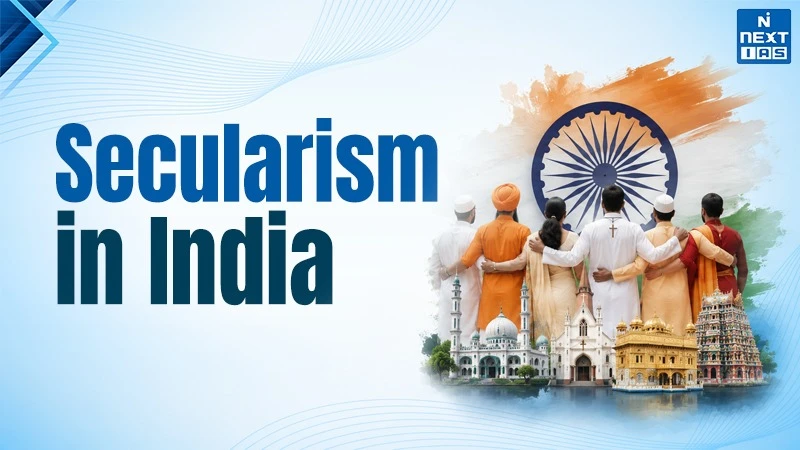
Secularism (धर्मनिरपेक्षता) in India comprises a positive model of equal respect of all religions (सर्वधर्म समभाव) whereas the western secularism has a separation of church and state. The word ‘secular’ became a part of the Indian constitution by the 42nd constitutional amendment act of 1976. Indian secularism means an equal treatment of all faiths. The Supreme Court in S R Bommai vs Union of India, 1994 affirmed secularism as part of the ‘basic structure’ of the Indian constitution. It means that even the parliament cannot remove or alter it.
Secularism Meaning
Secularism is the principle of separating religion from state. It ensures that the government does not establish and favour any religion and protect the religious freedom of all people of the country.
Secularism means that the state should treat all religions equally. It does not impose any particular faith on people. It safeguards the freedom of an individual to practice, profess, or even remain neutral towards any religion. India allows the state to regulate religious practices whenever need arises and uphold equality, dignity, public order and social reform.
History of India's Interfaith Culture
In ancient India, Ashoka about 2200 years ago and Harsha about 1400 years ago have patronized different religions. The historical people in India had freedom of religion and the state granted citizenship to the people irrespective of their religion (hinduism, buddhism, jainism or other). For example, the elora caves built between 5th and 10th centuries reflect a coexistence of religion and acceptance of inter-faith.
The secularism in India emerged from the freedom struggle and plural society. The word ‘secular’ was not included in the preamble at the time of enforcement of the constitution on 26th January 1950. However, articles 15, 16, 25 to 30, and other provisions of the Indian constitution guaranteed equality, religious freedom and minority rights.
The 42nd constitutional amendment act of 1976 inserted the term ‘secular’ in the preamble. India is now regarded as a ‘Sovereign Socialist Secular Democratic Republic’. In the S.R. Bommai vs Union of India (1994), the Supreme Court held secularism as a part of the basic structure of the constitution.
Constitutional Provisions for Secularism of India
| S.No. | Provision | Protection related to Secularism |
|---|---|---|
| 1 | Preamble |
|
| 2 | Article 14 |
|
| 3 | Article 15 |
|
| 4 | Article 16 |
|
| 5 | Article 25 |
|
| 6 | Article 26 |
|
| 7 | Article 27 |
|
| 8 | Article 28 |
|
| 9 | Articles 29 to 30 |
|
| 10 | Article 44 |
|
| 11 | Article 51A(e) |
|
| 12 | Article 325 |
|
Subsidy on Religious Pilgrimage by Government
- In the past, many people have argued that the subsidy given by the state or government for religious pilgrimage (Haj) affects the secularism of India. The Haj subsidy used to be given in the form of reduced airfare for eligible individuals or pilgrims.
- In 2012, the Supreme Court directed the government to progressively remove the subsidy within the next 10 years. The government removed the haj subsidy in January 2018.
- On the contrary, the indian muslim leaders supported this removal because haj must be performed out of the self-earned money by a muslim. The money which comes from borrowings or charity should be avoided in the pilgrimage.
Comparison of India and Western Secularism
| S.No. | Basis | Indian secularism | Western secularism (general model) |
|---|---|---|---|
| 1 | Core approach |
|
|
| 2 | State and religion relationship |
|
|
| 3 | Conceptual framework |
|
|
| 4 | Religious diversity |
|
|
| 5 | State support and regulation |
|
|
| 6 | Main objective |
|
|
Shah Bano Case
- The supreme court in the Shah Bano case on 23rd April 1985 ruled that a divorced muslim woman unable to maintain herself can claim the maintenance under section 125 of CrPC.
- The court also supported her claim beyond the ‘iddat’ period and discussed the clear objective of Uniform Civil Code (UCC). The parliament of India subsequently enacted the Muslim Women(Protection of rights on divorce) act of 1986.
Uniform Civil Code in Goa
- The only state in India which has a Uniform Civil Code is Goa and is often referred to as the Goa Civil Code or Goa Family Law. This means that there are common rules of marriages, divorce, and succession of private properties among all religious groups.
- For example, any muslim community marriage in Goa cannot practice polygamy or triple talaq. There is also a common rule that the sharing of property is equally divided between husband and wife.
- However, the UCC does not completely apply to certain communities and thus there are a few exceptions among some of the religious groups. But still Goa forms the best example among all the Indian states for the application of a broader Uniform Civil Code.
FAQs on Secularism
What is Secularism?
Secularism is the principle of separating religion from state for establishing a neutral state.
What is Indian Secularism?
Indian secularism is treating all religions equally and protecting the individual religious freedom.
What is a secular state?
The state which comprises no official religion and governs without any discrimination against any individual’s faith.
