
 80813-00200

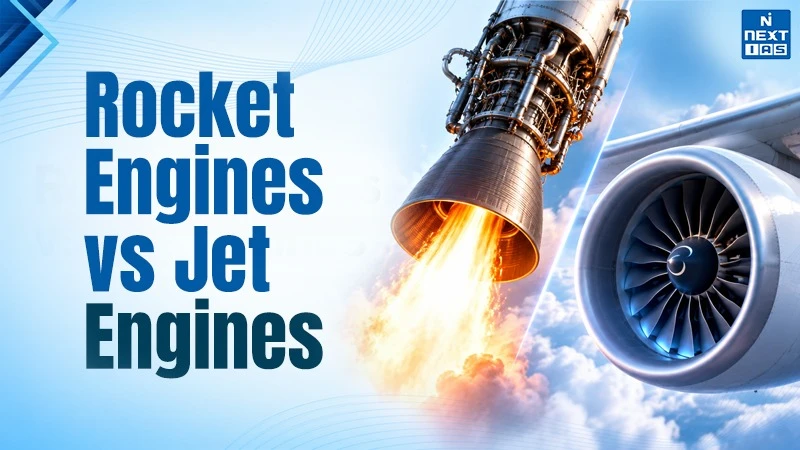
A rocket engine is a kind of propulsion system that produces thrust through the ejection of fast-flowing gas to enable the rocket to counteract gravity and traverse space. In contrast to airplane engines, rockets have their fuel and oxidizers in order to function in space where there is no atmosphere.
The types of rocket engines can be categorized according to their propellant into solid, liquid, and hybrid engines. Liquid engines allow more flexibility and restartability while solid engines are easier to manufacture and very reliable. Hybrid engines possess the qualities of both. The present and future spacecraft are increasingly employing more sophisticated engines that are more efficient, reusable, and controlled.
Types of Rocket Engines
Rocket engines are classified based on their propulsion mechanisms and fuel types. The major types include:
Chemical Rocket Engines
- Liquid-Propellant Engines: Use fuel and oxidizer stored separately (e.g., RP-1/LOX or hydrogen/oxygen). Offers better control and can be throttled or restarted.
- Solid-Propellant Engines: Fuel and oxidizer are mixed into a solid form. They are simple, reliable, and used for boosters, though non-throttleable.
- Hybrid Engines: Combine liquid oxidizers and solid fuels, offering some control while maintaining simplicity.
Electric Rocket Engines
- Ion Thrusters: Use electric fields to accelerate ions, ideal for deep space missions.
- Hall Effect Thrusters: Use magnetic fields to accelerate plasma, offering higher thrust than ion thrusters.
Nuclear Rocket Engines
- Nuclear Thermal Engines: Use a nuclear reactor to heat propellant, achieving higher efficiency than chemical rockets.
- Nuclear Electric Propulsion: Converts nuclear energy to electricity, powering electric engines for long-distance missions.
- Each type serves distinct roles, from heavy-lift rockets to long-term space exploration.
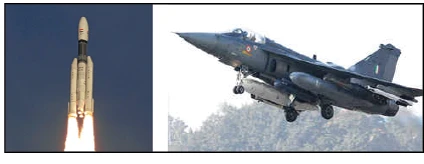
Rocket Engines vs Jet Engines
- Jet engines and rockets work on the same principle they produce thrust through an internal pressure difference and as explained b'/ Newton's 3rd law of motion eject exhaust gases in an equal and opposite direction.
- The main differences are while jets get the oxygen to burn fuel from the air and rockets carry their own oxygen which allows them to operate in space, Jet engines have 2 openings, an intake and exhaust nozzle where as rocket engines only have one opening, an exhaust nozzle.
Need for Jet Engines
- At present the launch vehicles or missiles are usually designed for one time use. Also, their efficiency is low as they are able to carry payloads just 2 to 4% of their lift of Mass.
- Thus, they are expensive and there is a need to reduce launch cost.
- Oxidiser comprises 70% of propellants, Thus, next generation propulsion system must be able to use atmospheric oxygen instead of carrying it. Hence need for air breathing propulsion such as ramjet and scramjet.
| ROCKET | JET |
|---|---|
| It carry both fuel and oxidiser | It carry fuel only and no oxidiser |
| It does not require atmospheric oxygen | It requires atmospheric oxygen |
| It is NON air breathing | It is air breathing |
| It works in vacuum and atmosphere | It works only in atmosphere |
| It uses solid or liquid fuel | It uses liquid fuel |
| It has simple structure | It has complex structure |
| It has low efficiency oxygen | It has high efficiency |
The Main Types of Jet Engines:
- Turbojet: Turbojet engine is an air breathing jet engine, This is one of the most common type of jet engines. It is still widely used in airplanes.
- Turbofan engines: Turbofans differ from the turbo jets in the way they have an additional component -- a fan. The fan air and then further compressed and combustion takes place in the burner.
- DUAL MODE RAMJET(DMRJ): Type Of jet engine Where a ramjet transforms into scramjet over Mach 4 to 8 range, therefore it can operate both in subsonic and supersonic combustion modes.
Ramjet Engine
- Ramjet is a form of air breathing jet engine that uses the vehicles high speed (supersonic) forward motion to compress incoming air for combustion (there is no compressor).
- The vehicle carries only the fuel. The fuel injected within the combustion chamber and the incoming compressed het air is glow down to subsonic speed to mix with fuel and get ignited.
- The expansion of hot gases after fuel Injected in combustion accelerates the exhaust air a velocity higher than that at the inlet and creates positive push.
- However, ramjets cannot produce thrust from zero speed or a standstill position. The air entering the engine should be at supersonic speeds.
- Therefore it requires an assisted take off like a rocket to accelerate it to a supersonic speed (Mach 3 to 6), where it begins producing thrust to force air into the inlet.
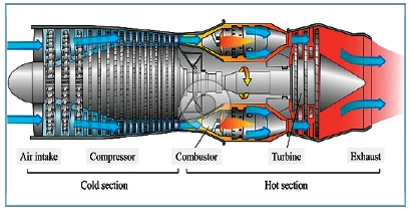
Ramjet engine is the most basic type of jet engine available capable of attaining speeds of 3 Mach. Though this engine has no moving parts inside it, there are only three parts:
- Converging Inlet
- Combustion chamber
- A nozzle
At the converging inlet, the air is compressed to a very high ratio and is sent inside. In the combustion chamber, fuel is injected and flame holders burn the fuel-air mixture. Thus combusted mixture has high enthalpy, due to which they flow rapidly towards nozzle.
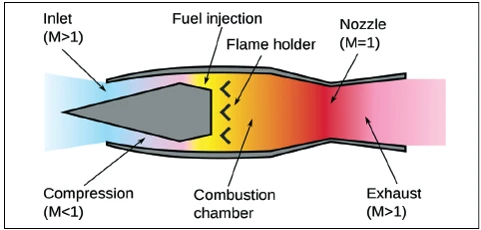
After they enter the nozzle, with decrease in pressure the jet velocity will increase to a great extent, majority of thrust is obtained from here.
These have increasing efficiency with increase in their speeds, because higher velocity means higher compression ratio at the inlet. So these are super-efficient at supersonic speeds.
Solid Fuel Ducted Ramjet Technology
- DRDO had successfully tested 'Solid Fuel Ducted Ramjet (SFOR)' propulsion-based missile system from ITR, Chandipur, Odisha last year.
- The success of SFDR propulsion technology will pave the way for the development Of long-range air-to-air missiles in the country
- The ramjet propulsion system used in the SFDR acts es an oxidiser and the solid propellant reacts as air flows through a solid propellant duct.
- Unlike conventional rockets that carry propellant and oxidiser, Ramjet uses the air as an oxidiser just like a jet engine. Therefore, the weight of the fuel required is eliminated.
- SFDR propulsion is designed in such a way that it allows for an up and down throttling. This further lets the missile to amplify its speed until it reaches the terminal phase of the flight.
- The speed increases until the point when sharp turns are required to search for highly manoeuvring targets.
- The first flight of SFDR, developed under a joint Ind04Russian project, was tested in 2018. it had achieved the speed of Mach 3
- The Indian SFDR will be used as variants of missiles such as the advanced version of ASTRA.
Scramjet Engine (Supersonic Combustion Ramjet)
- Ramjets work most efficiently at supersonic speeds around Mach 3 (three times the speed of sound) and can operate up to speeds of Mach 6.
- However, the ramjet efficiency starts to drop when the vehicle reaches hypersonic speeds.
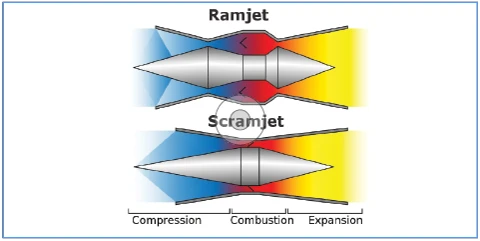
- A scramjet engine is an improvement over the ramjet engine as it efficiently operates at hypersonic speeds and allows supersonic combustion.
- Thus it is known as Supersonic Combustion Ramjet, or Scramjet.
- The difference between scramjet and ramjet is that, in scramjet combustion takes place at supersonic air velocities throughout the engine (incoming air is not slow down to subsonic speeds).
- At very high speed (hypersonic), if the air is slow down to subsonic, it would produce unmanageable heat and pressure. Thus, at higher speed there is a need to keep combustion at supersonic speed.
- Theoretical speed of scramjet is Mach 12 to 24.
The Scramjet engine designed by ISRO uses Hydrogen as fuel and the Oxygen from the atmospheric air as the oxidiser. ISRO conducted the maiden short duration experimental test of ISRO's Scramjet engine with a hypersonic flight at Mach 6. ISRO's Advanced Technology Vehicle (ATV), which is an advanced sounding rocket, was the solid rocket booster used for this recent test of Scramjet engines at supersonic conditions.
Skyroot Aerospace, a space technology startup based in Hyderabad, has successfully test-fired Dhawan-1, India's first privately developed fully cryogenic rocket engine. This will power the upper stages of its upcoming Vikram-2 orbital launch vehicle. The rocket engine Dhawan-1 is named after Satish Dhawan, an Indian rocket scientist.
It became the country's first privately (Made-in-India) developed fully cryogenic rocket engine running on two high-performance rocket propellants --- liquid natural gas (LNG) and liquid oxygen (LoX). The indigenous engine was developed using 3D printing with a superalloy.
High Thrust Cryogenic Engine
- The CE-20 is a cryogenic rocket engine developed by the Liquid Propulsion Systems Centre (ISRO subsidiary), It has been developed to power the upper stage of the Geosynchronous Satellite Launch Vehicle Mk III.
- The engine intakes liquid hydrogen as fuel and liquid oxygen as an oxidizer. The high thrust cryogenic engine is one of the most powerful upper stage cryogenic engines in the world.
Read our detailed article on Satellite Launch Vehicle
Semi Cryogenic Engine (SCE-200)
- The SCE-200 is an indigenously-developed liquid-fuel engine that runs on liquid oxygen (LOX) propellant and highly-refined kerosene, called RP-1 in a combustion chamber.
- It is developed by the Liquid Propulsion Systems Centre. The new engine will be tested on a GSLV-Mk III. It will help to increase rocket's payload carrying capacity.
FAQs
What is a rocket engine?
A rocket engine creates thrust using high-speed gases for the purpose of launching rockets and spacecrafts into space.
What are the different types of rocket engines?
There are three major kinds of rocket engines: solid, liquid, and hybrid rocket engines.
What happens when a rocket engine works in space?
It creates thrust by ejecting high-speed gases using Newton's third law of motion, in the absence of atmospheric oxygen.
