
 80813-00200


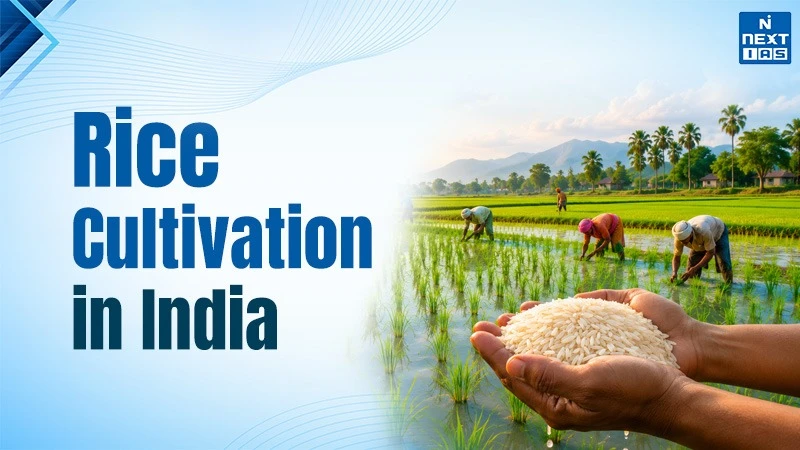
India is the largest producer of rice in the world and is the staple food in regions such as south and north-eastern India. Rice is a kharif crop and requires high humidity and high temperature above 25°C with annual rainfall above 100 cm. He unpolished rice contains higher nutritional value and is rich in vitamins A, B, and calcium whereas polished rice lacks such vitamins.
About 3,000 to 5,000 litres of water is required to produce just 1 kg of rice. To reduce water consumption, Direct Seeded Rice (DSR) can be utilized which saves around 20% of water by skipping the nursery and transplantation phase.
Rice can be grown below sea level and at high altitudes. Kuttanad also known as the rice bowl of Kerala is one of the places where rice is grown below the sea level whereas in Kashmir valleys, it is grown at the height of about 2,000 metres.
In Indian Culture, Rice is offered to the infants in Annaprashan ceremony and is the symbol of prosperity in Wedding ceremonies.
Types of Rice in India
| S.No. | Types of RIce | Key characteristics | Examples | Major regions or states in India |
|---|---|---|---|---|
| 1 | Basmati rice |
|
|
|
| 2 | Non-Basmati rice |
|
|
|
| 3 | Non-Basmati aromatic rice |
|
|
|
| 4 | White rice |
|
|
|
| 5 | Brown rice |
|
|
|
| 6 | Red rice |
|
|
|
| 7 | Black rice |
|
|
|
| 8 | Sticky or glutinous rice |
|
|
|
| 9 | Parboiled rice |
|
|
|
| 10 | Scented or Indigenous landrace rice |
|
|
|
| 11 | Hybrid rice |
|
|
|
| 12 | High-yielding variety or HYV rice |
|
|
|
| 13 | Upland or dryland rice |
|
|
|
| 14 | Lowland or wetland rice |
|
|
|
| 15 | Deep-water or flood-prone rice |
|
|
|
Benefits of Rice
- Rice is an important staple crop and a source of carbohydrates which provides the energy for our daily activities. The plain or white rice is naturally gluten-free and can make it suitable for people with coeliac diseases or gluten intolerant.
- Rice contains a lower amount of fat and is usually easy to digest. Thus, it is included in daily meals during the recovery from gastrointestinal illness.
- Rice also provides a small amount of protein and minerals. The brown, red and black rice retain their bran layer and thus usually contain more dietary fibre and micronutrients as compared to polished white rice.
- The fibre content present in the rice offers the efficient movement of the bowel. It can also improve the satisfaction of consuming food after having the meal.
- The rice is widely available, affordable and can be consumed with pulses, vegetables, curd, and egg to form a better nutritional diet.
- Rice is also essential for the control of blood-sugar. Generally, whole-grain rice can be a good choice.
Rice Crop Cultivation in India
| S.No. | Aspect | Details |
|---|---|---|
| 1 | Botanical name |
|
| 2 | Nature of crop |
|
| 3 | Main season |
|
| 4 | Other seasons |
|
| 5 | Temperature |
|
| 6 | Rainfall or water need |
|
| 7 | Suitable soils |
|
| 8 | Land requirement |
|
| 9 | Main cultivation methods |
|
| 10 | Irrigation |
|
| 11 | Major producing states |
|
| 12 | Key inputs |
|
| 13 | Harvesting |
|
| 14 | Important challenges |
|
| 15 | Sustainable practices |
|
FAQs about Rice Crop
Does Rice contain fat?
Yes, plain cooked rice contains little fat of about 0.2 to 0.3 grams per 100 grams. The brown rice contains comparatively more fat than white or plain rice.
What are the benefits of rice?
Rice provides energy-rich carbohydrates which are naturally gluten free, easy to digest and supplies small amounts of protein, minerals and vitamins.
How much water is present in rice?
The white rice contains about 68 grams of water per 100 grams. It is about 68 percent of water. The water content varies by rice variety and cooking method.
What vitamins are found in rice?
Rice contains primarily vitamin B-complex such as thiamin or B1, niacin or B3, B6, pantothenic acid and folate. The brown rice contains more natural vitamins whereas the white or plain rice contain the added vitamins B.
