
 80813-00200


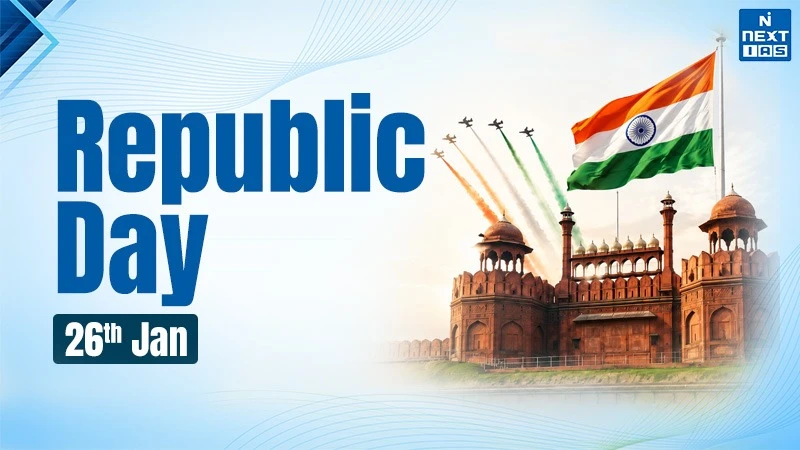
Republic Day is one of the most significant festivals celebrated by Indians on 26th January every year. Republic Day of India marks the date in which the Constitution of India was adopted in 1950. With the adoption of the Constitution, India became a sovereign democratic republic. 26th January was selected to remember the Purna Swaraj declaration that took place in 1930. On this date, Indian nationalists decided that they would get complete independence from the British government. Republic Day symbolises the ideals of justice, liberty, equality, and fraternity. The celebrations of the Republic Day highlight the military power of India, its culture and also the democratic spirit of the nation. Indian democracy can reflect the importance of the day in terms of constitutional machinery, fundamental rights, duties, and the democratic process in the preservation of unity and freedom of the nation.
What is Happy Republic Day?
Every year Republic Day is observed on 26th January to commemorate the date when the Indian Constitution came into effect and made India a Republic. Where the Independence Day commemorates India's independence from British colonial rule on 15th August 1947, Republic Day celebrates the establishment of the constitution of India. Republic Day is a national festival symbolising democracy, equality, justice and national unity.
Historical Background of 26th January
The transformation of India into a republic has been influenced by its quest for liberation from colonial rule and constitution making process. India attained independence on 15 August 1947 but still remained a country governed by a constitution until such a time that its constitution was framed. The Indian Constitution was adopted by the Constituent Assembly on 26 November 1949. This laid down the guidelines and institutions for independent India. Finally, India became a sovereign, democratic republic on 26 January 1950. When its constitution came into effect, it superseded the Government of India Act, 1935 as its governing structure. Dr. Rajendra Prasad was elected as the 1st President of the newly formed republic of India. The date 26 January was selected in honor of the declaration of Purna Swaraj of 1930.
Major Highlights of the 76th Republic Day in India
India observed its 76th Republic Day on 26 January 2025 at Kartavya Path, New Delhi, giving special importance to 75 years of the Constitution and Jan Bhagidari. President Droupadi Murmu presided over the celebrations, whereas President Prabowo Subianto of Indonesia served as the chief guest for this day.
The celebrations were an exhibit of the military strength, rich culture, unity and development of India. The parade included 31 tableaux on the theme of "Swarnim Bharat: Virasat aur Vikas" in addition to the first-ever tri-services tableau to show jointness among the armed forces. Besides this, there was a 350-member contingent from Indonesia in the celebrations.
Another important highlight was the cultural performance named "Jayati Jaya Mamaḥ Bharatam" performed by nearly 5,000 artistes in more than 45 dance forms all through Kartavya Path. There were around 10,000 special guests who were invited on this day representing different strata of society. The celebrations ended with the Beating Retreat Ceremony on 29 January 2025.
1st Republic Day of India
India celebrated its 1st Republic Day on 26th January 1950. On this day constitution of India came into force and Dr Rajendra Prasad became the 1st President of India. The first Republic Day ceremony was held at Irwin Stadium (now Major Dhyan Chand National Stadium) in New Delhi.
Key Events of Republic Day Celebration 2026
The Republic Day celebrations take place all over India on 26 January with great patriotic fervor. The major function takes place in New Delhi with the President hoisting the National Flag and singing of the National Anthem. The main event in the celebration of the Republic Day includes Republic Day parade which reflects the defensive might of India through parades of marching contingents and display of military hardware. The cultural events in the form of dance performances by school children and professional artists are an integral part of the celebrations which reflect the diverse culture of India. The tableaux from various states and union territories reflect their cultural tradition, achievements and significant themes. The celebrations also pay tribute to the people who have shown great acts of courage and self-sacrifice through gallantry awards. Such awards are given for bravery displayed under difficult conditions both military and civilian.
Parade and Beating Retreat Ceremony
The Republic Day Parade forms the highlight of the Republic Day celebrations in India. The Republic Day Parade depicts the military might, culture, and achievements of the nation. Armoured contingents of the Army, Navy, and Air Force march in the parade. The CAPF and police contingents also participate in the parade. The Republic Day Parade highlights the military power and modern defense systems as well as cultural tableaus of the states and union territories of the country. The performance of children on bicycles and that of school children make the Republic Day Parade more exciting. The President of India, who is the supreme commander of the Armed Forces, heads the ceremony and takes the salute.
The Beating Retreat Ceremony is an annual ceremony held on 29 January at the Vijay Chowk in New Delhi to signify the end of the Republic Day celebrations. It carries rich military significance as it marks the culmination of the day's activities and the march back to the barracks. The bands of the Army, Navy, and Air Force play patriotic tunes.
Chief Guest and Awards
It has been a practice for decades to invite a leader from abroad as the Chief Guest on India's Republic Day. It reflects India's diplomatic relationship and strategic partnership in the international community. Apart from this, the invitation is also a way of developing bilateral relationships and discussing common ground. Various leaders from countries such as Indonesia, France, the United States of America, Russia, South Africa and Brazil have graced the occasion as chief guest in the past.
Apart from the celebrations, Republic Day is also the day for awarding various awards and honors. The Padma Awards include Padma Vibhushan, Padma Bhushan, and Padma Shri, which are awards given to civilians who make distinguished contributions in various fields including public affairs, art, science, medicine, social work and literature. There are awards given for gallantry such as Param Vir Chakra, Ashoka Chakra, Maha Vir Chakra and Kirti Chakra. Both the civilian and gallantry awards honour civilians who are extremely dedicated and have contributed to the nation in an outstanding manner.
FAQs about Republic Day
Why do we celebrate Republic Day on 26 January?
India decided to celebrate the day of Purna Swaraj Declaration made in 1930. The Constitution started functioning on that day in 1950.
When did India become a republic?
India became a republic in 1950 on 26 January with the start of functioning of the Constitution.
Who was India's first president?
Dr. Rajendra Prasad was the first president of India.
When was the Constitution adopted?
The Constitution was adopted by the Constituent Assembly on 26 November 1949.
What is the difference between Republic Day and Independence Day?
The Independence Day is celebrated to mark the freedom from the British rule in 1947, whereas the Republic Day celebrates the adoption of the Constitution in 1950.
Where is the Republic Day parade celebrated?
The Republic Day parade takes place in New Delhi usually on the Kartavya path.
What is the significance of the Beating Retreat?
Celebrated on 29 January, the Beating Retreat marks the end of the Republic Day celebration through performances of the military bands.
