
 80813-00200
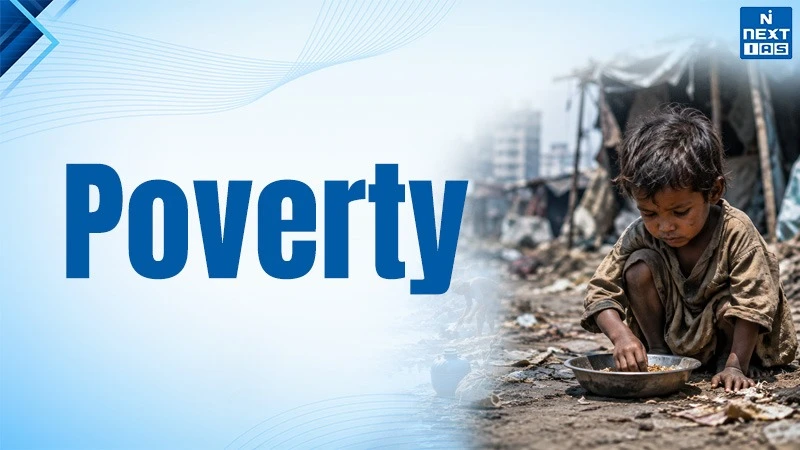
Poverty (निर्धनता ) is an economic state of inability to afford basic needs such as food, shelter, clothing and basic education. It is not just a lack of income but a multidimensional phenomenon which include hunger, poor health, limited education, and lack of access to sanitation. The main types of poverty include absolute poverty or extreme poverty which refers to a severe deprivation of basic human needs. Relative poverty is where the individuals or households lack the minimum amount of income needed to maintain the average standard of living.
How Poverty line is estimated in India?
- The official poverty line of India is estimated from Monthly per capita consumption expenditure (MPCE) and not from income. The latest official all-India estimates were based on the method of the Tendulkar Committee using the NSSO's 2011 to 2012 consumption-expenditure survey. In this method, the total consumption expenditure of a household is divided by its members to calculate MPCE. The poverty line shows the expenses needed for food and essential non-food items which includes health, education, clothing, fuel and housing-related needs. The method uses a broader consumption basket and adjusts poverty lines for rural-urban and state level price differences.
- For 2011 to 2012, the all-India poverty line was Rs. 816 per person per month in rural areas and Rs. 1,000 per person per month in urban areas. The persons whose MPCE fell below the poverty line were counted as poor.
- The Rangarajan Committee proposed a higher limit of Rs. 972 in rural and Rs. 1,407 in urban at 2011 to 2012 prices. However, these were not taken into account as the official threshold level.
Absolute Vs Relative Poverty
| S.No. | Basis | Absolute Poverty | Relative Poverty |
|---|---|---|---|
| 1 | Meaning |
|
|
| 2 | Poverty line |
|
|
| 3 | Reference point |
|
|
| 4 | Change over time |
|
|
| 5 | Main focus |
|
|
| 6 | Typical use |
|
|
| 7 | Example |
|
|
| 8 | Advantage |
|
|
| 9 | Limitation |
|
|
Causes of Poverty Gap
- The main causes of poverty include the economic, social, political and environmental factors. The unemployment, low wages, irregular work and lack of productive assets prevent families from earning sufficient for food, housing, health care and education.
- The unequal ownership of land, wealth and opportunities broadens the gap between rich and poor. The limited access to quality education and skills reduces the employment opportunities and engages people in low wages work.
- The illness, disability, high medical expenses and lack of social security can push households into poverty. The discrimination based on caste, gender, ethnicity or location restricts the access to resources and jobs.
- The population pressure, indebtedness, inflation and rising living costs further worsen the condition. The conflict, displacement, natural disasters and climate change can destroy homes, crops, livelihoods and public services.
- Weak governance and poor delivery of essential services deepen the poverty level. Therefore, poverty is lack of income and also involves lack of opportunities, security and dignity.
Zero Poverty
- Zero poverty is sustainable development goal 1 which includes ending poverty in all its forms. It seeks to raise incomes and ensure access to food, healthcare, education, housing, clean water, sanitation, financial services and social security.
- It requires a decent job, fair wages, equal access to land and resources and special support for vulnerable groups of people.
- The government needs to reduce inequality, strengthen public services and protection from unemployment, disasters and climate related shocks. The goal focusses resilience so that families do not fall back into poverty after a crisis. The target year of the United Nations for achieving Sustainable Development Goal 1 or SDG-1 is 2030.
FAQs about Poverty
What is Poverty?
Poverty is a condition where people lack sufficient income and resources to meet their basic needs.
What do you understand by Human poverty?
Human poverty is the deprivation of essential capabilities which includes health, education, nutrition, security, opportunities and a decent standard of living.
