
 80813-00200

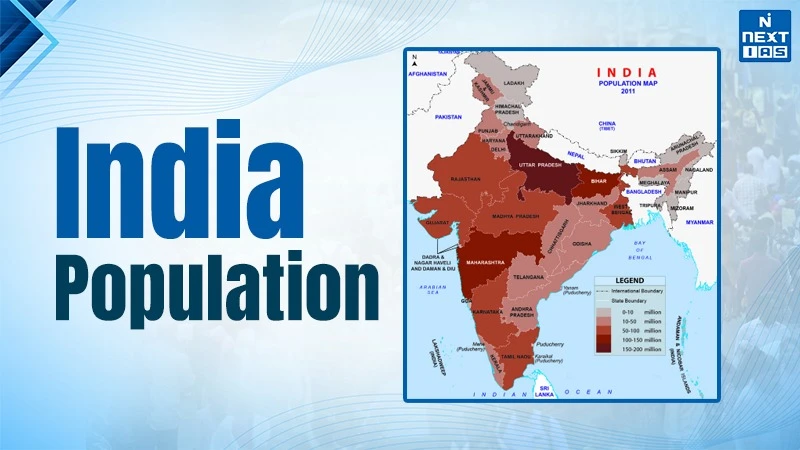
The total population of India is about 148 crore which represents over 17.7% of the world population. India has about 65% of the total population under the age of 35 years and comprises the world's largest youth workforce. India has a total fertility rate or TFR has reduced below the replacement level of about 1.9. It shows that the population growth will stabilize in about half a century. The population pattern varies from region to region. For example, Uttar Pradesh and Bihar are youthful and fast-growing states whereas Kerala and Tamil Nadu are ageing fastly. According to the United Nations, India will rise up to 170 crore population (approx.) by 2060 before it gradually declines.
Timeline of Population of India
| S.No. | Year | Population (crores) |
|---|---|---|
| 1 | 2026 | 147.7 Cr |
| 2 | 2020 | 140.3 Cr |
| 3 | 2010 | 124.3 Cr |
| 4 | 2000 | 105.7 Cr |
| 5 | 1975 | 62.3 Cr |
| 6 | 1947 | 34 Cr |
Population of India Statewise 2026
| Rank | State or Union Territory | Estimated Population | Population |
|---|---|---|---|
| 1 | Uttar Pradesh | 24,34,66,000 | 24.34 Cr |
| 2 | Bihar | 13,28,50,310 | 13.28 Cr |
| 3 | Maharashtra | 12,95,84,000 | 12.95 Cr |
| 4 | West Bengal | 10,06,31,000 | 10.06 Cr |
| 5 | Madhya Pradesh | 8,99,65,000 | 8.99 Cr |
| 6 | Rajasthan | 8,38,79,000 | 8.38 Cr |
| 7 | Tamil Nadu | 7,90,20,000 | 7.90 Cr |
| 8 | Gujarat | 7,43,43,000 | 7.43 Cr |
| 9 | Karnataka | 7,07,80,000 | 7.07 Cr |
| 10 | Andhra Pradesh | 5,37,40,000 | 5.37 Cr |
| 11 | Odisha | 4,74,70,000 | 4.74 Cr |
| 12 | Jharkhand | 4,11,08,000 | 4.11 Cr |
| 13 | Telangana | 3,86,65,000 | 3.86 Cr |
| 14 | Kerala | 3,62,39,000 | 3.62 Cr |
| 15 | Assam | 3,59,60,000 | 3.59 Cr |
| 16 | Haryana | 3,14,10,000 | 3.14 Cr |
| 17 | Punjab | 3,13,70,000 | 3.13 Cr |
| 18 | Chhattisgarh | 2,88,70,000 | 2.88 Cr |
| 19 | Delhi (NCT) | 2,23,00,000 | 2.23 Cr |
| 20 | Jammu and Kashmir | 1,40,10,000 | 1.40 Cr |
| 21 | Uttarakhand | 1,20,30,000 | 1.20 Cr |
| 22 | Himachal Pradesh | 75,90,000 | 75.9 Lakhs |
| 23 | Tripura | 42,70,000 | 42.7 Lakhs |
| 24 | Meghalaya | 34,60,000 | 34.6 Lakhs |
| 25 | Manipur | 33,20,000 | 33.2 Lakhs |
| 26 | Nagaland | 23,10,000 | 23.1 Lakhs |
| 27 | Chandigarh | 12,40,000 | 12.4 Lakhs |
| 28 | Goa | 16,00,000 | 16.0 Lakhs |
| 29 | Arunachal Pradesh | 14,60,000 | 14.6 Lakhs |
| 30 | Mizoram | 12,80,000 | 12.8 Lakhs |
| 31 | Puducherry | 16,90,000 | 16.9 Lakhs |
| 32 | Dadra and Nagar Haveli and Daman and Diu | 12,90,000 | 12.9 Lakhs |
| 33 | Sikkim | 7,10,000 | 7.1 Lakhs |
| 34 | Andaman and Nicobar Islands | 4,30,000 | 4.3 Lakhs |
| 35 | Ladakh | 3,00,000 | 3.0 Lakhs |
| 36 | Lakshadweep | 80,000 | 80 Thousand |
Highest Population State in India
Uttar Pradesh is the highest populated state in India. The state comprises an estimated population of 24.35 crore which is about 17% of India’s total population. Interestingly, if we consider Uttar Pradesh as a country, it will rank at 6th position in the world which means it will surpass many countries such as Brazil, Nigeria, and Russia. It is situated parallel to the fertile gangetic plain and comprises a population density of about 829 persons per square kilometre. The state has an extensive river-fed agriculture with Prayag as its most populous city.
10 Highest Populated Cities in India 2026
| Rank | City | State or UT | Estimated Population |
|---|---|---|---|
| 1 | Delhi | NCT of Delhi | 30,446,254 |
| 2 | Kolkata | West Bengal | 22,646,412 |
| 3 | Mumbai | Maharashtra | 20,385,414 |
| 4 | Bengaluru | Karnataka | 13,261,056 |
| 5 | Chennai | Tamil Nadu | 11,192,733 |
| 6 | Hyderabad | Telangana | 9,232,095 |
| 7 | Ahmedabad | Gujarat | 7,686,069 |
| 8 | Surat | Gujarat | 6,971,646 |
| 9 | Pune | Maharashtra | 6,871,311 |
| 10 | Jaipur | Rajasthan | 4,381,291 |
About India Demographics 2026
| S.No. | Demographic Indicators | Estimated figure |
|---|---|---|
| 1 | Total population | 1,476,625,576 |
| 2 | Annual population growth | 0.87% |
| 3 | Annual population increase | About 12.76 million |
| 4 | Median age | 29.2 years |
| 5 | Total fertility rate | 1.93 births per woman |
| 6 | Population density | 497 persons per sq km |
| 7 | Urban population | 555.3 million |
| 8 | Urbanisation level | 37.6% |
| 9 | Rural population | About 921.3 million |
| 10 | Net migration | 440,456 |
| 11 | India's share of world population | 17.8% |
| 12 | Global population rank | 1st |
The population growth rate of India has reduced in recent years due to decrease in fertility. However, the total population will increase in future decades because the majority of population in India lies in the reproductive ages. The urban population in India is about 37.6% whereas rural India is substantial. The population distribution is highly uneven.
For example, the Indo-gangetic plain or alluvial plains in north India is densely populated whereas the Himalaya, desert and forest areas are sparsely populated.
India Population Forecast
| S.No. | Year | Projected population | Broad demographic trend |
|---|---|---|---|
| 1 | 2035 | About 1.58 billion |
|
| 2 | 2040 | About 1.62 billion |
|
| 3 | 2045 | About 1.65 billion |
|
| 4 | 2050 | About 1.67 billion |
|
FAQs about India Population
What is the population of India?
The estimated population of India in 2026 is about 148 crore. India has the highest population in the world.
Which state has the largest population in India?
Uttar Pradesh in India has the largest population with about 24.35 crore estimated population in 2026.
