
 80813-00200

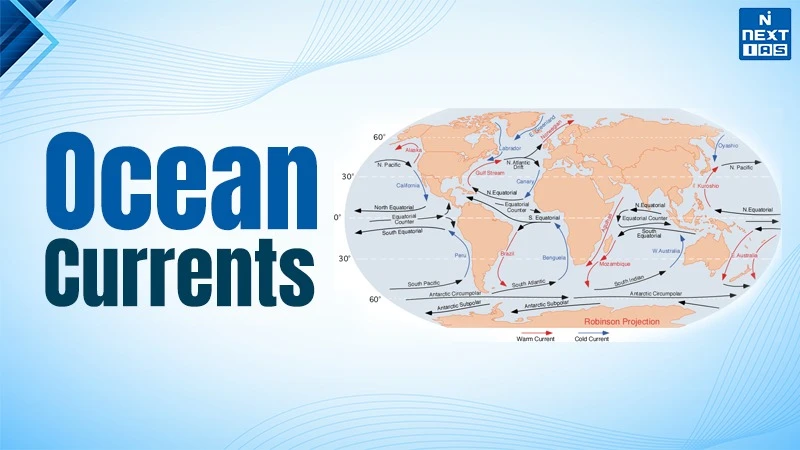
Ocean Currents are the global climate regulators. They are continuous and direction oriented movements of seawater driven by wind, density differences and rotation of Earth. They are responsible for the movement of heat and nutrients on earth. Interestingly, the Gulf stream transports over 100 times more water than all the rivers on our planet. This phenomenon keeps the western Europe warmer as compared to the polar latitudinal regions. The changes in ocean currents may affect rainfall, fisheries production, and global climate patterns.
List of Major Cold and Warm Ocean Currents
| S.No. | Warm Ocean Currents | Cold Ocean Currents |
|---|---|---|
| 1 | North Equatorial Current | Labrador Current |
| 2 | South Equatorial Current | East Greenland Current |
| 3 | Gulf Stream | Canary Current |
| 4 | North Atlantic Drift | Benguela Current |
| 5 | Norwegian Current | Falkland Current |
| 6 | Brazil Current | California Current |
| 7 | Guinea Current | Peru (Humboldt) Current |
| 8 | Kuroshio (Japan) Current | Oyashio Current |
| 9 | North Pacific Drift | West Australian Current |
| 10 | Alaska Current | West Wind Drift or Antarctic Circumpolar Current |
| 11 | East Australian Current | Antarctic Coastal Current or East Wind Drift |
| 12 | Mozambique Current | Baffin Island Current |
| 13 | Agulhas Current | - |
| 14 | East Madagascar Current | - |
| 15 | Monsoon Drift or Monsoon Current | - |
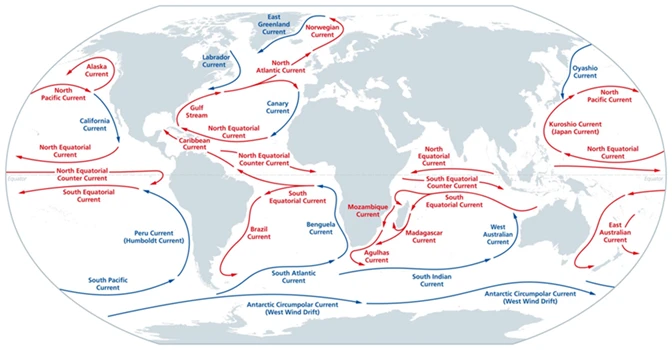
Causes of Ocean Currents
An ocean current is usually strongest at the surface and decreases in speed with depth. The ocean currents are primarily caused by the following factors on earth:
Planetary Winds
- The movement of water on the surface of the ocean is influenced by the wind blowing over it. The friction between the wind and the water's surface impacts the direction and speed of the water's movement.
- It is important to understand that the wind affects the momentum of the water, but it does not initiate the movement.
- A notable example of the impact of prevailing winds on ocean currents can be observed in the North Indian Ocean.
- In this region, the direction of the current completely changes when the monsoon winds reverse.
Temperature
- The movement of ocean water, both on the surface and below it, is initiated by temperature differences. The temperature of the ocean water at the equator differs significantly from that at the poles.
- The solar energy heats the water, causing it to expand. As a result, there is an 8 cm gradient between the elevated equatorial water and the middle latitude. This gradient causes the water to flow downhill.
- Due to its lower density, the warm water moves from areas of lower density to areas of higher density. On the other hand, the denser cold water sinks.
- The warm equatorial water slowly moves towards the poles along the surface, while the colder polar water slowly creeps along the bottom towards the equator.
Ocean Salinity
The ocean salinity often varies with evaporation, rainfall, influx of rivers in ocean water, formation and melting of ice. If the salinity is higher in ocean water then the water density drives the thermohaline circulation and deep ocean currents.
Coriolis Force
The coriolis force is the movement of air and water which is caused by the rotation of the earth. It is zero at the equator and maximum at the poles. It deflects the direction to the right in the northern hemisphere and to the left in the southern hemisphere. This force affects wind belts, cyclones and the path of ocean currents which creates a large circular ocean circulation system called gyres.
Coastal Configuration
The coastal alignment and presence of underwater ridges play an important role in determining the direction of ocean currents. The shape of the land also influences the flow of these currents. For example, the equatorial ocean current is divided into two branches after encountering the Brazilian coast.
Major Types of Ocean Currents
| On the Basis of Depth |
|
| On the Basis of Temperature |
Cold Current:
Warm Current:
|
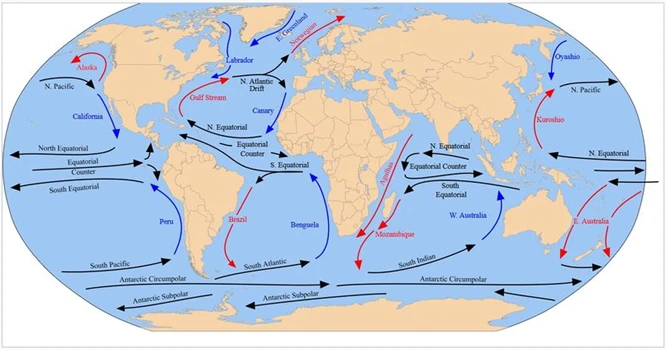
Some Other Prominent Terms
Gyre
A Gyre is a term used to describe a vast system of rotating ocean currents, particularly those influenced by large wind movements. These currents are generated by the Coriolis force.
Drift
- When ocean water is propelled forward by prevailing winds, it is referred to as Drift. The term "drift" is also used to measure the speed of an ocean current, which is typically measured in knots.
- Example - The North Atlantic Drift.
Streams
- On the other hand, when a substantial body of ocean water moves along a defined path, resembling a large river on land, it is known as a Stream.
- Streams tend to have a higher velocity compared to drifts.
- Example - The Gulf Stream.
Eddies
Ocean eddies are swirling and rotating masses of water which occur within ocean currents. They can impact regional oceanic and atmospheric conditions.
FAQs about Ocean Water Currents
What are Ocean Currents?
Ocean currents are continuous movement of sea water in a direction which are generated by gravity, wind, and water density.
How are ocean currents formed?
The ocean currents are formed by winds, coriolis force due to rotation of earth, and difference of temperature or salinity.
How do ocean currents affect the climate?
The ocean currents redistribute the solar heat of the earth's planet and warms the polar regions and cools the tropical coastal areas.
