
 80813-00200

The National Social Assistance Programme (NSAP) is a flagship welfare programme administered by the Ministry of Rural Development & implemented in rural & urban regions. It was launched on 15 August 1995. This programme has evolved from Article 41 of the Indian Constitution (DPSPs) that directs the state to provide public assistance to its citizens (old age, sickness & Divyanjan).
The NSAP or the Old Age Pension Scheme has identified & removed fake beneficiaries with the use of technologies such as Aadhaar based Direct benefit Transfers (DBTs) & Digital Life Certificates (DLCs). In the financial year 2026-2027, NSAP is intended to shift toward ‘Saturation’ that ensures 100 percent eligible beneficiaries are enrolled without leaving behind anyone.
What is the National Social Assistance Programme (NSAP)?
- These are intended to secure for the citizens adequate means of livelihood, raise the standard of living, improve public health, provide free and compulsory education for children etc.
- In particular, Article 41 of the Constitution of India directs the State to provide public assistance to its citizens in case of unemployment, old age, sickness and disablement and in other cases of undeserved want within the limit of its economic capacity and development.
- It is in accordance with these noble principles that the Government of India on 15th August 1995 included the National Social Assistance Programme in the Central Budget for 1995-96.
- The Prime Minister in his broadcast to the Nation on 28th July 1995 announced that the programme will come into effect from 15th August 1995. Accordingly the Government of India launched NSAP as a Centrally Sponsored Scheme w.e.f. 15th August 1995 towards fulfilment of these principles.
- The National Social Assistance Programme (NSAP) then comprised of National Old Age Pension Scheme (NOAPS), National Family Benefit Scheme (NFBS) and National Maternity Benefit Scheme (NMBS).
- These programmes were meant for providing social assistance benefit to the aged, the BPL households in the case of death of the primary breadwinner and for maternity.
- These programmes were aimed to ensure minimum national standards in addition to the benefits that the States were then providing or would provide in future.
Various Features of the Programme
- Targeted Scheme of Social Security: NSAP schemes target only the BPL individuals and thus, ensure that help goes to the sections of society that need it the most.
- Central Assistance with Implementation at State Level: This scheme is financed centrally but implemented at the state level.
- Various Schemes Under NSAP:
- Indira Gandhi National Old Age Pension Scheme (IGNOAPS): Provides monthly pension to elderly individuals over 60 years of age.
- Indira Gandhi National Widow Pension Scheme (IGNWPS): Helps widows over 40 years of age through financial help.
- Indira Gandhi National Disability Pension Scheme (IGNDPS): Assists disabled individuals aged 18 years and above.
- National Family Benefit Scheme (NFBS): Gives once off financial benefit to families in case the head of the family dies.
- Annapurna Scheme: Provides free food grains to senior citizens who are not covered under IGNOPS.
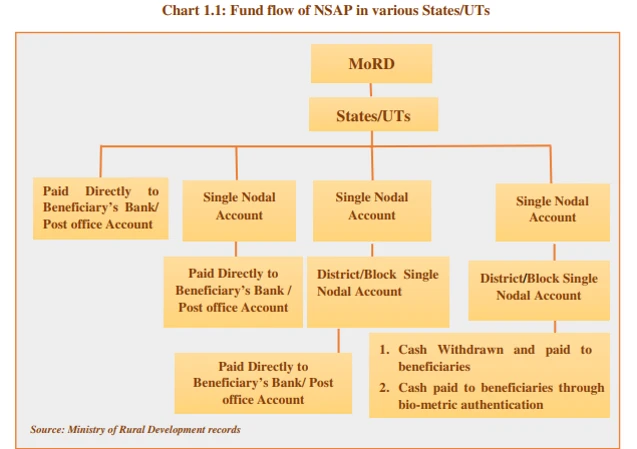
- Direct Benefit Transfer (DBT): Pensions and other financial benefits are transferred directly into bank accounts of the beneficiaries.
- Social Inclusion: Through the provision of support to socially marginalized groups, NSAP helps in poverty alleviation and social welfare.
Major Components of NSAP
- Indira Gandhi National Old Age Pension Scheme (IGNOAPS): Gives a monthly pension to old age people aged 60 years and above. People aged 60-79 years get ₹200 as a monthly pension whereas those aged 80 years and above get ₹500 as a monthly pension.
- Indira Gandhi National Widow Pension Scheme (IGNWPS): Is a scheme meant for widows aged 40 years and above. It offers a monthly pension of ₹300 to widows aged 40-79 years. Increases to ₹500 per month for widows aged 80 years and above.
- Indira Gandhi National Disability Pension Scheme (IGNDPS): It is a scheme for individuals aged 18 years and above with a disability of 80% or more. It gives a monthly pension of ₹300, which increases to ₹500 for people aged 80 years and above.
- National Family Benefit Scheme (NFBS): It gives a lump sum financial assistance of ₹20,000 to BPL families on the death of their primary income earner aged 18-59 years.
- Annapurna Scheme: It gives 10 kg of food grains every month to old age people who are entitled to IGNOAPS but are not getting any pension.
Significance
- Financial Security of the Vulnerable: NSAP ensures minimum income to elderly people, widows, and disabled persons to enable them to fulfill their basic requirements. NSAP serves as a social security net in case the breadwinner of the family passes away.
- Poverty Reduction: NSAP by providing financial help to vulnerable sections of society helps them alleviate economic hardships and improves their quality of life. Annapurna scheme ensures food security to senior citizens without any pension.
- Empowerment of Women and Disabled Individuals: IGNWPS helps in empowerment of widows financially.IGNDPS provides financial assistance to persons with disability for social integration.
- Help to Rural Areas and Weak Sections of Society: Majority of the beneficiaries of NSAP live in rural areas and financial assistance has a major role in alleviating socio-economic inequalities.
- Efficient and Transparent Implementation: Due to direct benefit transfer to bank accounts of the beneficiaries, there is no involvement of any middlemen and corruption is avoided. Conformity with the Objectives of Social Welfare Programmes. NSAP conforms to the objectives of social justice and welfare that the country follows.
Key Pointers about NSAP for UPSC CSE Prelims
- Launch Year: 1995
- Ministry: Ministry of Rural Development (MoRD)
- Objective:Provides social security to Below Poverty Line (BPL) households, especially the elderly, widows, and disabled persons.
- Type of Scheme: Centrally Sponsored Scheme (CSS) with 100% central assistance.
- Direct Benefit Transfer (DBT): Benefits are transferred directly to beneficiaries’ bank accounts.
- Components of NSAP:
- Indira Gandhi National Old Age Pension Scheme (IGNOAPS) – ₹200/month (60-79 years), ₹500/month (80+ years).
- Indira Gandhi National Widow Pension Scheme (IGNWPS) – ₹300/month (40-79 years), ₹500/month (80+ years).
- Indira Gandhi National Disability Pension Scheme (IGNDPS) – ₹300/month (18-79 years), ₹500/month (80+ years).
- National Family Benefit Scheme (NFBS) – One-time ₹20,000 to BPL families upon the death of a primary breadwinner (18-59 years).
- Annapurna Scheme – 10 kg of free food grains per month for eligible senior citizens not receiving a pension.
- Eligibility: Only Below Poverty Line (BPL) households are eligible.
- Implementation: Managed by State/UT governments under central guidelines.
- Significance: Ensures financial security, poverty alleviation, and social inclusion for the disadvantaged sections of society.
- Related Goals: Aligns with Directive Principles of State Policy (DPSP) – Article 41 (Right to Work, Education & Public Assistance).
UPSC CSE-Related Question
With reference to the Indira Gandhi National Old Age Pension Scheme (IGNOAPS) under the National Social Assistance Programme (NSAP), consider the following statements:
1. All individuals of 60 years or above belonging to households below the poverty line (BPL) are eligible to receive benefits.
2. The Central Assistance under this scheme mandates a mandatory matching financial contribution from the respective state governments.
Which of the statement(s) given above is/are correct?
[A] 1 only
[B] 2 only
[C] Both 1 and 2
[D] Neither 1 nor 2
FAQs about NSAP
How to apply NSAP?
You can apply offline at gram panchayat or ward office or online through UMANG or NSAP web portal with essential documents for verification and approval.
What is the NSAP scheme?
NSAP is a central social assistance programme which provides pensions and benefits to BPL elderly, widows, and disabled.
