
 80813-00200


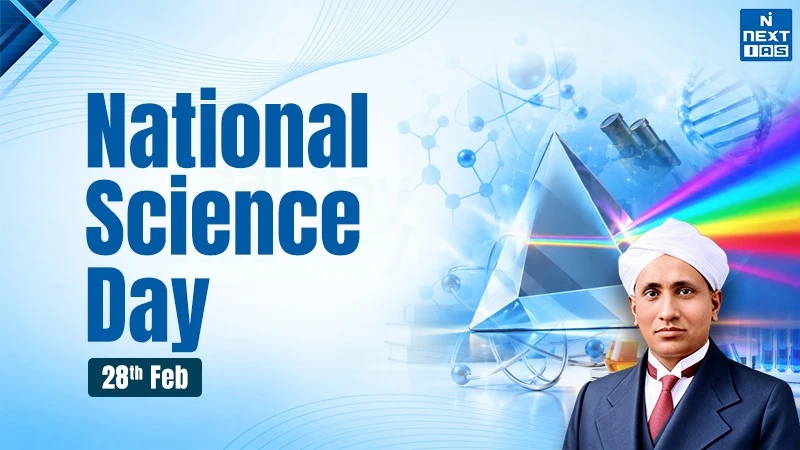
National Science Day is celebrated on 28th February every year in India. It marks the discovery of the Raman Effect by Indian Physicist Dr. C. V. Raman on 28th February 1928. It explains how the light changes its wavelength after interacting with the molecules of matter. Dr. C. V. Raman received the Nobel Prize in Physics in 1930 which was Asia's 1st nobel prize in science by an Indian.
Theme for National Science Day 2026
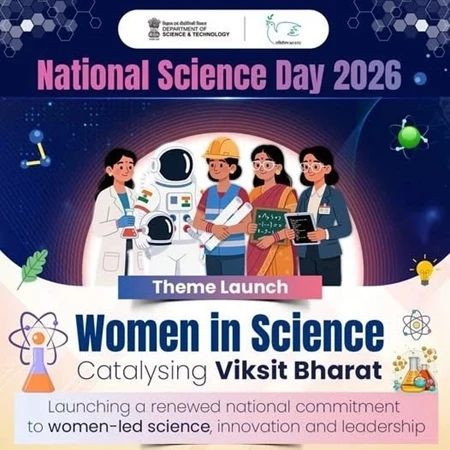
The theme changes annually and is decided by the Department of Science and Technology, Government of India. The theme for National Science Day 2026 is 'Women in Science: Catalysing Viksit Bharat'.
- The 2026 theme "Women in Science" demonstrates how women scientists for India Viksit Bharat 2047 developed the country's vision for a developed nation. The theme shows how female scientists create innovative solutions for AI and biotechnology and climate change and sustainable development fields. The initiative supports national goals by Viksit Bharat which aims to develop gender-inclusive STEM programs that solve healthcare and clean energy and environmental security problems.
- The celebrations feature science exhibitions that showcase women achievers and lectures and quizzes which include the NCSTC online event scheduled for February 21-22 and lab visits to ISRO and CSIR and student projects. The activities motivate young people especially girls to enter scientific fields which develop their scientific mindset and ability to solve practical problems.
- The theme demonstrates how space and biotech pioneers advanced national progress by establishing science as an essential national progress force. The events across educational institutions from schools to colleges to institutes present activities which stimulate curiosity and drive innovation while achieving equal development according to Raman's principle of resource-efficient creativity.
Historical Timeline of Science Day
| S.No. | Timeline | Event | Significance |
|---|---|---|---|
| 1 | 28 February 1928 |
|
|
| 2 | 1930 |
|
|
| 3 | 1986 |
|
|
| 4 | 28 February 1987 |
|
|
| 5 | 2020 |
|
|
| 6 | 2021 |
|
|
| 7 | 2022 |
|
|
| 8 | 2023 |
|
|
| 9 | 2024 |
|
|
| 10 | 2025 |
|
|
What is the Raman Effect?
Raman Effect is the change in the wavelength of light that occurs when a light beam is scattered and deflected by molecules of matter. When a monochromatic beam of light traverses a dust-free, transparent sample of any substance, its light photons undergo inelastic collisions with the molecules of the substance. These collisions make a part of the incident light scatter in directions other than that of the incident beam. Raman Effect is utilized in Raman Spectroscopy which is a method employed for determining and examining the chemical composition of substances.
Events and Celebrations
The celebration of National Science Day in India comprises official and public events across the country. Government bodies, educational and scientific institutions, organize various programs across the country to celebrate the National Day of Science. An overview of some of the events that take place as part of National Science Day celebrations in India:
- The conferment of National Awards for Science & Technology Communication to recognize outstanding efforts in popularizing science among the masses and motivating young minds towards scientific pursuits.
- The radio and television programs promote scientific ideas and thinking.
- The science exhibitions, interactive workshops, lectures by educational institutions.
- The research institutions organize exhibitions of their works which reflect latest advancements and achievements in various scientific fields.
- Non-Governmental Organisations (NGOs) and Community Groups also host events which make science accessible to a broader audience.
Objectives of the Celebration
Though the day mainly commemorates a historic scientific discovery by an Indian scientist, the celebrations of National Day of Science revolve around multiple objectives. Some of the prominent objectives of National Science Day celebrations can be seen as follows:
- Spreading the message of the importance of science and its application in daily life.
- To encourage the youth to engage in scientific activities and consider careers in science and technology.
- Inculcating scientific temper and fostering a culture of innovation among the general public.
FAQs about National Science Day
When is National Science Day celebrated?
National Science Day is celebrated on 28th February every year.
Why do we celebrate National Science Day?
National Science Day is celebrated to commemorate the discovery of the Raman Effect by Sir C.V. Raman on 28th February 1928.
When was the First National Science Day Celebrated?
The first National Science Day was celebrated in India on 28th February 1987.
