
 80813-00200

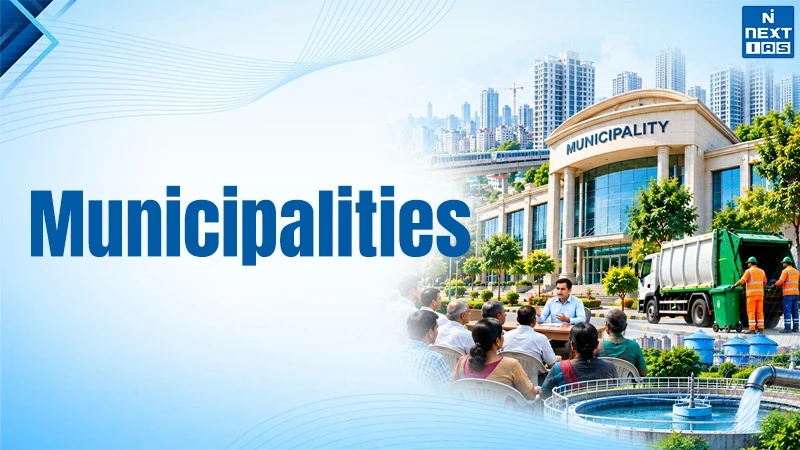
The Municipalities in India are the urban local self government bodies which manage civil infrastructure, public health, and urban planning. It was institutionalized through the 74th constitutional amendment act of 1992. It added Part IX-A and the 12th schedule of the constitution of India. Indian comprises 3 tier urban local bodies: Nagar Panchayats in transitional areas, Municipal Councils in smaller urban regions, and Municipal Corporations in big cities. The 12th schedule lists 18 functions of Municipalities including urban planning, water supply, sanitation, roads, improvement of slum areas and environmental protection. Interestingly, Madras established the oldest municipal corporation in 1688.
Meaning of Municipalities
- Municipalities, also known as Urban Local Bodies (ULBs) refer to the system of 'Urban Local Self-Governance' in India i.e. a system of governance of Urban Areas through the representatives elected by the people.
- They have been established in urban areas across all States as the third tier of government, aiming to build democracy at the local level.
- This system ensures that urban populations participate directly in the decision-making process, thereby enhancing the effectiveness and accountability of urban development initiatives.
Ministry of Housing and Urban Affairs (MoHUA),
Ministry of Defence in the case of Cantonment Boards (MoD),
Ministry of Home Affairs in the case of Union Territories (MHA).
Constitutional Provisions Regarding Municipalities
The original constitution did not contain any provision regarding the Municipalities or Urban Local Bodies (ULBs). However, the 74th Constitutional Amendment Act, of 1992, which gave constitutional status to the Urban Local Governance, added detailed constitutional provisions regarding the Municipalities. The same is discussed in detail in the sections that follow:
Part IX-A of Constitution
- The 74th Constitutional Amendment Act of 1992 added a new Part IX-A to the Constitution of India, entitled 'The Municipalities'.
- Part IX-A of the Indian Constitution consists of Articles 243-P to 243-ZG, which provides for various provisions regarding the Municipalities.
Twelfth Schedule (12th Schedule) to Constitution
- The 74th Constitutional Amendment Act of 1992 has also added a new Twelfth Schedule (12th Schedule) to the Indian Constitution.
- This Twelfth Schedule (12th Schedule) outlines the powers, authority, and responsibilities of Municipalities.
- It contains a comprehensive list of 18 functions that have been devolved to Municipalities to enable them to govern and manage a variety of local issues effectively.
Evolution of Urban Bodies
The concept of Urban Local Governance in India has existed since the ancient days. There is evidence of the same existing during the Harappan period. However, Urban Local Governance, as an organized formal institution in the modern sense, was introduced first in India during British rule.
The major events in this context are as follows:
- 1688-- The first Municipal Corporation in India was established at Madras (now Chennai).
- 1726-- Municipal Corporations were established in Bombay (now Mumbai) and Calcutta (now Kolkata).
- 1870- Lord Mayo's Resolution on Financial Decentralisation was
introduced in 1870.
- This envisioned the development of local self-government institutions to manage Municipal finances more effectively.
- 1882- Lord Ripon's Resolution of 1882, often referred to as the
'Magna Carta' of Local Self-Government, laid the foundation for the modern
framework of local governance.
- For the same reason, Lord Ripon is called the 'Father of Local Self-Government in India'.
- 1907-1909-- The Royal Commission on Decentralisation was
appointed in 1907 and it submitted its report in 1909.
- The Royal Commission on Decentralisation was chaired by C.E.H. Hobhouse which focused on enhancing local self-governance structures.
- 1919- Government of India Act of 1919 introduced the Dyarchical
Scheme, which made Local Self-Government a transferred subject
under the control of a responsible Indian Minister.
- This had the effect of promoting greater local autonomy.
- 1924-- The Cantonments Act was enacted in 1924 by the Central Legislature to govern the administration of cantonment areas.
- 1935-- The Government of India Act of 1935 made Local Self-Government a Provincial Subject. This led to transferring greater responsibility and autonomy to provincial governments for managing local affairs.
- 1949 Onwards-- Post independence, 1949 onwards, the Government of India appointed several committees and commissions to make recommendations on improving the functioning of urban local governments in India.
- 1992-- Finally, the 74th Constitutional Amendment Act,
1992 was passed by the Parliament, which gave the Municipalities
constitutional status as well as a uniformity of structure throughout the
country.
- This brought the states under constitutional obligation to adopt the new urban local government in accordance with and as per the structure provided by the provisions of the Act.
Constitutionalisation of Municipalities
- Based on the recommendations of various committees, the Parliament enacted the 74th Constitutional Amendment Act, 1992, which gave the Municipalities or Urban Local Bodies (ULBs) in India constitutional status.
- The 74th Constitutional Amendment Act of 1992 added various provisions in the
Constitution regarding the Municipalities or Urban Local Bodies (ULBs).
- Important constitutional provisions regarding the Municipalities are discussed in detail in the sections that follow.
Three Types
- The 74th Constitutional Amendment Act of 1992 provides for the
constitution of the following three types of Municipalities or Urban Local Bodies
(ULBs) in every State:
- A Nagar Panchayat (by whatever name called) for a Transitional Area,
- A Municipal Council for a Smaller Urban Area.
- A Municipal Corporation for a Larger Urban Area.
- The Governor has to specify a Transitional
Area, a Smaller Urban Area, or a Larger Urban Area, keeping in
view the following factors:
- The population of the area,
- The density of the population therein,
- The revenue generated for local administration,
- The percentage of employment in non-agricultural activities,
- Economic importance, and
- Such other factors as he/she may deem fit.
Composition of Municipalities
- A Municipality, usually, consists of a Chairperson and other members.
- The Chairperson as well as other members of a Panchayat shall have the right to vote in the meetings of the Panchayats.
- The State Legislature may also provide for the representation of the
following persons in a Municipality.
- Persons having special knowledge or experience in Municipal Administration without the right to vote in the meetings of the Municipality.
- The members of the Lok Sabha and the State Legislative Assembly represent constituencies that comprise wholly or partly the Municipal Area.
- The members of the Rajya Sabha and the State Legislative Council registered as electors within the Municipal Area.
- The Chairpersons of Committees (other than Wards Committees).
Election of Chairperson and Members
- All the members of a Municipality or Urban Local Bodies (ULBs) shall be
elected directly by the people of the Municipal Area.
- For this purpose, each Municipal Area shall be divided into territorial constituencies to be known as Wards.
- The State Legislature may provide the manner of election of the Chairperson of a Municipality.
Important Committees in a Municipality
Wards Committees
- There shall be constituted a Wards Committee, consisting of one or more wards, within the territorial area of a municipality having a population of three lakh or more.
- The state legislature may make provision w.r.t. the composition and the territorial area of a Wards Committee and the manner in which the seats in a wards committee shall be filled.
Other Committees
- In addition to the Wards Committees, the state legislature is also allowed to make any provision for the constitution of other committees.
- The chairpersons of such committees may be made members of the municipality.
Duration of Municipalities
- The 74th Constitutional Amendment Act of 1992 provides for a
five-year term of office for every Municipality from the date of its first
meeting.
- However, it can be dissolved before the completion of its term.
- Fresh elections to constitute a Municipality shall be completed:
- before the expiry of its duration of five years,
- in case of dissolution, before the expiry of a period of six months from the date of its dissolution.
- It is to be noted that if the remainder of the period (for which the dissolved Municipality would have continued) is b, it shall not be necessary to hold any election for constituting the new Municipality for such period.
- Moreover, a Municipality constituted upon the dissolution of a Municipality before the
expiration of its duration shall continue only for the remainder of the
period for which the dissolved Municipality would have continued had it not been
so dissolved.
- In other words, a municipality reconstituted after premature dissolution does not enjoy the full period of five years but remains in office only for the remainder of the period.
- The 74th Constitutional Amendment Act of 1992 also makes two more provisions with
respect to the dissolution of a Municipality:
- a Municipality must be given a reasonable opportunity to be heard before its dissolution, and
- no amendment of any law for the time being in force shall cause dissolution of a Municipality before the expiry of the five-year term.
Reservation of Seats
Reservation of Seats for SCs and STs
- The 74th Constitutional Amendment Act of 1992 provides for the reservation of seats for the Scheduled Castes (SCs) and the Scheduled Tribes (STs) in every Municipality in the proportion of their population to the total population in the Municipal Area.
- The State Legislature shall provide for the reservation of offices of Chairpersons in the Municipalities for Scheduled Castes (SCs) and Scheduled Tribes (STs).
- The reservation of seats as well as the reservation of offices of
Chairpersons in the Municipalities for the Scheduled Castes (SCs) and Scheduled
Tribes (STs), shall cease to have effect after the expiration of the period
specified in Article 334.
- Presently, this reservation is to last till 2030.
Reservation of Seats for Women
- The Act provides for the reservation of not less than one-third of the total number of seats for women (including the number of seats reserved for women belonging to the Scheduled Castes and Scheduled Tribes).
- Further, the State Legislature shall provide for the reservation of offices of Chairpersons in the Municipalities for women.
Reservation of Seats for Other Backward Classes (OBCs)
The Act authorizes the State Legislature to make any provision for the reservation of seats in any Municipality or offices of Chairperson in the Municipality in favor of Backward Classes.
Disqualification of Members
- A person shall be disqualified for being chosen as or for being a Member of a
Municipality if he/she is so disqualified:
- under any law for the time being in force for elections to the Legislature of the State concerned,
- under any law made by the State Legislature.
- All questions of disqualifications shall be referred to such authority as determined by the State Legislature.
Powers and Functions
- The State Legislature may endow the Municipalities or Urban Local Bodies (ULBs) with such powers and authority as may be necessary to enable them to function as institutions of self-government.
- State's provisions for the devolution of powers and responsibilities
upon Municipalities or Urban Local Bodies (ULBs) may contain:
- the preparation of plans for economic development and social justice, and
- the implementation of schemes for economic development and social justice as may be entrusted to them, including those in relation to the 18 matters listed in the Twelfth Schedule.
Jurisdictions of Municipalities
The jurisdiction of an Urban Local Government is limited to a specific Urban Area which is demarcated for this purpose by the State Government.
Finances of Municipalities
As per the provisions regarding the finances of Municipalities or Urban Local Bodies (ULBs), the State Legislature may:
- authorize a Municipality to levy, collect, and appropriate taxes, duties, tolls, and fees,
- assign to a Municipality taxes, duties, tolls, and fees levied and collected by the State Government,
- provide for making grants-in-aid to the Municipalities from the Consolidated Fund of the State, and
- provide for the constitution of funds for crediting all money of the Municipalities.
District Planning Committee (DPC)
- A District Planning Committee is to be constituted by every State at the district level to consolidate the plans prepared by Panchayats and Municipalities in the district, and to prepare a draft development plan for the district as a whole.
- The State Legislature may make provisions with respect to the
following:
- The composition of such Committees,
- The manner of election of Members and Chairpersons of such Committees, and
- The functions of such Committees in relation to district planning.
Metropolitan Planning Committee (MPC)
- Every Metropolitan Area shall have a Metropolitan Planning Committee (MPC) to prepare a Draft Development Plan and forward it to the State Government.
- The State Legislature may make provisions with respect to the
following:
- The composition of such Committees,
- The manner of election of Members and Chairpersons of such Committees,
- The representation in such Committees of the Central Government, State Government, and other organizations, and
- The functions of such Committees in relation to planning and coordination for the Metropolitan Area.
FAQs about Municipalities
What is a Municipality?
A municipality is an urban local self government body which administers and provides the civic services in small towns.
What is a Municipal Corporation?
A municipal corporation is an urban local body which administers and provides the basic civic services in larger cities.
Who is the head of a Municipal Corporation?
The Mayor is the head of a Municipal Corporation. He is an elected political head. The Municipal Commissioner is its executive head.
