
 80813-00200

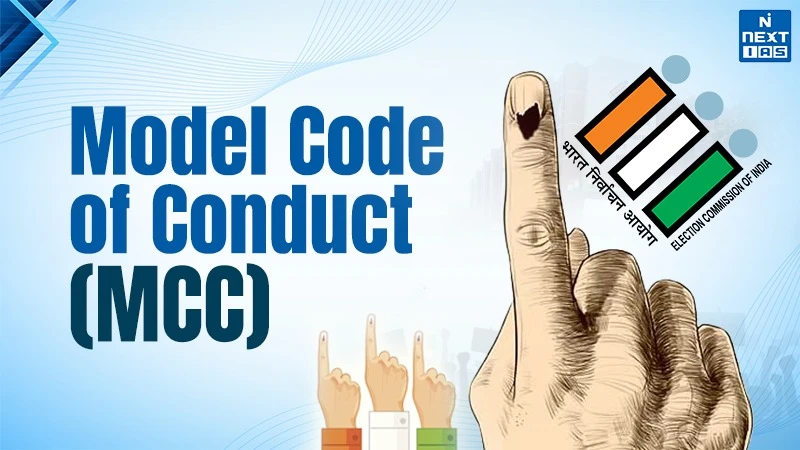
The Model Code of Conduct is a code of practice issued by the Election Commission of India in order to ensure free, fair and orderly elections. The development of MCC indicates attempts made to provide an equal footing for the political parties and candidates.
MCC provides norms for campaigning, making speeches and holding meetings, behaviour during polling day, election manifestos and the use of official machinery by the ruling party. This code does not allow the use of caste and religion as bases for appeal and other activities like bribery, intimidation and the misuse of official machinery.
About Model Code of Conduct
- The Model Code of Conduct (MCC) is a set of guidelines issued by the Election Commission of India to regulate the conduct of political parties and their candidates in the run-up to elections.
- These guidelines range from issues related to speeches, polling day, polling booths, portfolios, the content of election manifestos, processions, and the general conduct of the political candidates.
- The primary objective of the Model Code of Conduct (MCC) is to ensure that campaigns, polling, and counting proceed in an orderly, transparent, and peaceful manner.
- The Model Code of Conduct (MCC) helps the Election Commission of India in fulfilling its mandate, given by Article 324 of the Constitution, of supervising and conducting free and fair elections.
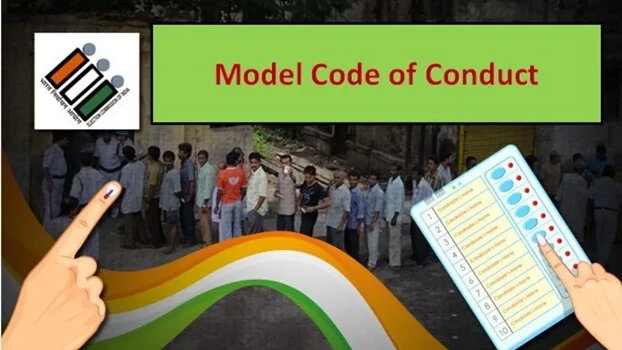
Objectives of Code of Conduct
The key objectives of the Model Code of Conduct (MCC) are:
- To ensure that elections are free, fair, and transparent, maintaining the integrity and credibility of the electoral process.
- To keep the campaign fair and healthy, and avoid clashes between parties.
- To provide a level playing field for all political parties.
- To ensure that the ruling party does not misuse its official position to gain an unfair advantage in an election.
Evolution of the Model Code of Conduct
The Model Code of Conduct (MCC) has evolved with the consensus of political parties to abide by the principles embodied in the said code and to respect and observe it in its letter and spirit. The evolution of the Code, over the years, can be seen as follows:
- Origin
- The origin of the MCC dates back to 1960 when a small set of Dos and Don’ts for the Assembly Election in Kerala in 1960.
- Spread
- In the 1962 Lok Sabha General Elections, the Commission circulated this code to all the recognized political parties, and the State Governments were requested to secure the acceptance of the Code by the Parties.
- In 1967, the Code was followed in the Lok Sabha and Assembly elections.
- In 1968, the Election Commission held meetings with political parties at the State level and circulated the Code of Conduct to observe minimum standards of behavior to ensure free and fair elections.
- In 1971-72, during the General Election to the House of the People/State Legislative Assemblies, the Commission circulated the Code again.
- At the time of general elections to some State Assemblies in 1974, the Commission issued the code of conduct to the political parties in those States.
- Consolidation
- In 1979, the Election Commission, in consultation with the political parties further amplified the code, adding a new Section placing restrictions on the “Party in power” to prevent cases of abuse of a position of power to get undue advantage over other parties and candidates
- In 1991, the code was consolidated and re-issued, which developed and shaped into its present form.
- Judicial Recognition
- The MCC has received judicial recognition in the Union of India Vs. Harbans Sigh Jalal and Others case of 2001 wherein the Supreme Court ruled that the Code of Conduct would come into force the moment the Election Commission issues the press release.
- This ruling laid at rest the controversy related to the date of enforcement of MCC.
- The MCC has received judicial recognition in the Union of India Vs. Harbans Sigh Jalal and Others case of 2001 wherein the Supreme Court ruled that the Code of Conduct would come into force the moment the Election Commission issues the press release.
Salient Features
The salient features of the Model Code of Conduct lay down how political parties, contesting candidates, and party(s) in power should conduct themselves during the process of elections. They issue necessary guidelines which have been mentioned below:
- General Conduct during electioneering.
- Holding meetings and processions.
- Poll day activities.
- Appointment of observers.
- Functioning of the party in power.
- Election Manifestos.
MCC Provisions for Political Parties
The Model Code of Conduct (MCC) in India has several significant provisions which include:
- General Conduct – Political Parties and their candidates are prohibited from engaging in activities that may stoke communal tensions or promote hatred between different groups.
- Criticism of rival parties should be based on their policies, schemes, and past performances, avoiding personal attacks.
- Further, places of worship such as temples, mosques, and churches should not be utilized for election propaganda.
- Meetings – The party or candidate must notify the local police authorities for organizing political meetings and election campaigns for proper management and security and to ensure law and order arrangements.
- Polling Day – The political party or candidate should collaborate with the polling authorities at the polling booths to ensure the smooth conduct of elections. For example, distribution of food or alcohol near polling stations is prohibited to prevent voter manipulation.
- Polling Booth – Only authorized individuals with passes from the Election Commission are allowed inside polling booths, apart from the voters.
- Observers – The Election Commission appoints observers to address complaints or issues raised by political candidates or their agents during the election process.
- Party in Power – The ruling party is expected to refrain from misusing its official position for electoral advantage, ensuring a level playing field for all candidates.
- Election Manifesto – The election manifesto shall not contain anything repugnant to the ideals and principles enshrined in the Constitution, and it shall be consistent with the letter and spirit of other provisions of the Model Code of Conduct.
Recent Additions
- Regulation of Opinion Polls and Exit Polls – The ECI has regulated the conduct of opinion polls and exit polls during the period specified by notifying guidelines to ensure fairness and prevent undue influence on voters.
- Prohibition of Advertisements in Print Media – Advertisements in print media are prohibited on polling day and one day before it unless their contents are pre-certified by screening committees to ensure compliance with election norms.
- Restriction on Government Advertisements – There is a restriction on government advertisements featuring political functionaries during the election period to prevent the misuse of public funds for political gains and ensure a level playing field for all parties.
Enforcement of Model Code of Conduct in India
The Election Commission announces the scheduled elections in a major press conference a few weeks before the formal process is set in motion. The Model Code of Conduct (MCC) comes into effect immediately after this announcement and remains in force until the announcement of election results. Thus, the Code remains in effect throughout the election process.
Applicability of MCC
- Lok Sabha Elections – During the General Elections to the House of People (Lok Sabha), the code is applicable throughout the country.
- Legislative Assembly Elections – During the General Elections to the Legislative Assembly (Vidhan Sabha), the code is applicable in the entire State.
- Bye-Elections – During the bye-elections, the code is applicable in the entire district or districts in which the constituency falls.
Parliamentary Standing Committee’s Position w.r.t. Legalization of MCC
In 2013, the Standing Committee on Personnel, Public Grievances, Law, and Justice suggested making the Model Code of Conduct (MCC) legally binding.
The arguments given by the Committee were as follows:
- Most of the provisions of the MCC are already contained in various laws and are therefore enforceable.
- Currently, there is an absence of an immediate appeal mechanism against the decisions of the Returning Officers. The decision can be challenged only after the announcement of election results.
Election Commission’s Position w.r.t. Legalization of MCC
The Election Commission has opposed making MCC legally binding due to practical concerns such as:
- It argues that elections get completed within a short time frame, typically around 45 days. Legal proceedings usually take longer, making it impractical to enforce MCC through the legislative process.
- The decision-making power will go to the judiciary and thus the swiftness in dealing with the cases of violation of MCC will be gone.
- The legal codification of these norms would be a potential nightmare, exposing the entire electoral process to needless litigation.
- The broad objectives of the MCC are best achieved by the oversight of an impartial election watchdog that can conduct free and fair elections.
Legal Provisions Aiding Implementation of MCC
Though the MCC is not legally enforceable, there are some existing legal provisions that align with the principles of the MCC and aid in its implementation. Some of such provisions can be seen as follows:
- The Representation of the People Act (RoPA) of 1951 contains some provisions which align with the implementation of the MCC:
- Section 8 of the Act deals with disqualification on conviction for certain offenses.
- Part VII of the Act contains provisions related to Corrupt Practices and Electoral Offences.
- Certain provisions of the Model Code of Conduct (MCC) are mentioned in the existing statutes like the Indian Penal Code (IPC) 1860, and Code of Criminal Procedure (CrPC) 1973.
Importance of Model Code of Conduct in Election
- Provides Equal Opportunity: Ensures that the ruling party cannot use government machinery or facilities to secure an electoral advantage.
- Facilitates Free and Fair Elections: Formulates rules to be followed by the political parties and their candidates to ensure the fairness of the entire process of elections.
- Controls Election Campaigns: Regulates political campaigning, including speeches, rallies, meetings, advertisements, etc.
- Avoids Abuses of Authority: Makes it impossible to announce new schemes, projects and grants that may affect the electorate while conducting elections.
- Guarantees the Freedom of Choice of Voters: Discourages practices like bribing, intimidation and politics based on caste, religion or communal considerations.
- Maintains Electoral Discipline: Sets the standards to be adhered to by the political parties and their candidates during elections.
- Enhances Public Confidence: The regular and consistent application of MCC ensures the confidence of the people in the Election Commission of India and the election process itself.
- Makes Political Behavior Ethical: Incentivizes ethical politics.
Criticism of Model Code of Conduct
Some of the main criticisms of Model Code of Conduct are as follows:
- Enforceability – Model Code of Conduct lacks legal enforceability and depends mainly upon moral coercion resulting into limitations in governance activities and budget allocations.
- Delayed and Inadequate Responses – Election Commission’s responses to derogatory statements made by influential politicians have been either delayed or inadequate, thus, making it possible for those violators to violate the Model Code of Conduct without any fear.
- Lack of Disqualification Authority – Election Commission does not have the power to disqualify the electoral malpractice committed candidate(s).
- Cannot De-register Political Parties – Election Commission lacks the power to de-register political parties for their electoral malpractices.
- Inefficiency in Preventing Malpractices – Various electoral malpractices like hate speech, fake news, threats to voters, etc., have not been prevented by the Model Code of Conduct due to many difficulties posed by the use of new technologies.
- Timing of Application of MCC – Election Commission is often criticized for either applying Model Code of Conduct too early or too late which affects the development activities.
- Low Awareness and Compliance – The MCC is not widely understood or adhered to by voters, candidates, political parties, and government officials highlighting the need for increased awareness and compliance efforts.
FAQs about MCC
What is the Model Code of Conduct (MCC)?
The MCC refers to guidelines framed by the Election Commission of India for regulating the conduct of political parties and their candidates in the conduct of elections.
When is the Model Code of Conduct operative?
The MCC becomes operative once the Election Commission issues notification regarding the schedule of elections.
Is the Model Code of Conduct Legally Enforceable?
The Model Code of Conduct (MCC) has originated and evolved with the consensus of political parties. It does not have any statutory backing and hence is not enforceable by any law.
