
 80813-00200


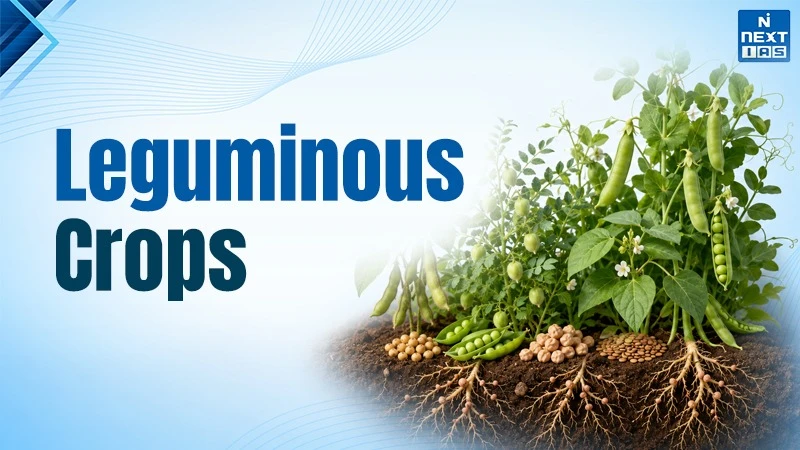
Leguminous crops belong to the fabaceae family of plants and include lentils, chickpeas, soybean, peanuts, green peas and green manure crops. The leguminous plants utilize biological nitrogen fixation because they cannot directly use the nitrogen gas from the atmosphere. The Rhizobium bacteria which live in the roots of legumes gets food and shelter from the plant and in return, the bacteria convert atmospheric nitrogen into usable ammonia. Legumes have a great significance for food and nutritional security as well as soil health in India.
It is interesting to note that all pulses are legumes but not all legumes are pulses. This is primarily because legumes include the stem and leaves whereas the pulses are the dried edible part of legumes.
Major Leguminous Crops in India
| S.No. | Type | Major Crops |
|---|---|---|
| 1 | Pulses |
|
| 2 | Oilseed legumes |
|
| 3 | Fodder legumes |
|
| 4 | Green manure |
|
Role of Leguminous Plants in Soil Fertility and Nitrogen Fixation
- The leguminous plants have a unique ability to enrich soil due to biological nitrogen fixation. The roots of leguminous plants develop nodules inhabited by nitrogen-fixing bacteria which are predominantly rhizobium.
- The bacteria fixes the atmospheric nitrogen which is not available for direct utilization by the plants into ammonia and other nitrogen compounds. In exchange, the plants supply the bacteria with carbohydrates and habitation.
- This will enhance the nitrogen status of the soil during the period of crop growth and post-decomposition of the residues. When the roots, leaves, and stems of leguminous plants are added to the soil through green manuring or crop residues, the nitrogen and organic matter gets released which enhances the physical and biological condition of the soil. This means that the subsequent non-leguminous crops such as cereals will benefit from the residual nitrogen.
- In rainfed regions and low-input agricultural systems, legumes play a major role in minimizing the use of artificial nitrogen fertilizers. They also assist in restoring degraded soils through addition of organic carbon to the soil. They minimize soil erosion by developing roots, and at times help in salinity management.
- The amount of nitrogen fixed by the crops varies with species of the plant, soil type, availability of water, and seed inoculation with proper rhizobia.
- Through the incorporation of leguminous plants in crop rotation, inter-cropping, and mixed farming, farmers will be able to maintain soil fertility for many years to come and achieve the national objective of balanced fertilizer application.
Major Leguminous Producing States
| S.No. | Crop | Major Producing States |
|---|---|---|
| 1 | Chickpea or chana |
|
| 2 | Pigeon pea or arhar or toor |
|
| 3 | Mung bean or Urd bean |
|
| 4 | Lentil or masoor |
|
| 5 | Groundnut |
|
| 6 | Soybean |
|
Agricultural Importance
- Leguminous crops ensure food security and sustainable agriculture as they are good sources of plant proteins and help prevent malnutrition, particularly in vegetarian diets.
- In agriculture, leguminous plants offer another source of income besides cereal and cash crops.
- The main agronomic value of legumes is their ability to fix nitrogen in the soil. They help to reduce the use of expensive nitrogenous fertilizers which saves money and prevents the development of environmental problems such as nitrate leaching and the release of greenhouse gases.
- Rotation of cereals with legumes breaks the cycle of pests and diseases, improves soil structure, and increases the organic matter.
- The legumes are suitable in different systems of crop rotation where they can be grown as rabi, kharif, and zaid crops, as intercrops along with cereals, and as short duration catch crops during the gap between different seasons.
- Leguminous plants have received attention in recent years in light of climate change due to their capacity to enhance soil fertility, decrease dependence on fertilizer, and stabilize yield in fluctuating rainfall conditions.
- In general, legumes play an essential role in the sustainable intensification of agricultural production in India.
Challenges in India
- Legumes in India face many problems or challenges even though they are significant crops. There are low and inconsistent yields because of the lack of better crop varieties, seed replacements, and proper agronomic practices.
- Farmers tend to cultivate local varieties that have low productivity and fail to use good seeds.
- The leguminous crops are normally cultivated in marginal and rain-fed areas where soil fertility is low and the rainfall is inconsistent.
- Therefore, making the crop susceptible to both drought and pests. The lack of proper irrigation, inadequate fertilization, and inability to protect the plants reduce production.
- Market problems such as inadequate procurement, unstable prices, and the role of middlemen deter farmers from increasing legume production.
- All these factors combined restrict the complete exploitation of leguminous crops to increase food security, soil fertility, and income for Indian farmers.
Government Schemes for Leguminous Crops in India
| S.No. | Scheme / Programme | Key Support for Leguminous Crops |
|---|---|---|
| 1 | National Food Security Mission - Nutri Cereals, Pulses and Oilseeds (NFSM-Pulses & Oilseeds) |
|
| 2 | PM‑KISAN |
|
| 3 | MSP and Procurement Operations |
|
| 4 | Seed Hub or Seed Village Schemes |
|
| 5 | Soil Health Card Scheme |
|
UPSC Practice Question
Which one of the following is a leguminous crop?
- A. Wheat
- B. Barley
- C. Sesbania
- D. Oats
FAQs about Leguminous Crops
What are Leguminous Crops?
The leguminous crops or plants belong to the fabaceae family that fix atmospheric nitrogen through root nodules. It enriches soil and provides protein-rich food and fodder. For example, Pulses and Oilseeds.
Why are Leguminous Crops important for sustainable agriculture?
Leguminous Crops fixes atmospheric nitrogen which ultimately enrich the soil fertility and reduces dependence on chemical fertilizers, and improves crop yield.
How do leguminous plants help in maintaining soil fertility?
The Rhizobium bacteria that lives in the root modules of the leguminous plants fix the atmospheric nitrogen into usable form. It also enriches soil nitrogen and improves fertility for subsequent crops.
