
 80813-00200


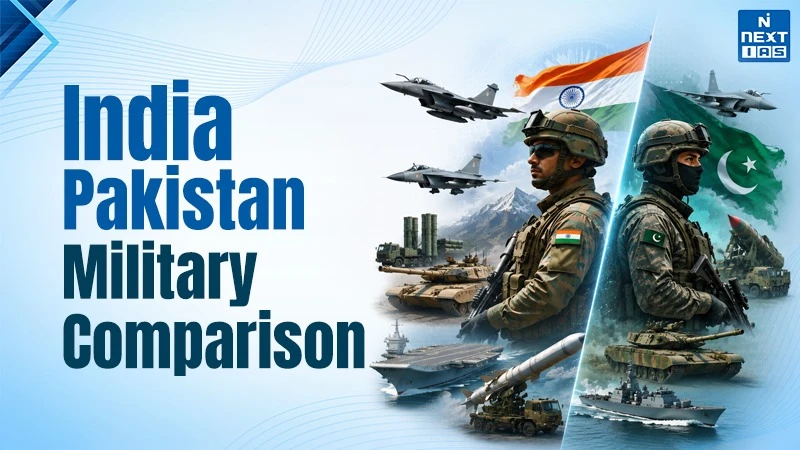
Both India and Pakistan have nuclear power. India possesses an undeniable edge over Pakistan regarding the total size of their conventional military forces. As reported by IISS (International Institute for Strategic Studies), India has approx 12.4 lakh army personnel while Pakistan has 560,000 military personnel. In Naval capacity of India 75,500 navy personnel and Pakistan have only 30,000 persons. Air capability of India 149,900 Air Force personnel, whereas Pakistan has 70,000 personnel. Moreover, India enjoys a better naval presence with its 2 aircraft carriers, 16 submarines, 11 destroyers, and 16 frigates, on the other hand, Pakistan has a fleet of 8 submarines and 10 frigates.
Regarding air power, India's number of 730 aircraft is more than Pakistan's total of 452 aircraft. The nuclear arsenals of both nations are nearly balanced with 172 and 170 warheads estimated for India and Pakistan correspondingly. The military budget of India for 2026-27 amounts to approximately ₹7.85 lakh crore. India has 2 Aircraft carriers INS Vikrant and INS Vikramaditya whereas Pakistan does not have it. India has a Nuclear triad which includes land based Intercontinental ballistic missiles (ICBMs), water-based submarine-launched ballistic missiles (SLBMs), and airforce based strategic bombers. Pakistan does not have a fully operational nuclear triad.
Indian Army vs Pakistan Army Comparison
The Indian Army has much greater numbers as compared to that of Pakistan with around 1.2 – 1.4 million soldiers on active duty as against 560,000 soldiers of Pakistan. The Indian Army has about 4,000 plus tanks and 1.4 lakhs plus armoured fighting vehicles which are almost thrice the number in Pakistan and 9,700 plus artillery pieces as compared to Pakistan's 4,600 artillery guns.
| S.No. | Parameter | India (approx.) | Pakistan (approx.) |
|---|---|---|---|
| 1 | Active army personnel | 1.2 million | 560,000 |
| 2 | Main battle tanks | 4,200 | 2,600 |
| 3 | Armoured fighting vehicles | 1.48 lakh+ | 49,000 |
| 4 | Artillery pieces (towed + self‑propelled + rockets) | 9,700+ | 4,600+ |
| 5 | Reservists (all services) | 11.5 lakh | 5.5 lakh |
| 6 | Paramilitary or border forces | 16 lakh+ (BSF, CRPF, etc.) | Large paramilitary (FC, Rangers, etc.) |
Indian Navy vs Pakistan Navy Comparison
The Indian Navy is significantly more powerful than the Pakistani Navy, which has around 110–150 warships compared to India's 290–300 warships, including 2 aircraft carriers, more destroyers, frigates, submarines (nuclear included) as well as other auxiliary vessels, giving India "blue water" capability and capacity for sea control, whereas Pakistan has concentrated mainly on submarines, fast attack crafts and coastal defense.
| S.No. | Parameter | India (approx.) | Pakistan (approx.) |
|---|---|---|---|
| 1 | Approx. naval personnel (active) | 67,000 | 30,000 |
| 2 | Major warships (frigates, destroyers, corvettes, etc.) | 290+ | 110+ |
| 3 | Submarines (conventional + nuclear) | 18 (including nuclear SSBNs) | 8 (diesel‑electric) |
| 4 | Aircraft carriers | 2 | 0 |
| 5 | Destroyers | 13 | 6 |
| 6 | Frigates | 13 | 9 |
| 7 | Corvettes / patrol vessels | 20+ | Several smaller craft |
Indian Air Force vs Pakistan Air Force Comparison
India has a larger number of aircraft – around 2,200+, including around 580–600 fighter jets, along with AWACS, tankers, and unmanned aerial vehicles, whereas Pakistan has around 1,300–1,400 aircraft, out of which it has around 470 fighter aircraft. India has the advantage of numbers and reach, and the variety of platforms, while Pakistan has the advantage of well-trained pilots, maneuverability, and cost-efficient jets.
| S.No. | Parameter | India (approx.) | Pakistan (approx.) |
|---|---|---|---|
| 1 | Approx. air force personnel | 1.35 lakh | 70,000 |
| 2 | Total military aircraft | 2,200+ | 1,400+ |
| 3 | Fighter / combat aircraft | 500–600 | 330–470 (estimates vary) |
| 4 | Aerial tankers | 6 | 4 |
| 5 | Helicopters (attack + utility) | 500+ | 370+ |
| 6 | Drones / UAVs | 100+ | 50+ |
India vs Pakistan Missile Systems and Nuclear Capabilities
- Nuclear capabilities of both countries are almost the same at an estimated number of 170-190 warheads for each of them, but India has a slight lead. India operates under the principle of minimum deterrence and no-first-use, while Pakistan has not adopted an official no-first-use doctrine and uses all three delivery modes.
- Missile capabilities of India cover short-range Prithmi, medium/intermediate range Agni-I to Agni-V, the supersonic cruise BrahMos, and the submarine-launched K-15/K-4 SLBM, thus making India develop its triad capacity (ground, air, naval). The main arsenal of Pakistan includes Ghaznavi, Shaheen-I/II/III, Babur cruise missiles, and developing sea-based capabilities.
- From a strategic point of view, India finds itself with a two-front threat (Pakistan & China) situation, with an increasing emphasis on longer range, canisterized, and mobile platforms. On the other hand, Pakistan is working on tactical nuclear weapons and shorter range missiles to counterbalance India's conventional dominance. In essence, India has more conventional forces and an evolving triad, while Pakistan has a dense and mobile nuclear and missile deployment. This makes for an interesting equilibrium for UPSC aspirants.
FAQs about India vs Pakistan Defence Powers
What country has a larger defence budget among India and Pakistan?
India's defence budget is roughly 8-10 times larger than Pakistan's which enables India to keep bigger forces and greater indigenous Research and Development.
Who has naval superiority among India and Pakistan?
India has a superior navy with aircraft carriers, larger surface fleet, and nuclear submarines whereas Pakistan's navy is smaller and more regionally focussed.
