
 80813-00200

IMF full form is International Monetary Fund. It is an international organisation created by an agreement signed in 1944 at the conference at Bretton Woods. It is for enhancing international monetary cooperation and ensuring economic and financial stability across the globe. This organisation is charged with the responsibility of offering its members policy advice and financial assistance when they face balance of payment problems. It keeps track of economic trends and exchange rates on a global scale in order to avert financial crises.
Historical Background of IMF
The idea for the International Monetary Fund (IMF) was born at the Bretton Woods conference in 1944, where 40 Allied countries considered setting up organisations to maintain economic stability after the war. The IMF started functioning on the global stage in December 1945, when its operations commenced in March 1947. The primary purpose of the IMF was to establish a regime of adjustable fixed exchange rates, foster international monetary cooperation, and lend temporary financial support to countries suffering from the imbalance of payments problems. After the collapse of the Bretton Woods fixed exchange rate regime in the early 1970s, the IMF has changed its purposes dramatically.
Objectives & Functions of International Monetary Fund
The main goal of the International Monetary Fund (IMF) is the improvement of the international monetary system and the establishment of economic stability. These objectives mainly include the following: the development of international monetary cooperation; the stability of the exchange rate and the promotion of international trade; the solution of the problems with balance of payments in member countries; the support of economic growth and employment.
IMF Functions
Surveillance and Economic Monitoring
IMF periodically monitors member countries economies through economic surveillance and performs Article IV consultations to evaluate economic policies, vulnerabilities and outlooks. The IMF also performs global monitoring such as World Economic Outlook to highlight emerging economic vulnerabilities.
Financial Support
The IMF lends money to countries facing balance of payments issues or financial crises. This lending is mostly based on certain policy actions or conditionality that helps to restore macroeconomic stability.
Capacity Building
The IMF offers technical assistance to governments and central banks for building strong fiscal and monetary systems.
How does the IMF Work?
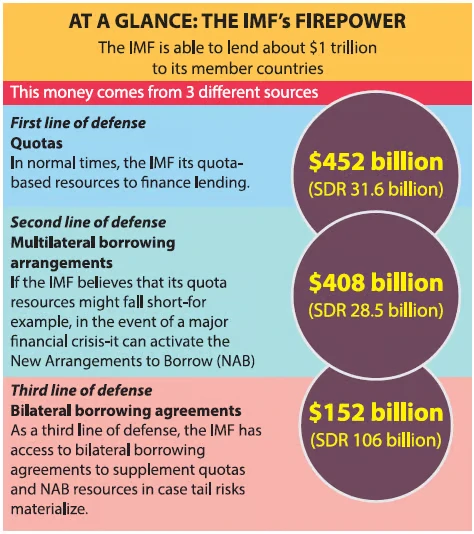
The International Monetary Fund provides financial assistance, economic analysis, and technical help to its member states for achieving global monetary and financial stability. This operation is mostly done using the IMF member country quotas, which play a role in determining financial contribution, voting power, and use of IMF resources.
- Financial Contributions of Members: The member countries make a financial contribution in accordance with their IMF quotas.
- Economic Surveillance: The IMF keeps an eye on the economies of its members by conducting consultations under Article IV.
- Financial Assistance: In case the countries have any kind of problems related to balance of payments, they can get financial help from the IMF for stabilizing their economies.
- Conditionality: There can be conditionality involved in the financial program of the IMF.
- Capacity Development: The IMF offers technical assistance and training programs to the governments and central banks for improving economic institutions.
- Allocation of Special Drawing Rights (SDRs): The IMF can allocate SDRs to the member states.
Governance Structure
The International Monetary Fund (IMF) is managed by the member countries according to the decision making process. The supreme governing body is the Board of Governors consisting of a single Governor and an Alternate Governor for each member country. In the case of India, the Finance Minister is the Governor while the RBI Governor is the Alternate Governor. The Board takes important decisions relating to changes in quotas, SDRs, the membership and modifications of the IMF's governing structure. There are two ministerial committees namely, the International Monetary and Financial Committee (IMFC) and the Development Committee which offer advice regarding international monetary, financial and developmental matters. The Executive Board of 24 Executive Directors supervises the affairs of the IMF. The managing director heads the staff of the IMF as well as presides over the Executive Board.
IMF Quota System
- The IMF’s quota system was created to raise funds for providing loans.
- Each member country is assigned a quota (i.e. contribution) that reflects the country’s relative size in the global economy.
- Higher quota is directly related to high voting rights and greater borrowing permissions.
- Quota defines the amount of assistance a country will get out of the contingency fund of the International Monetary Fund, as well as the power of a country to influence the lending decisions and tap into the funds themselves.
- Quotas are denominated in Special Drawing Rights (SDRs) – the IMF’s unit of account.
How IMF Quota is Determined?
- Upon joining the International Monetary Fund, each member country contributes a specified amount of money, known as a quota subscription.
- The quota subscription of a member country is determined according to the Quota Formula, which is based on the country’s economic performance and wealth.
- It is a weighted average of:
- GDP (weight of 50 percent),
- Openness (30 percent),
- Economic variability (15 percent),
- International reserves (5 percent).
Note: GDP of a member country is measured through a blend of GDP based on market exchange rates (weight of 60 per cent) and GDP based on PPP exchange rates (40 per cent).
IMF vs WTO vs World Bank
IMF, World Bank and WTO are some of the key institutions within the world economic order, but they have different areas of specialization. While the IMF works on promoting international monetary and financial stability, the World Bank specializes in economic development and poverty eradication, and the WTO sets the rules regulating international trade.
| Basis | IMF | World Bank | WTO |
|---|---|---|---|
| Full Name | International Monetary Fund | World Bank | World Trade Organization |
| Established | 1944 | 1944 | 1995 |
| Headquarters | Washington, D.C. | Washington, D.C. | Geneva, Switzerland |
| Primary Focus | Global monetary and financial stability | Development and poverty reduction | International trade |
| Major Role | Provides financial assistance and policy advice during economic difficulties | Provides loans and assistance for development projects | Establishes and administers global trade rules |
| Key Concern | Balance-of-payments and macroeconomic stability | Infrastructure, poverty, health, education and development | Trade liberalisation and fair trade |
| Major Instruments | Loans, surveillance, SDRs and technical assistance | Development loans, grants and technical assistance | Trade agreements and dispute settlement |
| India's Relevance | Balance of payments, economic surveillance and financial stability | Development financing and poverty reduction | India's trade policy and international trade negotiations |
IMF Major Criticism & Challenges
The International Monetary Fund (IMF) has been criticized on a number of grounds on account of its operations. Conditions attached to loans can ask borrowing nations to make certain reforms in their economic and political systems, which might pose problems in practice. Measures such as expenditure reduction and elimination of subsidies might cause some social sector concerns due to the impact they might have on weak sections of society.
The voting system within the IMF has also been blamed for putting more emphasis on the advanced nations, which have higher quotas in the organization. There are problems in terms of debt sustainability as a result of repeated borrowing. It becomes hard for developing countries to fulfill reform conditions and simultaneously keep the growth and welfare expenditure. Thus, debates about reforms in the IMF continue.
Reforms Taken by IMF in 2016
- The quotas for all 188 members were boosted, doubling the overall quota resources for the International Monetary Fund.
- Emerging and developing nation gained more influencing power in the governance planning of the International Monetary Fund. More than six per cent of the quota shares were transfer from the U.S. and European countries to developing and emerging nations. The reform gives emerging economies such as Brazil and China larger quota shares at the institution.
- India’s voting rights increased to 2.6% from the current 2.3% and China’s voting rights increased to 6% from 3.8%. China has the 3rd largest quota and voting share after the US and Japan. While, India, Russia and Brazil are among the top 10 members of the organization.
- About 6 per cent of quota shares will shift to emerging market countries. As a result, quota shares of the developed and traditionally strong economies such as the USA and European countries will be diminished. The quota shares of the poorest member countries will largely remain the same.
- The permanent capital resource of the International Monetary Fund has been doubled to SDR 477 billion (about US$659 billion).
- Executives Directors will now be appointed by elections, unlike earlier.
- IMF’s Executive body now consists of entirely elected Executive Directors, thus bringing an end to the category of appointed Executive Directors appointed by the five largest quota-holders.
- The reforms approved by the IMF’s Executive Board aim to ensure that the Fund can adaptively support the financing needs of Low-Income Countries (LICs) during the pandemic and recovery, while continuing to offer concessional loans at zero interest rates.
- The centrepiece of the approved policy reforms is a 45 per cent increase in the normal limits on access to concessional financing, coupled with the elimination of hard limits on access for the poorest countries. These higher access limits will facilitate the provision of more concessional support to LICs with strong policies and a large balance of payment needs.
Suggested IMF Reforms
The developing nations, including India, have been demanding the following reforms in the International Monetary Fund:
- Restructuring the voting rights/powers in the International Monetary Fund reflecting the current global economic scenario. This would require increasing the role of emerging nations like India and China while reducing the role of developed nations.
- Comprehensive review of the different conditionality associated with the IMF loans.
- More resources to IMF since the magnitude of international trade has increased and the number of countries that will approach to the International Monetary Fund (IMF).
- The current arrangement, which mandates the head of the IMF to be a European and the head of the World Bank to be an American, should be done away with.
- Long-term Crisis management rather than just short-term solutions advocated by the International Monetary Fund (IMF).
Suggested IMF Reforms
- India has been one of the largest recipients of funds from the International Monetary Fund.
- The Indian constituency countries include Bhutan, Bangladesh, and Sri Lanka.
- Presently, India holds 2.75% of the SDR quota and 2.63% of votes in the IMF.
- Though India has not been a frequent user of the organization, IMF credit has been instrumental in helping India in relevance to the Balance of Payments Crisis on multiple occasions, such as the post-partition crisis, Indo-Pakistan Conflicts of 1965 and 1971, in 1991-93, etc.
Major Reports Published by International Monetary Fund
World Economic Outlook
- The International Monetary Fund publishes World Economic Outlook Report twice a year, which contains an analysis of global economic developments for the near and medium term.
- The report forecasts include key macroeconomic indicators, such as inflation, GDP, current account balance, and fiscal balance of more than 180 countries across the world.
- It also publishes the report on annual International Capital Markets.
Global Financial Stability Report
- It provides assessment of the global financial system and markets.
- It addresses emerging market financing in a global context.
Fiscal Monitor
- It was launched in 2009 to survey and analyse the latest public finance developments, update fiscal implications of the crisis and medium-term fiscal projections, and assess policies to put public finances on a sustainable footing.
- It is prepared twice a year by the Fiscal Affairs Department of the organization.
- It focuses on current market conditions and highlights systemic issues that could pose potential risks to the financial stability and sustained market access by emerging market borrowers.
FAQs about IMF
What is the International Monetary Fund?
The IMF is an international financial organization that aims to foster monetary cooperation, promote financial stability, encourage sustainable economic growth, and international economic cooperation among members.
When was the IMF formed?
The IMF was created in 1944 through the Bretton Woods Conference and became operational on December 27, 1945.
In which city is the IMF headquarters?
The IMF headquarters is situated in Washington D.C., U.S. It is where the main functions of the organization take place.
What are the objectives of the IMF?
The objective of the organization includes fostering monetary cooperation, exchange rate stability, balanced payments, and the promotion of economic development.
What are the functions of the IMF?
The IMF performs economic and financial surveillance, lends money, gives technical assistance, and promotes international monetary cooperation.
How does the IMF assist the developing countries?
The IMF assists the developing countries in terms of finance, advice, technical assistance, capacity development, and other measures which help enhance the stability of their economy.
What are the IMF quotas?
Quotas of the IMF are the monetary contribution of the members and also affect their voting rights and access to finance and share in SDRs.
What are SDRs?
SDRs are the international monetary reserves provided by the IMF through basket of important currencies for member countries.
What is the significance of India in the IMF?
India is one of the IMF members participating in decision-making process, making monetary contributions, assessment, etc., and supporting reforms representing interests of developing countries.
What is the difference between IMF and World Bank?
IMF deals primarily with monetary and balance-of-payments problems whereas World Bank deals with long term development issues and poverty alleviation.
Why was the IMF established?
The IMF was established to provide international monetary cooperation and financial stability after the Second World War.
