
 80813-00200



Humayun was the 2nd Mughal Emperor who ruled India twice from 1530 to 1540 and again from 1555 until his death in 1556. He was defeated by Sher Shah Suri at Kannauj where he spent about 15 years in exile under Safavid in Persia. He regained the throne of Delhi in 1555 but unfortunately died the next year by falling from the staircase in the library. The Humayun tomb in Delhi became the 1st grand Mughal garden tomb which influenced other monuments such as Taj Mahal at Agra.
About Humayun
- After the sudden death of Babur, his oldest son Humayun succeeded him. Humayun was the only king in India who ruled two times from 1530 to 1540 and from 1555 to 1556.
- Humayun means 'fortunate,' but he remained 'unfortunate.' in his lifetime. He inherited a rich legacy of hardships but his own blunders made it even richer. As a ruler, he lacked vision in life and could not take a long-term view of political and military problems. He faced many challenges in firmly establishing the Mughal empire.
- Due to Babur's untimely death, the administration had not yet been consolidated. Babur spent most of his life in wars and could not take suitable steps to organise the administration of the territories which he conquered.
- The Mughal army was a heterogeneous body of several races such as Chaghatais, Uzbeks, Mughals, Persians, Afghans, and Hindustanis. Such an army could be controlled and disciplined only under a capable commander like Babur. Humayun was too weak for this purpose.
- After acquiring enormous wealth from the royal treasuries of Delhi and Ajmer, Babur distributed it so lavishly among his soldiers and nobles that very little was left for Humayun to conduct his administrative affairs. In due course, these nobles became very powerful and posed a threat to the stability of the Mughal Empire.
- Humayun had 3 brothers of which he made Kamran as the ruler of Kabul and Kandahar, Askari as the ruler of Rohilkhand, and Hindal as the ruler of Mewat. However, Humayun's brothers were ungrateful and incompetent. As a result, his sphere of influence and power was reduced.
Rise of the Afghans
- Even after the Battle of Ghaghra, the Afghans had not been subdued and were hoping to expel the Mughals. A few years back, the Afghans ruling Delhi still desired to capture power again.
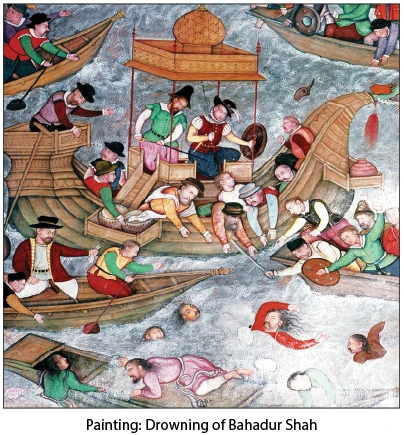
- Bahadur Shah who was the ruler of Gujarat was also an Afghan. He was also ambitious for the throne of Delhi. But Sher Shah in the East was the most important and influential Afghan.
- Therefore, Bahadur Shah in the West and Sher Shah in the East fought numerous battles with Humayun. Humayun failed to estimate Sher Shah Suri's growing power. He should not have accepted Sher Shah's half-hearted submission when Humayun besieged the Chunar fort.
- In the Battle of Kannauj, he made blunders in choosing a low land for placing his army's camp and remaining inactive before the enemy for 2 months. Thus, most of Humayun's troubles were the creation of his own. He had to understand the nature of Afghan power. Due to the large number of Afghan tribes scattered over north India, the Afghans could always unite under a capable leader and pose a tough challenge for Humayun.
- Without winning over the local ruler and zamindars to his side, the Mughals were bound to remain inferior. Sher Shah was superior to Humayan in preparing and planning battles and fighting the enemy. He always took advantage of every opportunity and could use smart strategies to conquer the enemy. Even in the case of Bahadur Shah, Humayun lacked military strategy and quick decision-making.
Administrative Reforms during Humayun's Reign
| S.No. | Area | Reform | Brief Description |
|---|---|---|---|
| 1 | Central administration | Emperor centric rule |
|
| 2 | Departmental division | 4 symbolic departments |
|
| 3 | Military affairs | Atashi department |
|
| 4 | Court organisation | 3 classes of officials |
|
| 5 | Ranking system | 12 grades |
|
| 6 | Territorial administration | Sarkar - Pargana - Village |
|
| 7 | Local officers | Shiqdar, Munsif and Qazi |
|
| 8 | Cultural patronage | Support to scholars and artists |
|
Humayun's Later Life
- After ruling for 10 years, Humayun was forced to spend 15 years outside India. Emperor Humayun became a prince without a kingdom. He wandered in Sindh and its neighbouring regions for two and a half years in the hope of regaining his kingdom. But the ruler of Sindh, Marwar, and his brothers were not willing to help him. Moreover, his brothers turned against him and tried to kill him.
- Ultimately, Humayun took shelter at the court of the Iranian King of the Safavid Dynasty. With his help, he recaptured Qandhar and Kabul from Kamran in 1545.
- Humayun proved himself to be a competent general and politician till his Bengal campaign. In 1555, he re-conquered Delhi after the disintegration of the Sur empire.
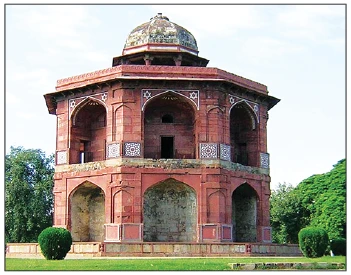
- However, he lived for a short period to enjoy the fruits of victory and died from a fall from the 1st floor of the library building in his fort in Delhi within 6 months of coming to power.
FAQs about Humayun
Who was Humayun?
Humayun was the 2nd emperor of the Mughal dynasty in India who ruled from 1530 to 1540 and from 1555 until he died in 1556.
When was Humayun born?
Humayun was born on 6 March 1508 at Kabul in Afghanistan.
Who was the son of Humayun?
The son of Humayun was Akbar who became one of the prominent emperors of the Mughal dynasty. He was known for his contributions to the expansion and consolidation of the empire.
Who built Humayun's Tomb?
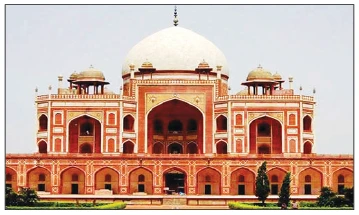
Humayun's Tomb was commissioned by his widow Empress Bega Begum in memory of her husband.
Where is Humayun's Tomb?
Humayun's Tomb is located in Delhi in India.
How did Humayun die?
Humayun fell from the stairs of his library in Delhi in 1556 and died.
Who wrote Humayunnama?
Humayunnama was written by Gulbadan Begum. She was the daughter of Babur and the half sister of Humayun.
