
 80813-00200


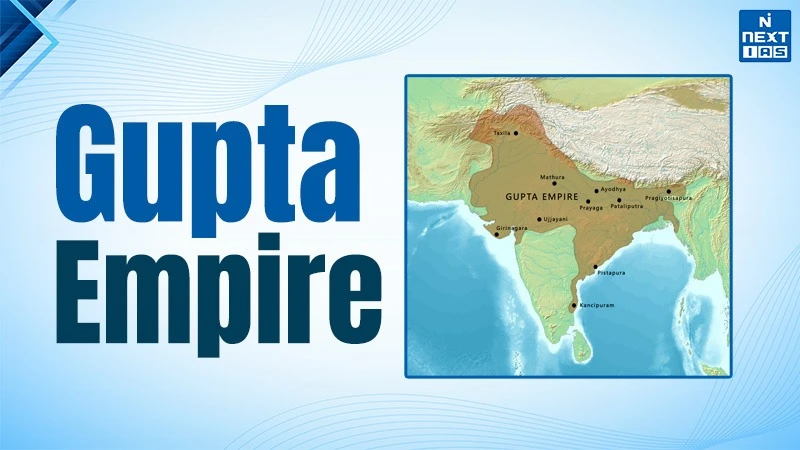
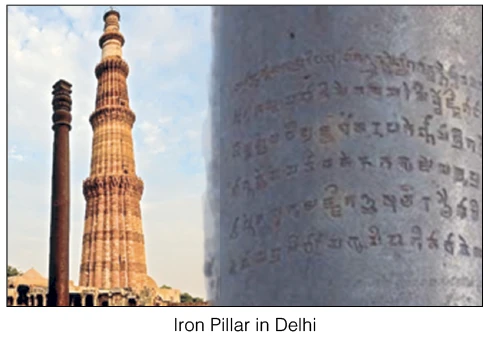
The period of Gupta Empire is considered as the Golden Age of India that flourished from 320 to 550 CE with its scientific explorations & decentralized system of government. The astronomers like Aryabhatt during this period were great Mathematicians & the Rustfree Iron Pillar of Delhi symbolizes the architectural milestone of Gupta period.
Unlike the centralized system in the Mauryan Empire, the Gupta era had a decentralized system of governance. The Guild system including merchants & artisans was often associated with money lending institutions. The period saw a shift from cave temples to stone temples for example the famous Dashavtar temple in Deogarh in Uttar Pradesh belonging to Lord Vishnu. Mahabharata & Ramayana were provided the literary form in the Gupta period. Astonishingly, while untouchability still prevailed in the period, the standard of shudras had improved in this time period & moreover, they were allowed to worship in temples & listen to the Puranas.
History of Gupta Empire
- The Gupta Empire was an ancient Indian empire founded by Sri Gupta. It spread across northern, central, and southern parts of India between 320 and 550 CE.
- The Gupta Empire is known as the ‘Golden Age of India’ due to its achievements in the arts, architecture, sciences, religion, and philosophy.
- During this Gupta Empire, India witnessed a renaissance in cultural and intellectual pursuits with significant contributions from figures like Kalidasa in literature and Aryabhata in science.
- The Gupta rulers developed an environment of stability and prosperity and facilitated advancements in various fields. At the beginning of the 4th century CE, no powerful empire existed in India. The Satavahanas and the Kushans had emerged as major political powers in the Deccan and the North respectively. There were the emergence of several other minor powers and new ruling families. Against this backdrop, the Guptas who were a family of uncertain origins, began to build an empire at the beginning of the 4th century A.D.
- The ancestry and early history of the Gupta family are little known and have naturally given rise to various speculations. Various historians have given different ancestry to the Guptas such as Vaishya, Brahmins, Kshatriyas, Ikshvaku clan.
- At the end of the 3rd century CE, the original kingdom of the Guptas comprised Uttar Pradesh and Bihar. However, Uttar Pradesh seems to have been a more important province for the Guptas than Bihar because early Gupta coins and inscriptions were mainly found in that state.
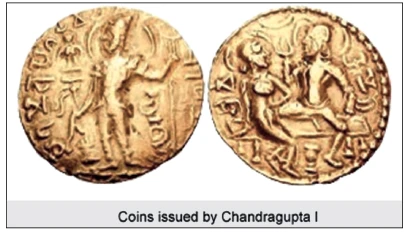
- As per the inscriptions, Sri Gupta was the founder of the Gupta dynasty and Ghatotkacha was the next to follow him. Chandragupta I was the first independent ruler.
Pataliputra as the Capital
- The capital of Gupta Empire was Pataliputra in present day Patna in Bihar. The Gupta Empire was a central political, economic, and cultural hub during the Gupta period.
- The region is known for its strategic location at the confluence of the River Ganges and River Son. The pataliputra was a thriving centre of administration and trade that facilitated the growth and prosperity of the Gupta Empire.
- The significance of the city was further enhanced by its role in promoting learning and artistic achievements which flourished under Gupta rule.
List of Important Rulers of Gupta Empire
| S.No. | Ruler | Approximate Reign (CE) |
|---|---|---|
| 1 | Sri Gupta | 240 to 280 CE |
| 2 | Ghatotkacha | 280 to 319 CE |
| 3 | Chandragupta I (with Kumaradevi) | 319 to 335 CE |
| 4 | Samudragupta | 335 to 375 CE |
| 5 | Ramagupta | 375 to 380 CE |
| 6 | Chandragupta II (Vikramaditya) | 380 to 415 CE |
| 7 | Kumaragupta I | 415 to 455 CE |
| 8 | Skandagupta | 455 to 467 CE |
| 9 | Purugupta | 467 to 473 CE |
| 10 | Kumaragupta II | 473 to 476 CE |
| 11 | Budhagupta | 476 to 495 CE |
| 12 | Narasimhagupta | 495 to 530 CE |
All the important Gupta Empire rulers have been discussed in detail in the following section.
Chandragupta I (C. 319-335 AD)
- Chandragupta-I was the son of Ghatotkacha and is considered the real founder of the Gupta Empire. He married the Lichchhavi princess named Kumara Devi.
- After declaring his independence in Magadha, he enlarged his kingdom with the help of a matrimonial alliance with the Lichchhavis. The boundaries of the kingdom covered parts of Bihar, Uttar Pradesh and Bengal. During the times of his son Samudragupta, the kingdom grew into an empire.
Samudragupta (335-380 AD)
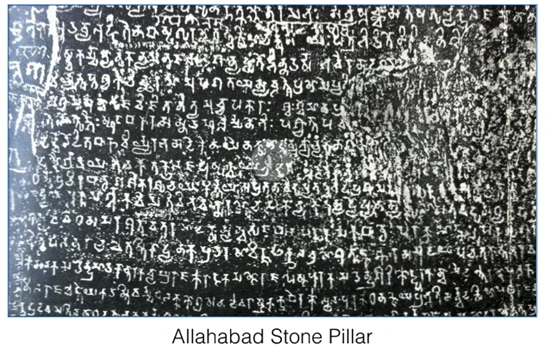
- Samudragupta was the son and successor of Chandragupta-I. He enormously expanded the Gupta kingdom. His court poet Harishena wrote a glorified account of his military expeditions. In a long inscription engraved at Allahabad, the poet enumerates the peoples and countries that were conquered by Samudragupta.
- Harishena also referred to him as Kaviraj which meant that he was a patron of poetic arts and a poet himself. Samudragupta also assumed the title of ‘Vikramanka’. He performed Ashvamedha Yajna which was the first Ashvamedha Yajna after Pushyamitra Shunga.
- Samudragupta’s prestige and influence spread even outside India. According to a Chinese source, Samudragupta granted permission to Ceylon king Meghavarman to build a Buddhist monastery at Bodhgaya.
- According to the inscription at Allahabad, Samudragupta never got defeated and is called the ‘Napoleon of India’. Also, Prithivyah Pratham Veer was the title of Samdudragupta which means ‘1st powerful person on Earth’.
Chandragupta II (C. 380 – C. 415 CE)
- Chandragupta II extended the limits of the empire through marriage, alliance, and conquest. The Gupta inscriptions mentioned Chandragupta-II as Samudragupta’s successor. However, based on literary sources, some copper coins, and inscriptions, it is suggested that the successor was Samudragupta’s other son, Ramagupta.
- Visakhadatta’s drama ‘Devichandraguptam’ mentions that Chandragupta-II killed his elder brother Ramagupta and ascended the throne.
- Chandragupta II entered into matrimonial alliances with the Nagas by marrying Princess Kuberanaga whose daughter Prabhavati was later married to Rudrasena-II of the Vakataka family. Thus, Chandragupta exercised indirect control over the Vakataka kingdom in central India and conquered western Malwa and Gujarat which had been under the rule of Sakas for about four centuries.
- The conquest of Sakas was the most important event of Chandragupta-II’s reign. He destroyed the Saka chieftain Rudrasena III and annexed his kingdom. The conquest gave Chandragupta the western sea coast, which was famous for trade and commerce. This contributed to the prosperity of Malwa and its chief city Ujjain which was the 2nd capital of Chandragupta II.
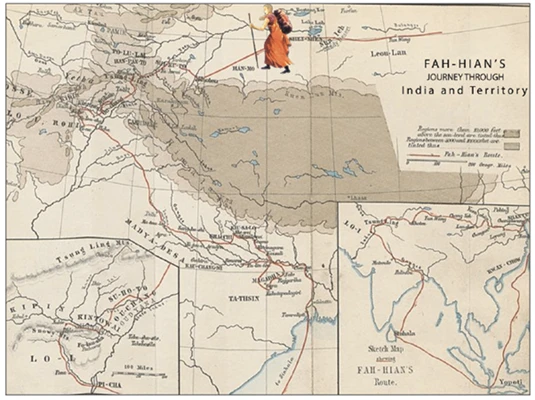
- Chandragupta II adopted the title of ‘Vikramaditya’ and the Chinese pilgrim Fa-Hsien (399 to 414) visited India during his rule and wrote an elaborate account of the lives of people. Many scholars adorned the court of Chandragupta II court at Ujjain known as the Navratnas or the nine gems. Chandragupta II was the 1st ruler to assume the ‘Param Bhagvat’ title.
Kumaragupta I (415 – 455 AD)
- Chandragupta-II was succeeded by his son Kumaragupta also known as Mahendraditya. The Damodarpur Copper Plate inscriptions (433 A.D. and 447 A.D.) refer to him as Maharajadhiraja. It also shows that he appointed the governor or Uparika of Pundravardhana bhukti or province being the biggest administrative division in the empire.
- The last known date of Kumaragupta is from a silver coin dated 455 A.D. The wide area over which his inscriptions are distributed indicates that he ruled over Magadha and Bengal in the east and Gujarat in the west.
- He maintained a cordial relationship with the Vakatakas which were established through matrimonial alliances. He established the Nalanda University in Bihar.
Skandagupta (455 – 467 AD)
- Skandagupta succeeded Kumaragupta-I and was the last powerful Gupta monarch. He assumed the titles of Vikramaditya, Devaraj and Sakapan.
- Skandagupta’s most significant achievement was defeating the Pushyamitras and throwing back the Huns who had troubled the Gupta Empire since his father’s reign.
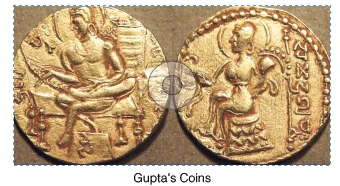
- These wars adversely affected the empire’s economy and the gold coinage of Skandagupta bears testimony to that. Skandagupta minted fewer types of gold coins than earlier rulers. He appears to have been the last Gupta ruler to mint silver coins in western India.
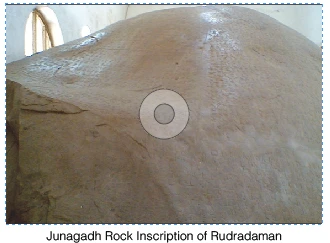
- However, the Junagadh inscription of his reign tells us about the public works undertaken during his times.
- The Sudarsana lake which was originally built during the Mauryan times burst due to excessive rains and his governor Pamadatta repaired it. This indicates that the state undertook the task of public works. The last known date of Skandagupta is 467 A.D. from his silver coins.
Later Guptas
- There is not much clarity on the order of successors of Skandagupta.
- The division of the Gupta Empire into many parts had already begun towards the close of Skandagupta’s reign.
- Thus, an inscription from western Malwa, recorded in Skandagupta’s last year, does not refer to him but to some other rulers beginning with Chandragupta-II.
- Inscriptions mention some of Skandagupta’s successors: Budhagupta, Vainyagupta, Bhanugupta, Narasimhagupta Baladitya, Kumaragupta-II, and Vismigupta.
- It is unlikely they all ruled over a vast empire, as Chandragupta-II and Kumaragupta-I had done earlier.
- The Guptas continued to rule until about 550 A.D., but by then, their power had already become insignificant.
Polity & Administration during Gupta Period
The polity and administration of the Gupta Empire are as follows:
- Decentralisation and Devolution of Power: The king was advised by a Council of Ministers, responsible for various administrative and military duties.
- A range of ministers and officials managed military and other affairs under the king’s direction.
- The Gupta Empire did not have an overly elaborate bureaucracy due to the effective decentralisation of administrative authority through land grants and friendly Samanta contracts with subdued neighbours.
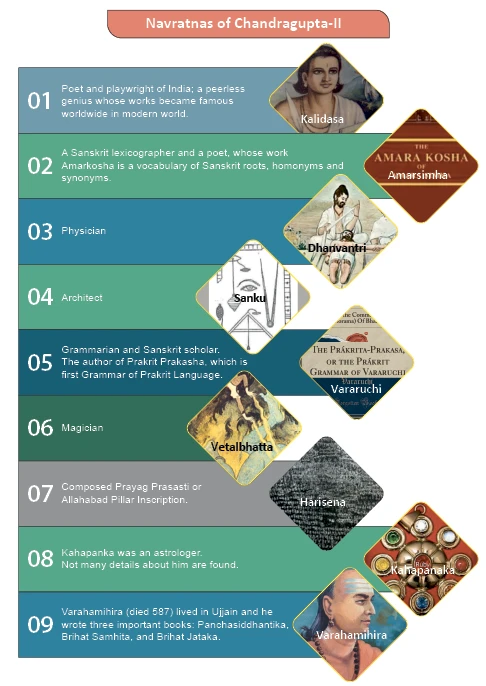
| S.No. | Name | Area of Contribution |
|---|---|---|
| 1 | Kalidasa | Poet and Playwright |
| 2 | Amarasimha | Lexicographer (Amarakosha) |
| 3 | Dhanvantari | Physician, Ayurveda |
| 4 | Varahamihira | Astronomy and Astrology |
| 5 | Vararuchi | Grammarian |
| 6 | Kahapanaka | Astrologer |
| 7 | Shanku | Architect |
| 8 | Vetala Bhatta | Magician/Political Counsel |
| 9 | Ghatakarpara | Poet |
- Samanta System: The power was devolved to various authorities, giving rise to political hierarchies.
- Land Grants: Decentralization was also effected via various land grants, which granted persons and institutions varied immunities and concessions.
- This is one reason that, unlike the Mauryan period, the Gupta Empire had a manageable bureaucracy.
- The Gupta Empire administration was highly centralised. The king was at the top, wielding absolute power but often guided by a council of ministers.
- The Gupta empire was divided into provinces called Bhuktis, each governed by a Uparika or provincial governor and further subdivided into Vishayas (districts) managed by officials called Vishayapatis.
- Local administration involved village assemblies, which were essential in managing local affairs.
- The Guptas maintained a strong bureaucratic system and relied on feudal lords and guilds for regional governance and tax collection. This system contributed to the Gupta empire’s long-lasting stability and prosperity.
Important Developments in the Gupta kingdom
Economy
The developments in the economy of the Gupta Empire is as follows:
- The economy during the Gupta period was characterised by flourishing trade, a well-functioning guild system, flourishing manufacturing industries, and a high standard of living.
- Of course, agriculture was the main occupation of the people, but other occupations, like commerce and the production of crafts, had become specialized occupations in which different social groups were engaged.
Guild System
- A guild is an association of artisans or merchants who oversee the practice of their craft in a particular area.
- In the Gupta Era, the activities of Guilds increased considerably. Guilds came to acquire considerable autonomous power. These trade guilds were both politically and economically influential.
- Guilds could control one trade in a province and wield economic dominance. Moreover, they became politically influential and also started maintaining militias.
Society
The developments in the society of the Gupta Empire are as follows:
- Chandragupta II was a patron of art and literature. Samudragupta is represented on his coins playing the veena, and Chandragupta II is credited with maintaining nine luminaries or great scholars in his court.
- In ancient India, art was mainly inspired by religion. Few survivors of non-religious art from ancient India exist. Buddhism gave great impetus to art in the Mauryan and post-Mauryan periods.
- It led to the creation of massive stone pillars, the cutting of beautiful caves and the raising of high stupas or relic towers.
- The stupas appeared as dome-like structures on round bases mainly of stone—numerous images of the Buddha.
Decline of Gupta Dynasty
Towards the end of the 6th century, the Gupta Empire began falling. Some of the salient factors that contributed towards the disintegration of the Gupta empire are as follows:
- Huna Invasions: The successors of Chandragupta II had to face an invasion by the Hunas from Central Asia in the second half of the fifth century A.D.
- Although the Gupta king Skandagupta initially tried effectively to stem the march of the Hunas into India, his successors proved to be weak. They could not cope with the Huna invaders, who excelled in horsemanship and possibly used metal stirrups.
- They could move quickly, and being excellent archers, they seem to have attained considerable success in Iran and India.
- Administrative Weaknesses: The Gupta Empire’s policy in conquered areas was to restore the authority of local chiefs or kings once they had accepted Gupta suzerainty.
- No efforts were made to impose strict and effective control over these regions.
- Hence it was natural that whenever there was a crisis of succession or a weak monarchy within the Gupta empire, these local chiefs would re-establish their independent authority.
- This created a problem for almost every Gupta King who had to reinforce his authority.
- The constant military campaigns were a strain on the state treasury.
- Towards the end of the fifth century A.D. and beginning of sixth century A.D. taking advantage of the weak Gupta emperors, many regional powers reasserted their authority and in due course, declared their independence.
- Rise of the Feudatories: The Gupta empire was further undermined by the increase of the feudatories.
- The governors appointed by the Gupta kings in north Bengal and their feudatories in Samatata or south-east Bengal tended to become independent.
- Issuance of Land Grants: The Gupta Empire may have found it difficult to maintain a large professional army due to the growing practice of land grants for religious and other purposes, which was bound to reduce its revenues.
- Decline in Trade: Their income may have further been affected by the decline of foreign trade.
- The migration of a guild of silk weavers from Gujarat to Malwa in A.D. 473 and their adoption of non-productive professions show that there was little demand for the cloth they produced.
- Besides the reasons quoted above, divisions within the imperial family, concentration of power in the hands of local chiefs or governors, and a loose administrative structure contributed to the disintegration of the Gupta empire.
FAQs about Gupta Society
Who was the founder of Gupta Empire?
Sri Gupta was the founder of Gupta Empire. He established the Gupta dynasty around 240 CE.
Who was the last ruler of Gupta Empire?
Vishnugupta is regarded as the last ruler of Gupta Empire who ruled around 540 to 550 CE.
Who was Samudragupta?
Samudragupta was a powerful ruler and a military genius of the Gupta dynasty. He was also known as ‘Napoleon of India’
