
 80813-00200

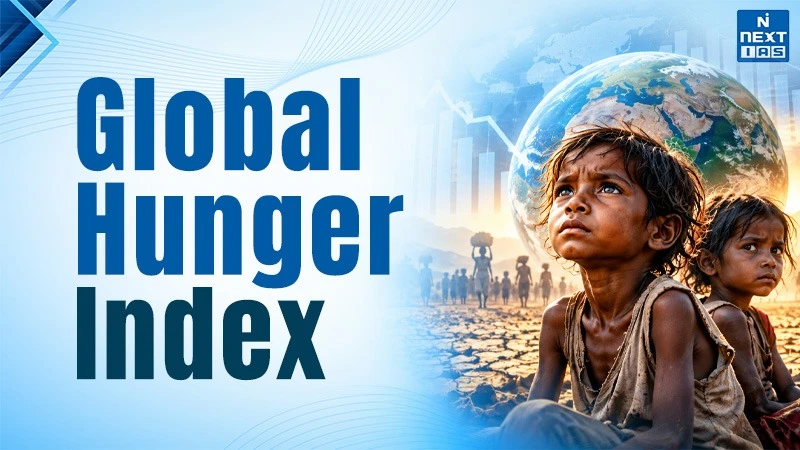
The Global Hunger Index (GHI) measures hunger on the basis of 4 parameters, which are undernourishment, child wasting, child stunting, and child mortality rate. The Global GHI Score is 18.3 that falls under moderate category. Out of the total number of 123 to 136 countries that were evaluated, 52 had low hunger, 36 had moderate hunger, 35 had serious hunger, and 7 had alarming hunger including Somalia, Burundi, and Yemen, whereas no country falls under the extremely alarming hunger category. At the present pace of progress, there is not a single country that will be able to meet low hunger status by 2030.
This report is given annually by Concern Worldwide and Welthungerhilfe. In the GHI 2025 report, the GHI score of India stood at 25.8, and the country ranked in the “serious” hunger group with a rank of 102 out of 123 nations. The parameters used for India were 12.0% undernourishment, 18.7% child wasting, 32.9% child stunting, and 2.8% under-five mortality. It is important to note from the report that childhood undernutrition is still one of the most significant problems in spite of progress in hunger and child mortality rates.
Global Hunger Index 2025
The Global Hunger Index (GHI) for 2025 portrays a mixed situation concerning the status of food and nutrition security around the world. While the overall GHI score at the global level stood at 18.3, it was 19.0 in 2016, showing some limited improvement during the period. Hunger at the global level remained moderate, whereas South of Sahara in Africa and South Asia had been experiencing serious hunger.
| Aspect | Global Hunger Index 2025: Key Details |
|---|---|
| Global GHI Score | 18.3, placing global hunger in the moderate category |
| Change since 2016 | Score declined only slightly from 19.0 to 18.3, indicating slow progress |
| Countries assessed | Data were assessed for 136 countries |
| Countries ranked | 123 countries had sufficient data for a 2025 GHI score and rank |
| Hunger severity | 52 countries had low hunger, 36 moderate, 35 serious, and 7 alarming |
| Extremely alarming | No country with a calculated 2025 score was placed in the extremely alarming category |
| Serious hunger regions | Africa South of the Sahara and South Asia remained the regions with serious hunger levels |
| Major drivers | Armed conflict, climate shocks, economic fragility and weakening humanitarian assistance |
| Conflict impact | Armed violence contributed to 20 food crises affecting nearly 140 million people in the year covered by the report |
| Countries showing notable progress | Mozambique, Rwanda, Somalia, Togo and Uganda were highlighted for notable progress, although challenges remain |
| Countries with worsening 2025 scores | In 27 countries, hunger increased compared with 2016 |
| Stalled progress | In 10 countries, progress since 2016 largely stalled |
| Countries worse than 2000 | Fiji, Jordan, Libya, Solomon Islands and Syria had 2025 scores worse than their 2000 scores |
| 2030 outlook | At the current pace, at least 56 countries are projected not to reach low hunger by 2030 |
Calculation Method
There are 4 major indicators that determine the value of the Global Hunger Index (GHI)
- Undernourishment: This indicator evaluates the proportion of people who do not get sufficient dietary energy intake to meet basic nutrition needs. It shows poor food access at the population level.
- Child Wasting: This indicator evaluates the proportion of children under the age of five who suffer from low weight for height. It represents acute malnutrition, which usually occurs because of the shortage of food recently or due to illnesses.
- Child Stunting: This indicator evaluates the proportion of children under the age of five who suffer from low height for age. It shows chronic malnutrition, which can occur because of poor nutrition or unhealthy living conditions.
- Child Mortality: This indicator evaluates the child mortality rate of those under the age of five.
India & Global Hunger Index
- In terms of GHI, India scored 25.8 and was ranked 102nd out of 123 ranked countries, being placed in the category of "serious".
- The 4 indicators for India according to the GHI were 12.0% of undernourishment, 18.7% of child wasting, 32.9% of child stunting and 2.8% of under-five mortality.
- In comparison with the GHI score in 2000, which was 38.1, there was progress in the country.
- Nevertheless, child wasting and stunting continue to be major problems for India nutritionally.
- India's position should be analyzed cautiously since GHI uses data from various reference years and methodology varies between the reports.
- In addition, rankings vary depending on the set of countries covered by the report.
| Year | GHI Score | Hunger Severity |
|---|---|---|
| 2000 | 38.1 | Serious |
| 2008 | 34.6 | Serious |
| 2016 | 29.3 | Serious |
| 2025 | 25.8 | Serious |
Causes of Hunger and Malnutrition
Hunger and malnutrition are caused by factors that are interrelated from an economic, social, environmental, and health perspective:
- Poverty and Inequality: Low-income households may not be able to have sufficient, nutritious, and varied food, while inequality in access to resources can make nutrition deficiency worse.
- Food Insecurity: Inadequate availability, accessibility or affordability of food can cause insufficient diet and micronutrient deficiencies.
- Climate Change and Extreme Weather: Floods, droughts, heatwaves, and changes in rain pattern can reduce agricultural productivity and food availability and make food more expensive.
- Conflict and Displacement: Violence can destroy farms and infrastructure and force people to leave their homes and livelihoods.
- Unemployment and Low-Income Levels: Lack of steady income can make nutritious food and healthcare less affordable.
- Poor Sanitation and Health Care: Unsafe water and poor health care services can cause infections and make the absorption of nutrients difficult for the body.
- Insufficient Mother and Child Nutrition: Poor maternal nutrition, low birth weight, insufficient breastfeeding, and lack of complementary feeding can contribute to wasting and stunting in children.
Government Initiatives to Combat Hunger in India
India has taken many steps to ensure food security, nutrition and delivery of other services especially to vulnerable households, women and children.
- The National Food Security Act (NFSA), 2013: It acts as a legal backing for providing subsidised foodgrains and nutritional benefits to pregnant women, lactating mothers and children.
- Public Distribution System (PDS): This initiative involves the distribution of necessary foodgrains to beneficiaries via Fair Price Shops.
- PM POSHAN: This scheme delivers hot cooked meals to children studying in government and government-aided schools.
- Integrated Child Development Services (ICDS): Under Anganwadi Services, this initiative ensures supplementary nutrition, health services, referral services and preschool education to young children and their mothers.
- POSHAN Abhiyaan: This initiative concentrates on the improvement of nutritional outcomes through convergence, technology, community engagement and behaviour change approach.
- Pradhan Mantri Garib Kalyan Anna Yojana (PMGKAY): This initiative is related to providing free foodgrains to eligible beneficiaries under the food security system.
- National Nutrition Mission: It is another name for Poshan Abhiyaan and is aimed at reducing malnutrition in children, adolescents, pregnant women and lactating mothers.
Global Initiatives against Hunger
There are a number of international institutions and partnerships that aim to reduce the number of people who go hungry, improve nutrition levels and secure the world's food supply.
- United Nations SDG 2 - Zero Hunger: This goal sets out to end hunger, improve food security, nutrition and promote sustainable agriculture by 2030. It is specifically concerned with providing all-year-round access to nutritious food.
- FAO Programs: FAO helps countries transform their agrifood systems, increase agricultural productivity, improve rural livelihoods and sustainable food production.
- World Food Programme (WFP): WFP offers food and nutrition support during periods of conflicts, disasters and emergencies. It has programs like school feeding and programs for building resilience.
- UNICEF Nutrition Programs: UNICEF particularly concentrates on the nutritional needs of mothers and children, promoting breastfeeding, complementary feeding, micronutrient interventions, treatment of wasting among children, and nutrition in emergency situations.
- Partnerships for Global Food Security: Governments, civil society and development institutions work in multilateral partnerships such as the Global Alliance Against Hunger and Poverty and others for food security.
FAQs on GHI
What is Global Hunger Index (GHI)?
The GHI is an indicator that measures and tracks the levels of hunger and undernutrition in countries with the help of four main indicators.
What are the indicators used for calculating the GHI?
For calculating the hunger scores, GHI uses undernourishment, child wasting, child stunting, and under-five mortality rates.
Which organizations publish GHI?
Every year, GHI is published by Concern Worldwide and Welthungerhilfe.
