
 80813-00200


Fiscal Policy is formulated and managed by the Ministry of Finance to maintain economic growth, employment and social equality. Fiscal policy helps the Government in directing public spending, borrowing, and taxation. The key objectives of fiscal policy include resource allocation and price stability.
As per Union Budget 2026-2027, India has shifted its primary focus to long term Fiscal Consolidation and Infrastructure led-growth. The Fiscal Policy target for Financial Year 2026-27 has been set at 4.3% of Gross Domestic Product (GDP). It was capped at 4.4% of GDP in the previous financial year 2025-26.
It is based on the principles of Keynesian economics, which states that governments can influence macroeconomic productivity levels by increasing or decreasing tax levels and public spending.
Objectives of Fiscal Policy in India
Some of the main objectives or role of fiscal policy in India can be seen as follows:
- To mobilise additional resources into socially necessary lines of development
- To achieve and maintain economic stability
- To stabilize the price level.
- To maintain the growth rate of the economy.
- To maintain equilibrium in the balance of payments.
- To raise the standard of living of the citizens of the country.
- To reduce extreme inequality in income and wealth
- To provide the necessary incentives to the private sector for its healthy growth. etc
Major Tools of Fiscal Policy
Major tools of this policy used by the government are as follows:
Public Expenditure
It includes subsidies, transfer payments including welfare programs, public works projects and government salaries. By increasing or decreasing its spending, the government can directly influence economic activity. For example, more government spending can increase demand, leading to higher output and employment.
Taxation
The government can influence economic activity through its taxation policy. By reducing taxes, the government leaves individuals and businesses with more income to spend and invest, which can boost economic growth. Conversely, increasing taxes can help cool down an overheated economy by reducing the amount of disposable income available.
Public Borrowing
Public borrowing refers to the means by which governments finance their expenditures that exceed tax revenues. Under it, the government raises money from the domestic population or from abroad through instruments such as bonds, NSC, Kisan Vikas Patra, etc. Public borrowing is a common practice used to fund public services, infrastructure projects, welfare programs, and to manage the country's policy.
Other Measures
Other fiscal measures adopted by the government include:
- Rationing and price control
- Regulation of wages
- Increase the production of goods and services
Difference Between Fiscal Policy and Monetary Policy
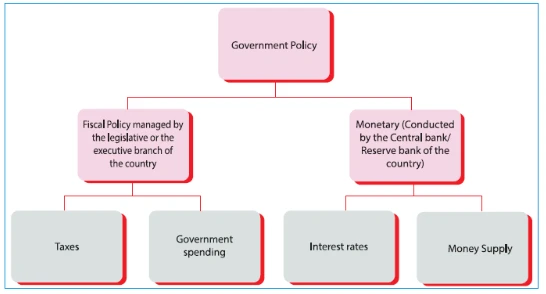
| Basis | Fiscal Policy | Monetary Policy |
|---|---|---|
| Meaning | It is related to government revenue, expenditure and borrowing to influence economic activity. | It is related to money supply, interest rates and credit conditions to influence the economy. |
| Formulated by | Government of India through the Ministry of Finance. | Reserve Bank of India (RBI) |
| Main Instruments | Taxation, government expenditure, subsidies and public borrowing | Repo rate, reverse repo rate, CRR, SLR and open market operations, among others. |
| Primary Objective | Promote economic growth, employment, redistribution and macroeconomic stability. | Maintain price stability while keeping growth considerations in view. |
3 Main Types of Policy
Based on the economic conditions and the objectives that governments aim to achieve, It can be categorized into three main types
| Expansionary | Contractionary/Tight | Neutral | |
|---|---|---|---|
| Mechanism | Fiscal policy that increases aggregate demand directly through an increase in government spending is called expansionary. | Fiscal policy that reduces demand via lower spending is called contractionary or tight. | A neutral fiscal policy refers to a strategy by which the government's budget is designed to neither stimulate nor restrain economic growth. |
| Objective | The objective of Expansionary Fiscal Policy is to reduce unemployment and also results in better GDP. | The objective of Contractionary Fiscal Policy is to reduce inflation. | The objective of Neutral Fiscal policy is to maintain the status quo in the economy. |
| Caution | It can cause some inflation. | It can trigger some unemployment. | It may lead to degradation due to inaction in prevailing conditions. |
| Suitability | This type of policy is usually undertaken during recessions to increase the level of economic activity. | This type of policy is usually undertaken during inflationary periods to control excess money supply. | This type of fiscal policy is usually followed when an economy is in equilibrium. |
Cyclicality
The cyclicality of the fiscal policy refers to a change in direction of government expenditure and taxes based on economic conditions and fluctuations in economic growth.
There are two types of cyclical fiscal policies:
Counter-Cyclical
It refers to the steps taken by the government that go against the direction of the economic or business cycle.
- For example, in a recession or slowdown, the government, usually, takes the route of expansionary fiscal policy. This increases expenditure and reduces taxes to create a demand that can drive an economic boom. This increases the consumption potential of the economy and helps soften the recession.
Pro-Cyclical
It refers to the type of fiscal policy wherein the government reinforces the business cycle by being expansionary during good times and contractionary during recessions.
- Pursuing a pro-cyclical fiscal policy is generally regarded as dangerous as it could raise macroeconomic volatility, depress investment, hamper growth and harm the poor. For example, adopting Contractionary Fiscal Policy during a recession will reduce the government expenditure and increase the taxes. This will further decrease the consumption potential of the economy and deepen the recession.
Related Concepts
Fiscal Deficit
Fiscal Deficit refers to the gap between the government's total expenditure in a given financial year and its total revenue (excluding borrowings) in the same financial year. It is expressed as a percentage of the Gross Domestic Product (GDP) and is an indicator of the government's financial health.
Fiscal Consolidation
Fiscal consolidation is a process where the government's fiscal health is improved by reducing the fiscal deficit to levels which are manageable and bearable for the economy. Improved tax revenue realization and better aligned expenditure are important components of fiscal consolidation.
Fiscal Drag
Fiscal drag is an economic term whereby inflation or income growth moves taxpayers into higher tax brackets. It occurs mainly due to Progressive Taxation, whereby individuals are moved into higher tax brackets because of inflation or increased income.
Fiscal Neutrality
Fiscal neutrality is when a government taxing, spending, or borrowing decision has or is intended to have no net effect on the economy. Any new spending introduced by a policy change that is fiscally neutral in this sense is expected to be entirely offset by additional revenues generated. Thus, Fiscal Neutrality creates a condition where demand is neither stimulated nor diminished by taxation and government spending.
Crowding Out Effect
The crowding out effect is an economic theory suggesting that increased government spending leads to a reduction in private sector spending. This phenomenon occurs because the resources used by the government must come from somewhere, typically through increased taxation or borrowing. Thus, the private sector is left with lesser resources to invest.
Pump Priming
Pump priming is the action taken to stimulate an economy usually during a recessionary period, through government spending, and interest rate and tax reductions. Pump priming involves introducing relatively small amounts of government funds into a depressed economy in order to spur growth.
Economic Stimulus
An economic stimulus is the use of monetary or fiscal policy changes to kick start growth during a recession. Governments can accomplish this by using methods such as lowering interest rates, increasing government spending and quantitative easing, to name a few. In the wake of COVID-19 Pandemic, the Government announced 3 tranches of economic stimulus under the Atma Nirbhar Bharat Programme.
FAQs on Fiscal Policy
What is fiscal consolidation?
Fiscal consolidation refers to improving the government's fiscal health by reducing fiscal deficit.
Who prepares fiscal policy in India?
It is formulated in India by the Finance Ministry of the Central or State Governments.
What are the three types of fiscal policy?
Based on the objective, there are three types of fiscal policies – Expansionary, Contractionary and Neutral.
