
 80813-00200


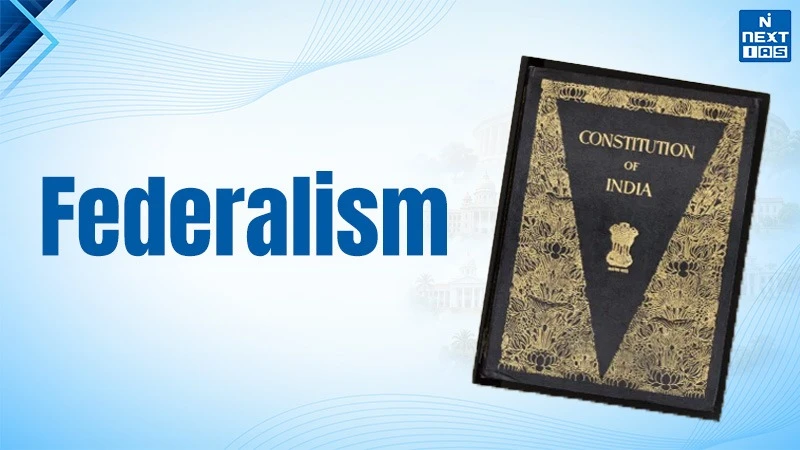
Federalism is a type of political structure that refers to a form of governance in which the distribution of powers is provided in the constitution between various levels of government, mostly the national and state governments. In India, Federalism allows the Union and the States to govern within their constitutional spheres.
The Indian Constitution includes elements of federalism, such as a written Constitution, distribution of powers, supremacy of Constitution, and an independent judiciary. However, the Union has been given wide-ranging powers in the Indian Constitution. There are distribution of subjects in the Union List, State List, and Concurrent List in the 7th Schedule of the Constitution.
Division of Powers in the Federation of India
- Union List: Comprises subjects of national significance, over which Parliament has exclusive legislative powers, e.g., defence, foreign policy, atomic energy, and banking.
- State List: Deals with subjects related mainly to individual states, e.g., police, public order, public health, agriculture, and local government. The state legislature generally has jurisdiction over such subjects.
- Concurrent List: Includes those subjects over which both Parliament and State Legislatures may legislate, e.g., education, forests, marriage, and adoption. In case of any conflict, the Union legislation generally prevails, subject to provisions of the Constitution.
- Residual Powers: Powers over subjects not listed in Union, State, or Concurrent Lists lie with Union Parliament under Article 248.
- Articles 245-254 and Seventh Schedule: Articles 245-254 provide the constitutional basis for legislative relationship, while the Seventh Schedule provides the classification of subjects among the three lists.
Federal Features of the Indian Constitution
- Dual Government: The Constitution recognises two types of governments- Union Government and State Governments and both have their powers defined by the Constitution.
- Written & Supreme Constitution: It has a written Constitution which is regarded as the supreme law of the land, and both the Union and State Governments enjoy their power under it.
- Distribution of Powers: The powers to legislate are distributed between the Union and the State Governments according to the Union List, State List, and Concurrent List of the Seventh Schedule.
- Constitutional Limitation: The governments at both levels operate their powers within the limitations set by the Constitution.
- Independent Judiciary: The Constitution empowers an independent judiciary comprising the Supreme Court to interpret the Constitution and settle disputes between the Union and the States.
- Bicameral Legislature: The Parliament comprises the Lok Sabha and the Rajya Sabha. The Rajya Sabha represents the States at the Union level.
- Distributive Financial Structure: The financial structure between the Union and State governments is also provided by the Constitution.
Cooperative Federalism vs Competitive Federalism
| Basis | Cooperative Federalism | Competitive Federalism |
|---|---|---|
| Meaning | Emphasises cooperation and coordination between the Union and States to achieve common objectives. | Encourages States and Union Territories to compete for better performance, investment and development outcomes. |
| Approach | Collaborative and consensus-oriented. | Performance- and outcome-oriented. |
| Main Focus | Joint policymaking and implementation. | Innovation, efficiency and improved governance. |
| Role of States | States work with the Union as partners in policy implementation. | States compete with one another on development indicators and investment opportunities. |
| Role of NITI Aayog | Provides a platform for Centre–State consultation and policy coordination. | Uses rankings and performance indicators to encourage States to improve outcomes. |
| Example | GST Council, where the Union and States participate in decisions on GST. | State rankings based on indicators such as development, innovation and SDG performance. |
Major Problems of Indian Federalism
- Centralization of Power: The constitution provides the Union with a lot of power in the form of residual powers, emergency powers and situations when Parliament can legislate on subjects of the State.
- Governor-related Problems: The Governor is appointed by the Union but acts as the constitutional head of the State. There are often issues related to the power of the Governor, their involvement in the formation of government, assent to Bills and relation with the elected State government.
- Fiscal Disequilibrium: The states bear a major portion of expenditure obligations but there is inequality in the capability to generate revenue. The dependence on tax devolution, grants and other transfers may cause issues related to fiscal autonomy.
- Inter-State Water Issues: Disputes related to rivers and distribution of water, including the Cauvery river, Krishna river and Ravi-Beas river are examples of problems affecting centre-state and inter-state relations.
- Article 356: Article 356 allows the imposition of President's rule when there is a failure of constitutional machinery in the State.
Historical Background of India’ Federal Strcuture
- Government of India Act, 1919: Introduced dyarchy in provinces and increased involvement of provinces in government. This was an initial move towards more provincial autonomy.
- Government of India Act, 1935: Provided for provincial autonomy and proposed a federation of British Indian provinces and princely states. Though the federation did not materialize, some of the federal characteristics of the federation had a bearing on the Indian Constitution.
- Cabinet Mission Plan, 1946: Suggested a Constitution with a comparatively smaller Union and larger role of provinces. It became an important aspect of the constitutional deliberations before independence.
- Constituent Assembly: After independence, the Constituent Assembly argued on how to strike a balance between national unity and regional autonomy. The Constitution eventually provided for a Union with a distribution of powers between the Union and States.
- Constitution of India, 1950: The Constitution of India made India a federation with a strong Centre, division of powers, independent judiciary and a written Constitution.
- States Reorganization Act, 1956: The reorganization of States, mainly on the linguistic basis, played an important role in the development of Indian federalism.
FAQs on Federalism
What is meant by federalism?
It refers to the division of constitutional powers amongst 2 or more levels of the government like the Union and States.
Is India a federation or a unitary state?
India is a federation with a strong Union. Powers have been distributed between the Union and States with some unitary elements, especially during emergencies.
What are some key federal features of India?
Some of the important federal features of India are dual polity, written Constitution, supremacy of Constitution, division of powers, independent judiciary, bicameralism and fiscal distribution between Union and States.
How are powers divided between Center and States?
Powers are divided between Center and States through Seventh Schedule into Union List, State List and Concurrent List. Residuary legislative powers rest with the Parliament.
