
 80813-00200



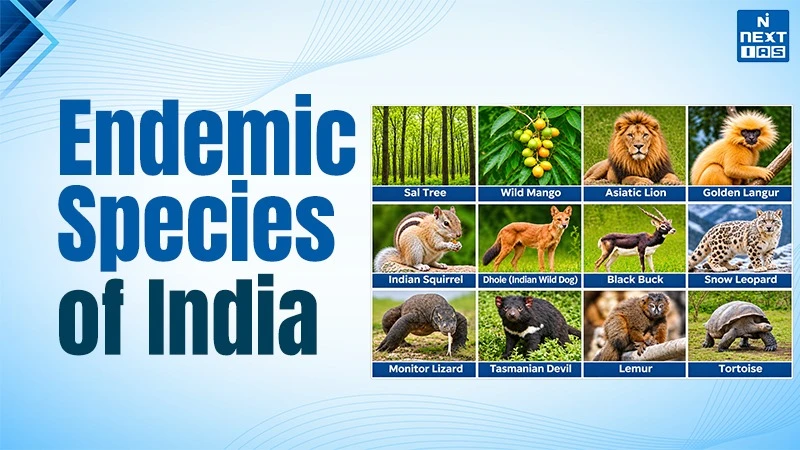
Endemic species of India are plants and animals that are naturally occurring in a certain geographic area and not found anywhere else on earth. The Western Ghats, Eastern Himalayas and the Andaman and Nicobar Islands are some regions known to be the areas of endemism. The lion-tailed macaque, the Nilgiri tahr and the purple frog are some of the well-known species.
Endemic species are especially susceptible to habitat loss, climate change, invasive species and human interventions. The study of biodiversity in recent times has improved the conservation practices of India. As per the report of the Zoological Survey of India published in 2026, there were 709 new faunal species reported in 2025, out of which 483 were described for the first time while 226 were discovered in India.
About the Endemic Species
- India is among the 17 mega-diversified countries of the world which has spectacular and unique biological diversity due to its varied topography, climate and ecological areas.
- India hosts a diverse range of ecosystems such as tropical rain forest, alpine meadow, mangroves, deserts, coral reef and island ecosystems. All these diverse environments have led to a number of endemic species.
- India’s high level of endemism is especially concentrated in the Western Ghats, Eastern Himalayas and Andaman and Nicobar Islands-region.
- These regions are internationally recognized as a biodiversity hotspot due to their high level of species diversity and endemism.
The Concept of Endemism
- Endemism refers to the presence of a taxon (species, genus, or family) that is unique to a particular geographic area.
- Endemism may be categorized into:
- Paleo-endemism : Species that were formerly widely distributed but that are now limited in a small region by environmental changes or competition with other species.
- Neo-endemism : Species that are comparatively recent in evolution and have not yet been dispersed over a broad geographic area.
Major Endemic Species (Fauna and Flora) of India
Endemic Mammals of India
| Common Name | Scientific Name | Habitat / Region | Key Characteristics |
|---|---|---|---|
| Nilgiri Tahr | Nilgiritragus hylocrius | Western Ghats (mainly Tamil Nadu and Kerala) | A mountain goat which adapted to steep rocky cliffs of the Western Ghats. Characterised by thick brown coat and curved horns, that is is well known for its excellent climbing ability. |
| Lion-tailed Macaque | Macaca silenus | Tropical rainforests of the Western Ghats | A rare arboreal monkey recognized by its silver-white mane and lion-like tail tuft. It spends most of its life in canopies of the tree while feeding on fruits, insects, and small animals. |
| Nilgiri Langur | Semnopithecus johnii | Nilgiri Hills, Western Ghats forests | A leaf-eating monkey with shiny black fur and golden-brown head. It mainly inhabits evergreen and moist deciduous forests. |
| Pygmy Hog | Porcula salvania | Grasslands of Assam, especially around Manas National Park | The smallest and rarest wild pig in the world, measuring about 25 cm in height, and for shelter and survival mainly depends on dense tall grasslands. |
| Hispid Hare | Caprolagus hispidus | Northeast India | A shy and nocturnal rabbit-like mammal with coarse bristly fur. It prefers dense grassland habitats and is rarely seen in the wild. |
| Malabar Civet | Viverra civettina | Western Ghats | It is one of the rarest mammals in India, which is known for its elongated body and spotted coat. It is nocturnal and mainly feeds on fruits, insects, and small vertebrates. |
| Nilgiri Marten | Martes gwatkinsii | Western Ghats | Nilgiri Martin is the only marten species found in South India. Characterised by a slender body, dark brown fur, and a distinctive yellow throat patch. It is an agile tree climber and active predator. |
| Indian Giant Squirrel | Ratufa indica | Tropical deciduous forests of central and southern India | A large arboreal squirrel known for its bright multi-colored fur and long bushy tail. It spends most of its life in trees and feeds mainly on fruits, nuts, and bark. |
| Bonnet macaque | Macaca radiata | Southern India, Goa, Gujarat and Maharashtra | |
| Black-footed Gray Langur | Semnopithecus hypoleucos Blyth | Southern India | |
| Namdhapa Flying Squirrel | Biswamoyopterus biswasi | Arunachal Pradesh (Namdhapa National Park) | |
| Andaman Archipelago Rat | Rattus stoicus | Andaman & Nicobar Is. | |
| Bengal Marsh Mongoose | Herpestes palustris Ghose, | West Bengal |
Endemic Birds of India
| Common Name | Scientific Name | Habitat / Region | Key Characteristics |
|---|---|---|---|
| Great Indian Bustard | Ardeotis nigriceps | Arid grasslands of Rajasthan and adjoining regions | One of the heaviest flying birds in the world. It prefers open grasslands and is critically endangered due to habitat loss and collisions with power lines. |
| Forest Owlet | Athene blewitti | Dry deciduous forests of Madhya Pradesh and central India | A small owl species once believed to be extinct. It is diurnal (active during the day) and feeds mainly on insects, lizards, and small rodents. |
| Nilgiri Wood Pigeon | Columba elphinstonii | Evergreen and montane forests of the Western Ghats | A large forest pigeon with dark plumage and distinctive checkered neck pattern, usually found in high-altitude forests. |
| White-bellied Treepie | Dendrocitta leucogastra | Evergreen forests of the Western Ghats | A striking bird with black, white, and chestnut coloration. It is highly active and feeds on fruits, insects, and small animals. |
| Malabar Parakeet | Psittacula eupatria | Forests of the Western Ghats | A long-tailed parrot known for its bluish-grey body and red beak. It usually lives in flocks and feeds on fruits and seeds. |
| Jerdon's Courser | Cursorius bitorquatus | Scrub forests of the Eastern Ghats in Andhra Pradesh | A rare nocturnal bird rediscovered in 1986 after being thought extinct. It inhabits dry scrub forests and open areas. |
| Narcondam Hornbill | Aceros narcondami | Narcondam Island in the Andaman Sea | A large hornbill endemic to a single island. It plays an important ecological role as a seed disperser in island forests. |
| Bugun Liocichla | Liocichla bugunorum | Arunachal Pradesh (Eastern Himalayas) | A recently discovered bird species (2006), known for its colorful plumage. It inhabits subtropical forests and has a very limited population. |
Endemic Reptiles of India
| Common Name | Scientific Name | Habitat / Region | Key Characteristics |
|---|---|---|---|
| Cochin Forest Cane Turtle | Vijayachelys silvatica | Western Ghats forests | A small and rare forest turtle found in dense evergreen forests. It has a domed shell and spends most of its time hidden under leaf litter, feeding on fruits, fungi, and small invertebrates. |
| Andaman Day Gecko | Phelsuma andamanensis | Andaman Islands | A bright green arboreal gecko active during the day. It usually inhabits trees and feeds on insects and nectar. |
| Indian Golden Gecko | Calodactylodes aureus | Eastern Ghats (mainly Andhra Pradesh) | A large golden-yellow gecko known for living in rocky caves and cliff habitats. It is nocturnal and feeds on insects. |
| Short-crested Bay Island Lizard | Calotes andamanensis | Andaman and Nicobar Islands (Bay Islands) | A tree-dwelling lizard with a short crest along its head and back. It is well adapted to tropical forest habitats. |
| Satpura Leopard Gecko | Eublepharis satpuraensis | Satpura Range (Central India) | A ground-dwelling gecko with leopard-like spots. It is nocturnal and prefers rocky terrain and dry forests. |
| South Indian Flying Lizard | Draco dussumieri | Western Ghats forests | A unique gliding lizard capable of moving between trees using wing-like skin flaps called patagia. It feeds mainly on ants and small insects. |
Endemic Amphibians of India
| Common Name | Scientific Name | Habitat / Region | Key Characteristics |
|---|---|---|---|
| Andaman Frog | Indirana andamanensis | Andaman Islands | A small stream-dwelling frog found in moist forest habitats. It usually lives near forest streams and feeds on small insects and invertebrates. |
| Little Meghalayan Horned Frog | Megophrys megadermus | Meghalaya (Northeast India) | A camouflaged forest frog with horn-like projections above the eyes. It blends well with leaf litter on the forest floor. |
| Bicolored Frog | Clinotarsus curtipes | Western Ghats | A medium-sized frog with two distinct body colors. It prefers moist evergreen forests and breeds near streams during the monsoon season. |
| Zaimeng Lake Crocodile Newt | Tylototriton zaimeng | Northeast India | A rare salamander-like amphibian with rough skin and bright markings. It inhabits freshwater habitats such as lakes and forest streams. |
Endemic Flora of India
| Species (Common Name) | Scientific Name | Region in India | Key Features |
|---|---|---|---|
| Red Sanders | Pterocarpus santalinus | Eastern Ghats (Andhra Pradesh) | Highly valued red timber used in medicines, dyes and luxury furniture; endemic to the Eastern Ghats; IUCN Status: Endangered |
| Pitcher Plant | Nepenthes khasiana | Meghalaya (Khasi & Jaintia Hills) | Carnivorous plant with pitcher-shaped leaves that trap and digest insects; the only pitcher plant species endemic to India; IUCN Status: Endangered |
| Neelakurinji | Strobilanthes kunthiana | Western Ghats (Nilgiri Hills) | Famous for mass flowering once every 12 years, covering hills with blue flowers; ecologically significant for pollinators; IUCN Status: Vulnerable |
| Blue Vanda Orchid | Vanda coerulea | Northeast India | Rare blue orchid known for ornamental value and horticultural trade; found in subtropical forests; IUCN Status: Vulnerable |
| Lady’s Slipper Orchid | Paphiopedilum druryi | Western Ghats (Kerala, Tamil Nadu) | Orchid with distinctive slipper-shaped flower; extremely restricted habitat; threatened by illegal collection; IUCN Status: Critically Endangered |
| Travancore Tree | Syzygium travancoricum | Western Ghats (Kerala) | Rare tree found in freshwater swamp forests; highly threatened due to habitat loss; IUCN Status: Critically Endangered |
| Malabar Lily / Glory Lily | Gloriosa superba | Western Ghats | Medicinal plant with striking red-yellow flowers; source of colchicine used in pharmaceuticals; IUCN Status: Vulnerable |
| Beddome’s Cycad | Cycas beddomei | Eastern Ghats (Andhra Pradesh) | Ancient gymnosperm regarded as a living fossil; slow-growing species threatened by habitat degradation; IUCN Status: Endangered |
| Rhododendron | Rhododendron niveum | Eastern Himalayas (Sikkim) | Evergreen flowering tree and state tree of Sikkim; adapted to cool mountain ecosystems; IUCN Status: Vulnerable |
| Wild Jackfruit | Artocarpus hirsutus | Western Ghats | Large evergreen tree valued for timber and edible fruit; plays a role in forest ecosystem stability; IUCN Status: Near Threatened |
| Malabar Tamarind | Garcinia gummi-gutta | Western Ghats | Fruit used as souring agent in South Indian cuisine and traditional medicine; also used in nutraceuticals; IUCN Status: Least Concern |
| Vateria | Vateria indica | Western Ghats | Tall evergreen tree producing white dammar resin used in varnishes and incense; threatened by logging; IUCN Status: Endangered |
| Cullenia | Cullenia exarillata | Western Ghats | Important canopy tree that provides food for birds, bats and arboreal mammals; vital for rainforest ecology; IUCN Status: Near Threatened |
| Nilgiri Balsam | Impatiens denisonii | Western Ghats | Colourful flowering plant endemic to moist forests of Nilgiri region; sensitive to habitat disturbance; Endemic species |
| Indian Podocarpus | Podocarpus wallichianus | Eastern Himalayas | Coniferous tree found in montane forests; important component of Himalayan ecosystems; IUCN Status: Near Threatened |
Major Threats to Endemic Species
- Habitat Fragmentation- linear infrastructure projects like (roads, power lines) and urban development divide continuous habitats in the areas such as the Western Ghats leading to genetic isolations and increased road kill cases.
- Climate Change - the climate change is the escalator to extinction, such as the high-altitude species like the Nilgiri Tahr are forced upwards until they can find no more appropriate habitats in their mountainous habitat; and eventually leading to ran out of viable habitat.
- Invasive alien species : Invasive alien species such as Lantana camara and Prosopis juliflora sometimes dominate the native plants, disrupting the food chains that numerous endemic animals like the Sangai are dependent on.
- Biological vulnerability : small population within restricted ranges implies that even one very dramatic event (forest fire, landslide, disease) can destroy a species leading to total extinction.
- Anthropogenic Pressures : Exploitation for illegal trade (e.g. Red Sanders) and Jhum (Shifting) cultivation in the Northeast cause rapid loss of primary canopy cover.
- Narrow niche specialization : HIghly specialization makes these species less adaptable to the rapid environmental changes and become more incapable of responding to the rapid Anthropocene change compared to general species.
Govt Initiatives
- Protected Area (PA) Network: Governed under the wildlife protection act, 1972, it provides an extensive network of National Parks, wildlife sanctuaries, conservation reserves, and community reserves which provides essential in-situ protection.
- Biosphere reserve programme : Operates at the landscape level and conserves unique ecosystems allowing sustainable coexistence of human activity and biodiversity conservation.
- Biological Diversity Act 2002 : The primary legislation protecting bio-resource and preventing biopiracy. It mandates a three-tier structure—
- National Biodiversity Authority (NBA)
- State Biodiversity Boards (SBB) and
- Biodiversity Management Committees (BMCs)
- The BMCs create People Biodiversity Registers (PBR) documenting the local endemic species and traditional knowledge.
- Integrated Development of Wildlife Habitats (IDWH) : Under the IDWH, the government identifies critically endangered endemic species for specialized recovery.
- National Mission for Green India : It focuses on the restoration of the degraded forest ecosystem and widening the forest cover, which indirectly protects the endemic plants and animals.
- Species recovery programmes : It aims at the protection of threatened and endemic species; implemented under the Ministry of Environment, Forest and Climate Change.
FAQs about Endemic Species of India
What are endemic species?
Endemic species are those plants and animals that naturally occur in a particular geographic area only.
In which areas of India are there many endemic species?
The Western Ghats, Eastern Himalayas, Andaman and Nicobar Islands, and Northeast areas are the hotspots for such species.
What are some examples of endemic species of India?
Lion-tailed macaque, Nilgiri tahr, purple frog, Malabar civet, and Nicobar megapode are some of the endemic species.
Why are endemic species significant?
They help maintain the ecological balance and are important in maintaining biodiversity.
What are the threats to endemic species in India?
Destruction of habitat and deforestation, climatic changes, invasion by other species, pollution, and poaching are the threats to endemic species in India.
