
 80813-00200


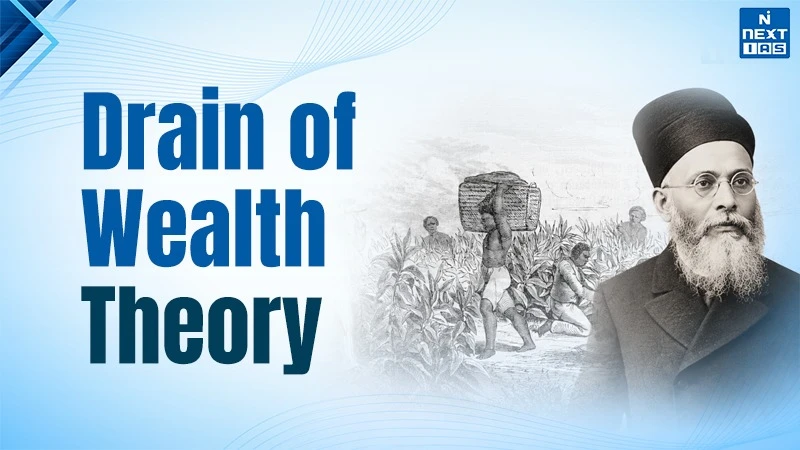
In a paper named 'England's Debt to India', Dadabhai Naoroji first highlighted in 1867 that Britain was bleeding India by extracting and appropriating more than 1/4th of India's revenue. The term 'drain of wealth' refers to the exploitation of wealth and resources by the British during their colonial rule in India. Spices, cotton, gold, and ancient materials of importance are being drained from India for which India received nothing in return. According to Dadabhai Naoroji about fifteen hundred million pounds was transferred from India to Britain.
The drain of wealth main mechanism that includes Home Charges, Military Expenditures, Deindustrialization, Interest on Debt and Remittances & Profits. The major impact of the drain of wealth on traditional artisans, traditional industries, and capital deficiency.
About Drain of Wealth Theory
- The term 'drain of wealth' refers to the unidirectional flow of a portion of wealth and resources from India to Britain, for which India received nothing in return.
- The drain of wealth from Bengal began in 1757 when the company's servants began to carry home immense fortunes extracted from Indian rulers, Zamindars, Merchants and the common people.
- According to one estimate, they sent home nearly £ 6 million between 1758 and 1765.
- This amount was more than four times the total land revenue collection of the Nawab of Bengal in 1765.
- This amount did not include the company's trading profits, often no less illegally derived.
- The drain took the form of an excess of India's exports over its imports, for which India got no returns.
- The exact amount of the annual drain has yet to be calculated, and historians differ on its quantum. In fact, the drain, at least from 1757 to 1856, was widely accepted by British officials.
- The drain increased after 1858, though the British administrators and imperialist writers began denying its existence. By the end of the 19th century, it constituted nearly 6% of India's national income and one-third of its national savings.
- The wealth drained of India was crucial in financing Britain's capitalist development, especially during Britain's early industrialisation in the 18th and beginning of the 19th centuries.
- It has been estimated that it constituted nearly two per cent of Britain's national income during that period. This figure assumes importance given Britain's investment of about seven per cent of its national income in industry and agriculture at that time.
Responsible Factors and Forces Behind Drain of Wealth
- The emergence of the company as a political power.
- The Colonial character of British rule put British economic interests before Indian interests.
- British never desired to settle down in India. Indian conquest was temporary for them.
- The British introduced a very complex administrative and legal system in India.
Wealth Drain Mechanism during British India
- Investments: Under this system, the company used Indian resources to purchase goods from the Indian market and export them to Britain. The proceeds of these trades remained in Britain.
- Home Charges: This refers to expenditures incurred in England by the Secretary of State on behalf of India. They included dividends paid to shareholders of the East India Company, Interest on public debt raised abroad, civil and military charges, and store purchases in England.
- European Finance Capital: European ventures in India supported each other against Indian competition, and Indians were left out of economic activities. The government intervened only when they generated profit, and these profits were not invested in India.
Major Impacts of Wealth Drain
- Consistent outflow of a significant portion of the Indian Gross National Product.
- It seriously affected the purchasing power of Indians.
- De-industrialisation of the Indian Economy.
- It completely Ruined traditional artisans/ craftsmen.
- Famines and poverty increased frequently and drastically, respectively.
- De-urbanisation of India.
Role of Dadabhai Naoroji
- The early proponent of Drain of Wealth theory, Dadabhai Naoroji elaborated on it in his book, Poverty and Un-British Rule in India.
- According to him, India was being robbed of its wealth through such policies and this robbery was responsible for causing poverty and hindering the development of India.
- The Drain of Wealth theory developed by Dadabhai Naoroji made an insightful analysis of how the British polices were systematically draining the wealth of India in favor of Britain without making any equitable arrangements.
- The Drain of Wealth was further exacerbated by British revenue polices, heavy taxation and utilization of the Indian wealth for conducting military campaigns and for administration expenses in India.
- According to him, the "drain" was one of the main reasons for poverty in India as it made impossible the investment of the wealth into agriculture, industries, and welfare of people.
FAQs about Drain Wealth by British
What is the Drain of Wealth Theory?
Drain of Wealth Theory described the way by which British rule in India was causing a flow of wealth and income from India to Britain without proper economic gains.
Who formulated the Drain of Wealth Theory?
Dadabhai Naoroji had presented this theory quite systematically, especially in his famous book Poverty and Un-British Rule in India.
What was the major point of this theory?
This theory asserted that economic policies adopted during the period of colonialism were causing a continuous drain of wealth in India, resulting in poverty in India.
Through what medium the wealth of India used to drain out?
Wealth was draining out through home charges, salaries, pensions, interest payments, profits, administrative costs, and money sent out by British administrators.
Why is the Drain of Wealth Theory significant?
Because it had pointed out the economic exploitation of India by the Britishers.
