
 80813-00200


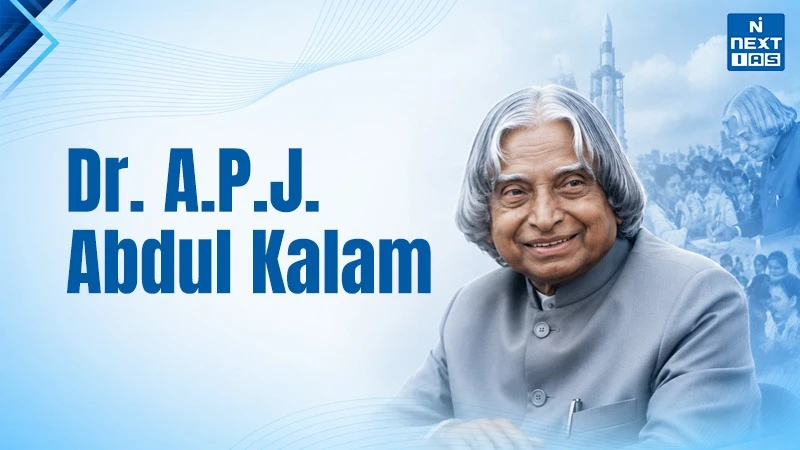
Dr. A. P. J. Abdul Kalam (1931-2015) served as the 11th President of India from 2002 to 2007. He is known as the ‘Missile Man of India’ for his great contributions in Missile development & Space programmes in India. In 1998, the First Indigenous coronary stent & in 2012, an indigenous tablet (PC) for healthcare workers at primary health centres in rural areas was developed.
Dr. Kalam was born on October 15, 1931 in Tamil Nadu. He was also an expert in playing ‘Veena’ (a musical instrument) & deeply influenced by Carnatic music. He was also equipped with the Bhagwat Geeta & Upanishads. Dr. A. P. J. Abdul Kalam died on 27 July 2015 at IIM Shilllong while interacting & addressing the students. In honor of his dedication to students and his constant commitment in shaping the next generation, his birth anniversary (15th October) is celebrated as World Students’ Day.
Biography of Dr. Abdul Kalam’s Life
- Dr. Avul Pakir Jainulabdeen Abdul Kalam was born on 15th October 1931 in Rameshwaram district in the state of Tamil Nadu in India. He was an eminent aerospace scientist, teacher, author and later became the 11th President of India.
- His early life was full of financial hardship which contributed in strengthening his hard work, discipline and dedication to education. He studied physics and later pursued a specialisation in aeronautical engineering at the Madras Institute of Technology.
- After completing his graduation, he worked for nearly 4 decades in the Defence Research and Development Organisation (DRDO) and the Indian Space Research Organisation (ISRO). He was the project director of India's SLV-III programme and contributed to the successful launch of the Rohini satellite into near-Earth orbit in 1980.
- He contributed to the development of missile programmes in India which helped develop strategic missile systems. On becoming the President of India in 2002, Kalam used his office to motivate young people to pursue knowledge, innovation and national development.
- Dr. A.P.J. Abdul Kalam was a prolific writer and authored many books such as ‘Wings of Fire’ and ‘Ignited Minds’. He always preferred to engage himself with the students after his presidency. He died while addressing students at IIM Shillong on 27th July 2015. His life remained a powerful example of humility, scientific temper and service to the nation.
- Dr. A.P.J. Abdul Kalam was honoured with the Padma Bhushan in 1981 and Padma Vibhushan in 1990 for his contributions in Science, Space research and Defence Technology. Moreover, he received the Bharat Ratna in 1997 which is the highest civilian award of India.
Key Achievements of Dr. A. P. J. Abdul Kalam
| S.No. | Area | Achievements |
|---|---|---|
| 1 | Space Technology |
|
| 2 | Missile Development |
|
| 3 | Defence & Nuclear Tests |
|
| 4 | Scientific Leadership |
|
| 5 | Presidency |
|
| 6 | Awards & Honours |
|
| 7 | Educational Contributions |
|
World Students' Day
- World Students Day is observed on the 15th of October each year in India to celebrate the birth anniversary of Dr. A.P.J. Abdul Kalam.
- Though celebrated in India as a world day, It is not officially designated by the United Nations, as October 15 is marked by the UN as the International Day of Rural Women.
- He played an important role in advancing the country’s space and defence programs as a scientist.
- Furthermore, his lasting legacy as an educator, author, and visionary President has made significant contributions to the development of the nation.
Major Contributions in the Field of Space, Engineering and Medicine
| S. No. | Achievement | Description |
|---|---|---|
| 1 | India’s first Indigenous Hovercraft | Dr. Kalam and his team developed Nandi which is India’s Indigenous hovercraft. |
| 2 | India’s first Satellite Launch Vehicle | As project Director of ISRO, Dr. Kalam led the development of SLV III, successfully launching the Rohini satellite in 1980. |
| 3 | INCOSPAR Committee | Dr. Kalam was part of the committee that established TERLS, Thumba Equatorial Rocket Launching Station, for space research. |
| 4 | Ballistic Missile Project | Leading DRDO, Dr. Kalam developed indigenous guided missiles like Agni and Prithvi based on the SLV Program. |
| 5 | Chief Scientific Advisor and DRDO Secretary | He served as a Chief scientific advisor to the government of India coordinating the Pokhran II nuclear test. |
| 6 | Launch Vehicle | Dr. Kalam promoted and backed the advancement of different satellite launch vehicles, such as the Polar Satellite Launch Vehicle (PSLV) and the Geosynchronous Satellite Launch Vehicle (GSLV). |
| 7 | Integrated Guided Missile Development Program | Dr. Kalam at DRDO implemented this program which advanced India’s missile technology, as a result he was named as ‘Missile Man of India’. |
| 8 | Kalam-Raju Stent (Universal Healthcare Plan) | Dr. Kalam and D. Soma Raju collaborated to develop a coronary stent ‘Kalam-Raju Stent‘ to make healthcare accessible to all. |
| 9 | Kalam Raju Tablet | Dr. Kalam and Dr. Soma Raju, came up with a rough tablet computer to take care of the health of underprivileged people of rural India. |
| 10 | PURA – Provision of Urban Amenities to Rural Areas | Dr. Kalam gives the strategy for rural development in India as discussed in his book Target 3 Billion. It proposes that urban infrastructure and services be provided in rural hubs to create economic opportunities outside of cities. |
| 11 | An Innovator in Fiberglass Technology | He played a pioneering role in the field of fiberglass technology and guided a team of young individuals to embark on this endeavour at ISRO. Their work encompassed the entire process, starting from designing and developing composite rocket motor cases, all the way to their production. |
Technology Vision 2020
In 1998, a comprehensive plan named Technology Vision 2020 was proposed. Its objective was to outline a roadmap for India’s transformation from a less-developed nation to a developed society within a span of 20 years. The plan aimed to achieve this by implementing various measures, including enhancing agricultural productivity, promoting technology as a catalyst for economic growth, and improving accessibility to healthcare and education. Vision 2020, as supported by Dr. Kalam, sought to transform India into a developed country by 2020 by creating rural-urban, education, and health parity, however it faced difficulties, and most of its objectives extended till 2030. The Agenda 2026 of India focuses on high-tech and sustainable development (green energy, AI, creative economy) towards a 2047 developed status.
Dr. Kalam talked of ‘Creating a Liveable Earth’ – In Last Speech
- “Sustainable development enables the realisation of green clean environment without pollution, having prosperity without poverty, peace without fear of war and a happy place to live for all citizens of the nation of the world.”
- In this last speech, Dr. A.P.J. Abdul Kalam laid the blueprint of his ‘World vision 2030 of a liveable planet earth’.
Interesting Facts about 11th President of India
- Dr. Kalam was awarded the Doctor of Science degree by 28 universities. He has received several awards including the National Design Award, Dr. Biren Roy Space Award, Professor Y Nayudhamma Memorial Gold Medal (1996), GM Modi Science Award (1996), R K Firodia Award for Excellence in Science and Technology (1996), Veer Shavalkar Award (1998), For National Integration Indira Gandhi Award (1997).
- He is a member of numerous professional societies including Aeronautical Society of India, Astronautical Society, and Aeronautical Society of India, Indian National Academy of Engineering, Indian Academy of Sciences and Institute of Electronics and Telecommunications Engineers.
- He is also the author of many books – India 2020: A Vision for the New Millennium, Wings of Fire: An Autobiography, and Ignited Minds-Unleashing the Power within India etc.
Books & Literary Keywords
- "Wings of Fire Summary": His autobiography remains a top-searched inspirational book.
- "Ignited Minds": Focusing on his message to the youth of India.
- "Indomitable Spirit": His reflections on values and purpose.
- "Turning Points": His journey through the presidency.
- "Advantage India": One of his final books discussing the future of the nation.
APJ Abdul Kalam’s Quotes
- "If you want to shine like a sun, first burn like a sun."
- "Climbing to the top demands strength, whether it is to the top of Mount Everest or to the top of your career."
- "To become "unique," the challenge is to fight the hardest battle which anyone can imagine until you reach your destination."
- “Dream is not something that you see while sleeping, it is something that does not let you sleep."
- “When our signature changes to autograph, this marks the Success.”
FAQs about Dr. A.P.J. Abdul Kalam
Who is known as the Missile Man of India?
Dr. A.P.J. Abdul Kalam is known as the ‘Missile Man of India’ for his crucial role in the development of India’s ballistic missile and space launch vehicle technology.
What are the contributions of APJ Abdul Kalam?
Dr. A.P.J. Abdul Kalam contributed to the development of SLV-III (Rohini, 1980), IGMDP missiles (Agni, Prithvi), and co-developed low-cost Kalam–Raju stent and tablet for healthcare etc.
Which Island is named after Dr. A.P.J. Abdul Kalam?
Wheeler Island was renamed Dr. A.P.J. Abdul Kalam Island in 2015. The Island is situated off the coast of Odisha.
