
 80813-00200


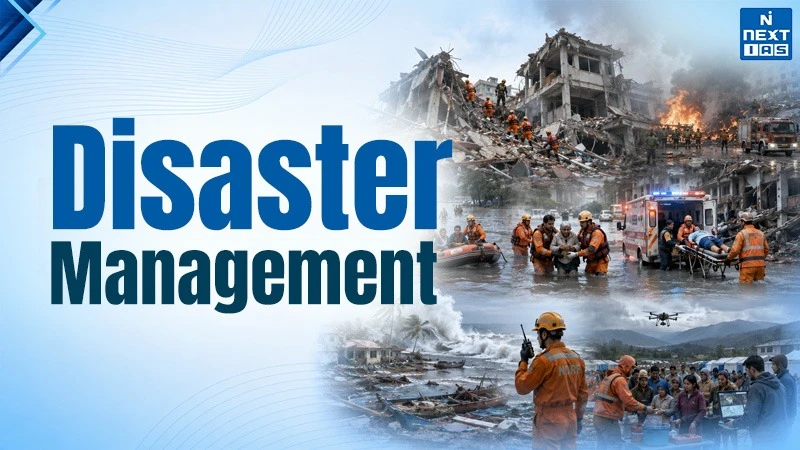
Disaster Management was established under the Disaster Management Act of 2005. It is a continuous and structured framework which is formulated to minimize the loss of human lives, property and assets at the time of natural or man-made emergencies. The 4 pillars of Disaster Management are Mitigation, Preparedness, Response and Recovery.
The Disaster Management Act established a 3-tier institutional governance architecture which includes the National, State and District level. The National Disaster Response Force (NDRF) is a specialized force which is trained in search and rescue at the time of emergencies such as earthquake and floods.
High-tech early warning systems such as the DART or Deep Ocean Assessment and Reporting of Tsunamis are placed on the floor of the ocean. The system immediately beams real-time data through satellite to coastal warning centres. Moreover, during Cyclone Fani in 2019, the state disaster management authority of Odisha successfully evacuated about 1.2 million people in just 24 hours. They followed the Zero Casualty Evacuation Strategy and used targeted SMS warnings, automated sirens and over 800 cyclone shelters. This was later recognised by the United Nations for reducing thousands of casualties.
Objectives of Disaster Management
| S.No. | Objective | Explanation |
|---|---|---|
| 1 | Prevention of disasters |
|
| 2 | Reduction of disaster risk |
|
| 3 | Mitigation of impacts |
|
| 4 | Strengthen preparedness |
|
| 5 | Early warning and communication |
|
| 6 | Prompt response |
|
| 7 | Protect vulnerable groups |
|
| 8 | Build institutional capacity |
|
| 9 | Promote resilience |
|
| 10 | Recovery and rehabilitation |
|
| 11 | Build Back Better |
|
About National Disaster Management Authority (NDMA)
The National Disaster Management Authority was formed under the Disaster Management Act of 2005 and is the apex statutory body for disaster management in the country. The Prime Minister of India is its ex-officio chairperson of NDMA and may have up to 9 other members as prescribed by the central government.
- The National Disaster Management Authority forms the national policies, planning and guidelines to ensure the timely and effective disaster response.
- It coordinates disaster risk reduction, mitigation, preparedness, early warning systems, response, relief, rehabilitation, reconstruction and capacity building.
- NDMA can issue disaster related guidelines, promote resilient infrastructure and seek to integrate disaster risk concerns into development planning.
- It focuses on prevention, preparedness and resilience, strengthening of risk assessment and its monitoring, developing technology equipped forecasting and fail-safe communication, encouraging environmentally sustainable mitigation and protecting vulnerable groups.
- The National Executive Committee helps the NDMA in performing its functions whereas the SDMA at state level and DDMA at the district level implement the framework.
National Policy on Disaster Management
- The National Policy on Disaster Management 2009 was formed under the Disaster Management Act of 2005. It was approved by the Union Cabinet on 22 October 2009. It envisages building a safe and disaster resilient nation with the help of a proactive, holistic and technology driven approach.
- The National Policy on Disaster Management provides roles to central ministries, state government, local authorities, civil society organizations and private sector.
- It focuses on institutional, legal and financial arrangements, technology and communication systems training, research, knowledge management and technical assistance for a safer construction and land usage.
- Community participation is an important aspect of the policy. It encourages the involvement of Panchayati Raj Institutions, urban local bodies and community based organizations to ensure transparency, accountability, relief and preparedness.
Overall, the National Policy on Disaster Management seeks to reduce the life losses, livelihoods, assets and ecosystems and enables the resilient recovery after disasters.
Related FAQs
What is Disaster Management?
Disaster management is the constant process of prevention, mitigation, preparedness, response and reconstruction after the disaster.
How to manage disaster?
The disasters can be managed by assessing risk involved, issuing of early warmings, preparing communities, evacuating safely, rescuing victims, providing relief and restoring services.
