
 80813-00200



Cooperative banks in India are financial institutions that are owned by the members of the society and provide banking services along with the concept of cooperation and mutual help. Cooperative banks basically cater to farmers, small-scale industries, rural households, and other disadvantaged segments through deposits, credits, and financial services.
Unlike commercial banks, the cooperative banks function on the cooperative model where members play a part in governance. The country has a wide range of cooperative banks, which broadly consist of Urban Cooperative Banks (UCBs), as well as Rural Cooperative Banks, which include State Cooperative Banks, District Central Cooperative Banks, and Primary Agricultural Credit Societies. The regulatory body for cooperative banks in India includes RBI and also other state bodies as per the bank.

What are Cooperative Banks?
Cooperative Banks refer to those financial institutions under the Banking System in India that operate on the principles of cooperation and mutual benefit for their members.
Key Features
- They belong to their members who are both the owners and customers of the bank.
- Thus, it can be said that the customers are the owners of these banks.
- Cooperative Banks are named so because these have the cooperation of stakeholders as the motive.
- They operate on the principle of "one person, one vote" in decision making in decision-making and are managed on the basis of cooperation, self-help, and no profit no loss.
- Along with lending, these banks also accept deposits.
- They are incorporated and registered under the States' Cooperative Societies Act passed by the concerned state.
- The National Bank for Agriculture and Rural Development (NABARD) is the apex body of the cooperative sector in India.
Regulation of Cooperative Banks in India
These banks in India, broadly, come under the dual control of:
- Reserve Bank of India: Under the Banking Regulation Act, 1949, and the Banking Laws (Application to Co-operative Societies) Act, 1965, the RBI is responsible for regulating banking aspects of these banks, such as capital adequacy, risk control, and lending norms.
- Registrar of Co-operative Societies (RCS) of respective State or Central Government: They are responsible for regulation of management-related aspects of these banks, such as incorporation, registration, management, audit, supersession of board of directors, and liquidation.
Difference Between Commercial Banks and Cooperative Banks
| Basis of Difference | Commercial Banks | Cooperatives Banks |
|---|---|---|
| Formed as | Joint-stock Banks. | Co-operative organizations. |
| Governing Act | Banking Regulation Act 1949. | Co-operative Societies Act of 1904. |
| Regulation | Subject to the control of the Reserve Bank of India directly. | Subject to the rules laid down by the Registrar of Co-operative Societies. |
| SLR and CRR Requirements | Relatively Higher. | Relatively Lower. |
| Services Offered | Larger scope in offering a variety of banking services. | Lesser scope in offering a variety of banking services. |
| Area of Operation | Large-scale operation, usually countrywide. | Small-scale operation, usually limited to a region. |
| Main functions | Mostly provide short-term finance to industry, trade, and commerce, including priority sectors like exports, etc. | Usually cater to the credit needs of agriculturists. |
| Rate of interest | Offer lower rates of interest on deposits compared to co-op banks. | Offer a slightly higher rate of interest on deposits. |
| Borrowers | Borrowers of commercial banks are only account holders and have no voting power as such, so they cannot have any influence on the lending policy of these banks. | Borrowers are member shareholders, so they have some influence on the lending policy of the banks, on account of their voting power. |
| Flexibility in lending | Commercial banks are free from any rigidities in terms of lending options. | Co-operative banks do have not much scope for flexibility on account of the rigidities of the bylaws of the Co-operative Societies. |
Types & Structure of Cooperative Banks
These banks, under the Banking System in India, are primarily categorized into -- Rural Cooperative Banks (RCBS), and Urban Cooperative Banks (UCBS). They are further sub-categorised as shown below.
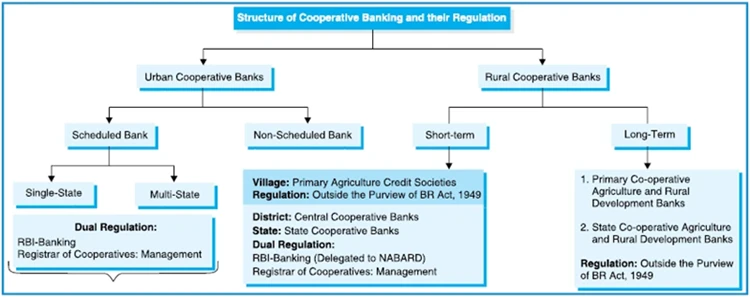
Urban Cooperative Banks (UCBs)
- They operate in urban and semi-urban areas.
- They mainly lend to small borrowers and businesses.
- Based on their regulation regime, they are categorized into two types -- Scheduled Banks and Non-Scheduled Banks.
Rural Cooperative Banks (RCBs)
- They focus on serving the financial needs of people in rural areas.
- Depending on the type of lending, they are divided into 2 sub-categories -- Short- Term Structures, and Long-Term Structures.
Short-Term Structures
- They lend upto 1 year for purposes such as cultivation activities, buying seeds and fertilizers, etc.
- They have a 3-tier setup.
State Cooperative Banks
- Each state has its own State Cooperative Bank, which is the apex body for cooperative banks in that particular state.
- They operate at the state level.
- It acts as the mediator between RBI and NABARD on the one side and Central or District Cooperative Bank and Primary Agricultural Credit Societies on the other side.
District Cooperative Central Banks (DCCBs)
- They operate at the District level.
- They get loans from the State Cooperative Bank and grant loans to Primary Agricultural Credit Societies and individuals.
Primary Agricultural Credit Societies (PACS)
- Primary Agricultural Credit Society (PACS) is a basic unit and smallest cooperative credit institution in India.
- They operate at the Gram Panchayat and village level.
- They provide short-term loans (1 year to 3 years) to its members for agricultural purposes.
Long-Term Structures
- They lend to meet medium and long-term fund requirements (1.5 years -- 25 years) for purposes such as land development, purchase of pumps, etc.
- They have a 2-tier set up:
State Cooperative Agricultural and Rural Development Banks (SCARDBs)
State Cooperative Agriculture and Rural Development Banks (SCARDBs) focus on providing long-term credit for agricultural and rural development purposes.
Primary Cooperative Agricultural and Rural Development Banks (PCARDBs)
Primary Cooperative Agricultural and Rural Development Banks (PCARDBs) are aimed at providing financial services to rural areas, especially to small and marginal farmers, agricultural laborers, and rural artisans.
Significance
Due to their very nature of working, they play crucial roles in the Indian economy. Some of their major roles can be seen as follows:
- Financial Inclusion: They serve the purpose of promoting financial inclusion by reaching out to unbanked and underbanked segments of the society.
- Credit Availability: They provide ease in getting credit for their customers at competitive interest rates.
- Promoting Saving Habits: They promote savings habit through provision of deposit schemes customized according to the rural needs.
- Rural Development: They have greater knowledge about local needs and therefore, play a vital part in rural development by financing agricultural activities in the rural sector.
- Rural Development: Most of the banks work in the rural areas and cater to the needs of the farmers and other rural community members.
- Financial Literacy Education: They serve the purpose of educating people about finance.
FAQs on Cooperative Banks
Which is the first Cooperative Bank in India?
The first Cooperative Bank in India was the Anyonya Co-operative Bank (ACBL), established in 1889 in Vadodara, Gujarat. It is no longer operational now.
Who regulates Cooperative Banks in India?
They come under the dual control of the Reserve Bank of India and the Registrar of Cooperative Societies of the respective state or central government. While the RBI regulates the banking aspects, the Registrar of Co-operative Societies regulates management-related aspects of these banks.
