
 80813-00200


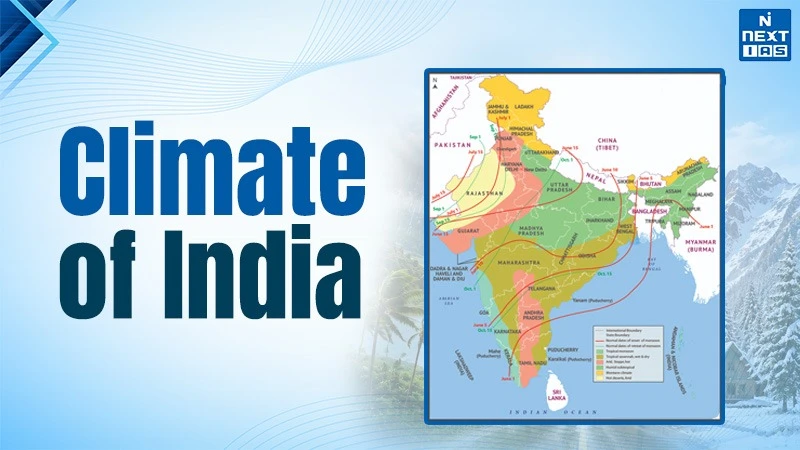
The climate is a long-term weather pattern of a specific region, developed over 30 years or more. These include precipitation, temperature, humidity and wind in a specific region. India has a tropical monsoon climate, ranging from arid deserts in the west to alpine tundra in the north.
India has 4 climatic seasons, that is Winter from December to March, Summer from April to June, Southwest Monsoon from June to September and Post-Monsoon or Retreating Monsoon from October to November.
Climate of India
- India's climate is mainly tropical monsoon, with distinct wet and dry seasons.
- However, due to its vast geographical extent, diverse topography, and varying latitudes, the country experiences various climatic conditions, from arid in the northwest to temperate in the Himalayan region.
- The influence of the Indian Ocean and the Himalayas further affects regional climates, creating distinct patterns such as coastal, desert, and subtropical climates.
Salient Features of Indian Climate
Reversal of Winds
- The Indian climate is characterised by the complete reversal of the wind system with the change of season in a year.
- During the winter, winds generally blow from northeast to southwest in the direction of trade winds.
- These winds are dry and devoid of moisture, and they are characterised by low temperatures and high-pressure conditions over the country.
- During the summer season, complete reversals in the direction of the winds are observed, and these blow primarily from southwest to northeast.
- These moist winds, also known as monsoon winds, are characterised by high temperatures and low-pressure conditions over the country.
Seasonal and Variable Rainfall
- In India, over 80 percent of the annual rainfall happens at the end of summer, the period lasting between one to five months depending on the area.
- The rain falls in a very intense way, bringing problems such as flooding and soil erosion.
- It may also come in the form of continuous rainfall for a long time, followed by dry spell in the region.
- Moreover, there are areas receiving rainfall in very different amounts in India; for instance, the amount of rainfall experienced in Tura, located in Garo Hills of Meghalaya within a day exceeds that of rainfall received by Jaisalmer in 10 years.
- The climate of India is known for its complexity and extremes. The climate makes it possible to practice different types of agriculture in India.
Plurality of Seasons
- The Indian climate is characterised by constantly changing weather conditions.
- There are three main seasons, but when considered broader, this number goes to six: winter, fall of winter, spring, summer, rainy, and autumn.
Unity of Indian Climate
- The Himalayas and the associated mountain ranges in the north of India extend from east to west.
- These towering mountain ranges block the cold northerly winds from Central Asia from entering India.
- As a result, even areas north of the tropic of Cancer experience a tropical climate.
- The Himalayas also act as a barrier, compelling the monsoon winds to release their moisture over the Indian subcontinent, thereby influencing the entire country's monsoon-type climate.
Major Influencing Factors in Climate Change
The climate of India is influenced by several factors, including its latitudinal extent, proximity to the Indian Ocean, and the Himalayan mountain range. These factors contribute to regional variations in temperature, precipitation, and the duration of seasons across the country. Such major factors are as follows:
- Factor Related to Physiographic Features
- Factor Related to Air Pressure and Wind
- Other Geographical Factors
All these factors have been discussed in detail in the section that follows.
Factor Related to Physiographic Features
Latitude and Location
- The Tropic of Cancer passes through the central part of India in an east-west direction.
- Thus, the northern part of India lies in the sub-tropical and temperate zone, and the southern part falls in the tropical zone.
- The characteristic of a tropical weather condition is receiving a high amount of insolation.
- Being nearer to the equator and also due to the oceanic effect, the southern part of India experiences a small annual and diurnal temperature range.
The Himalayan Mountains
- The Himalayas play an essential role in lending a sub-tropical touch to the climate of India.
- The lofty mountain chain provides an invincible shield to protect the subcontinent from the cold winds of north Asia, thus protecting it from severely cold winters.
- It also traps the Monsoon winds, forcing them to shed moisture within the sub-continent.
Distance from the Sea
- India is a peninsular country with a long coastline of 7,517 km.
- The sea provides a moderating effect on temperature in coastal areas.
- Areas of interior India are far away from the moderating influence of the sea, and thus, they have extreme climates.
Altitude
- It means the height above the average sea level.
- Temperature decreases with height.
- Due to thin air, places in the mountains are cooler than places on the plains, as there is less conductive heating.
Distribution of Land and Water
- Compared to land, water heats up and cools down more slowly.
- This differential heating between land and sea creates varying air pressure zones throughout the seasons around the Indian subcontinent.
- Consequently, these pressure differences lead to the reversal of monsoon winds.
Relief
- The physiography, or relief, of India significantly influences temperature, air pressure, wind direction and speed, as well as the amount and distribution of rainfall.
- For example, Mangalore, located on the western slope (windward slope) of the Western Ghats, receives a mean annual rainfall of more than 2000 mm, whereas Bangalore, situated in the rain shadow region (leeward side), gets only 500 mm.
- Similarly, the southern slopes of the Himalayas receive annual rainfall of more than 2000 mm, whereas the northern slopes receive only 50 mm of mean annual rainfall.
Factor Related to Air Pressure and Wind
Pressure Conditions
- During summer, the interior parts of the North Indian Plains covering Rajasthan, Punjab, Haryana, and Western Uttar Pradesh are intensely hot.
- Such high temperatures heat up the air in that region. Hot air rises, creating a low-pressure area under it.
- This low pressure is also known as monsoonal trough.
- On the other hand, the temperature in the Indian Ocean is relatively low, as water needs more time to heat than land.
- This results in the creation of a relatively high-pressure region over the sea, creating a temperature and pressure difference between the North Central Indian Plains and the Indian Ocean.
Direction of Surface Winds
- This system of surface winds consists of monsoon winds, land and sea breeze, and local winds.
- Due to the difference in pressure of land and sea caused by differential heating, wind from the high-pressure region of the sea starts moving towards the low-pressure regions of North India.
- Thus, by the middle of June, the general movement of air is from the equatorial region of the Indian Ocean to the Indian subcontinent, and the direction of these winds is from southwest to northeast.
- This brings moisture from the sea with it, causing widespread rain in most parts of the country.
- In winter, the winds blow from land to sea, making them cold and dry.
- Coastal regions remain under the influence of sea breeze, while interior areas are affected by local winds and monsoon winds.
- Interior areas often observe cold waves in winter and heat waves in summer.
Variation in Temperature
- While in the summer, the temperature touches 55°C in western Rajasthan, it drops to as low as minus 45°C in winter around Leh.
- Churu in Rajasthan may record a temperature of 50°C or more on a June day, while the temperature hardly goes up to 19°C in Tawang (Arunachal Pradesh) on the same day.
- On a December night, the temperature in Dras (Jammu and Kashmir) may drop to minus 45°C, while Thiruvananthapuram or Chennai records 20°C or 22°C on the same night.
- Moreover, even within a single location, daily temperature variations can be strikingly pronounced.
- In Kerala and the Andaman Islands, the difference between day and night temperatures may be hardly seven or eight degrees Celsius.
- However, in the Thar desert, if the day temperature is around 50°C, at night, it may drop considerably to 15°-20°C.
- Sikkim is the only State in India that experiences both tropical and temperate climatic conditions and vegetation accordingly.
The Range of Temperature
It is the numerical difference between the minimum and maximum values of temperature in a given period of time.
Thus, the Annual Range of Temperature means the difference between maximum and minimum temperature values in a year, and the Diurnal Temperature Range (DTR) is the difference between the daily maximum and minimum temperature.
Variation in Precipitation
- Variation occurs not only in the type of precipitation but also in its amount and seasonal distribution.
- The western coast from Kerala to the northern tip of Maharashtra receives very heavy rainfall during monsoonal July and August, while the whole of the Coromandel Coast goes dry. It gets wet in winter, while dryness is all over India.
- For example, while Cherrapunji and Mawsynram in the Khasi Hills of Meghalaya receive over 1,080 cm of rainfall annually, Jaisalmer in Rajasthan gets less than 9 cm during the same period.
- Snowfall occurs in the Himalayas and only rains over the rest of the country.
Other Geographical Factors
Jet Streams
- Air currents in the upper layers of the atmosphere are known as jet streams. It could determine the arrival and departure of the monsoons.
- The genesis of the tropical easterly jet is strongly correlated with the monsoon.
Western Disturbances
- Low-pressure systems that originate over the Mediterranean region in winter and move eastwards towards India, passing over Iran, Afghanistan, and Pakistan, are responsible for the winter rain in northern India.
Conditions in the Regions Surrounding India
- Temperature and pressure conditions in East Africa, Iran, Central Asia and Tibet determine the strength of the monsoons and the occasional dry spells.
- For example, elevated temperatures in East Africa can attract the monsoon winds from the Indian Ocean towards that region, potentially leading to a dry spell in India.
Conditions over the Ocean
- The weather conditions over the Indian Ocean and the South China Sea may be responsible for cyclones or typhoons, which often affect the east coast of India.
India's Climate Diversity
- The climatic conditions of India are best understood through an annual cycle of distinct seasons.
- The country's shape, size, location, latitudinal extent, and contrasting relief have resulted in diverse climatic conditions in different parts of India, ranging from tropical monsoonal in the south to polar in the higher altitudes of the Himalayas in the north.
- This diversity is reflected in regional variations in temperature, rainfall amount, season commencement, and duration.
Rhythm of Seasons in India
Meteorologists recognise the following four seasons:
- The Cold Weather Season
- The Hot Weather Season
- The Southwest Monsoon Season
- The Retreating Monsoon Season.
Differences Between Weather & Climate
| Weather | Climate |
|---|---|
| Weather is the momentary state of the atmosphere. | Climate refers to the average of the weather conditions over a longer period of time. |
| Weather changes quickly, within a day or week. | Climate change is imperceptive and may be noted after 40 years or more. |
FAQ about Climate
What are the control affecting the climate of India?
The climate of India is influenced by its latitude, which affects temperature and seasonal changes, and altitude, which impacts temperature and precipitation.
